


Introduction: Why Product Data Is the Biggest Challenge for P21 Distributors in 2026
Managing product information used to be simple—upload descriptions, add prices, and keep a few specs updated. But in 2026, B2B buyers expect far more. They want complete, accurate, and enriched product data across every channel: ecommerce, mobile apps, sales portals, and customer self-service tools.
The problem? Prophet 21 wasn’t built to manage large volumes of marketing-rich product content.
That’s where PIM for P21 (Product Information Management) becomes essential.
A PIM centralizes all product information in one place, enriches it, and syncs it seamlessly to Prophet 21 (P21). For distributors handling thousands of SKUs, vendor catalogs, and channel-specific content, this is the only way to deliver consistent and high-quality data.
This guide explains everything distributors need to know about PIM for P21, why it matters in 2026, and how it transforms ecommerce, operations, and customer experience.
What Is PIM?
A Product Information Management (PIM) system is a central hub that stores, manages, enriches, and distributes all product data. It acts as the single source of truth for every team—marketing, ecommerce, product, and sales.
What a PIM Stores
- Product titles and descriptions
- SKU-level attributes (size, weight, materials, features)
- Technical documents, spec sheets, installation guides
- High-quality product images and videos
- Cross-sell and upsell relationships
- Category and taxonomy structures
- Pricing tiers and channel-specific content
- Vendor data feeds
When all data lives in one place, teams stop guessing or searching for files. They simply open the PIM, update the information, and push it to all sales channels.
What Makes a PIM Different from P21?
Epicor Prophet 21 is a strong ERP for managing inventory, pricing, order processing, supply chain workflows, purchasing, and warehousing. But P21 was not built to manage rich product data.
P21 is an ERP. It handles:
- Orders
- Inventory
- Purchasing
- Accounting
- Customer records
But it lacks tools for:
- Rich product content
- Image management
- Mass updates
- Attribute standardization
- Multi-channel distribution
A PIM fills that gap—especially distributors managing thousands of product variations.
Why P21 Distributors Need PIM in 2026
Buyers Expect Better Digital Experiences
In 2026, B2B buyers act like B2C customers:
- They search with detailed queries
- They compare specs
- They need more images and documents to make decisions
- They expect consistent information across all touchpoints
Without enriched data, ecommerce conversions drop and sales reps lose time searching for details.
Vendor Data Is Exploding
Most distributors receive:
- Monthly vendor price updates
- Seasonal product catalogs
- New SKUs
- Configurable variations
Managing this in P21 alone is slow and error-prone. A PIM automates ingestion, cleans data, and updates P21 instantly.
Internal Teams Need a Single Source of Truth
Marketing, ecommerce, and product teams cannot operate consistently if they rely on separate spreadsheets. PIM brings everyone together.
P21 Ecommerce and Mobile Apps Need Rich Content
If you are using or planning:
- A P21-integrated ecommerce site
- A distributor portal
- Magento or Shopify connected to P21
A PIM becomes essential.
Looking to connect P21 to Magento? Read our guide: P21 Magento Integration: Complete Guide.
Challenges P21 Distributors Face Without PIM
.png)
1. Inconsistent Product Information
Different channels show different details. One SKU has three versions of the same description.
2. Missing Images and Documents
Distributors often lack structured systems to store spec sheets, manuals, or product images.
3. Slow Time to Market
Updating 1,000+ SKUs manually in P21 can take weeks.
4. Manual Work and Human Errors
Teams juggle spreadsheets, PDFs, and vendor catalogs.
5. Difficulty Managing Large Attribute Sets
Industrial, electrical, MRO, HVAC, and manufacturing distributors often need 20–70+ attributes per product.
6. No Standardization Across Brands
Vendors use different naming conventions:
- Diameter vs. Dia
- PSI vs. Pressure
- Voltage vs. V
PIM standardizes all data before syncing to P21.
7. Poor Ecommerce SEO
Search engines reward rich product data. Weak content → low rankings.
8. Customer Complaints and Higher Returns
When specs are outdated or incomplete, customers order the wrong product.
How PIM for P21 Works (Step-by-Step)
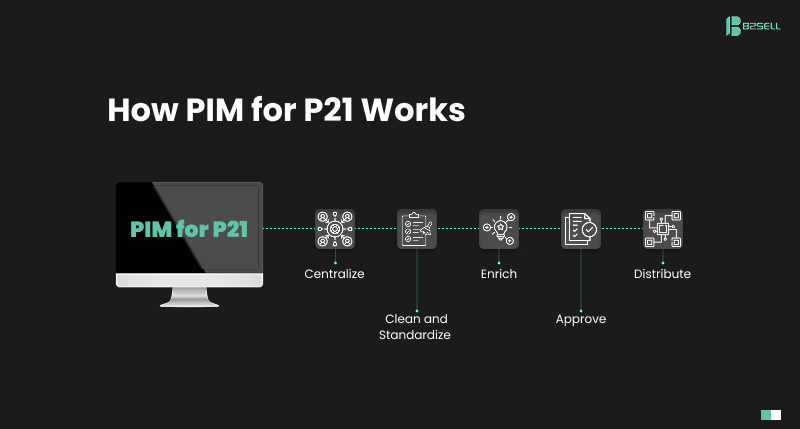
Step 1: Centralize
Import all product data from:
- Prophet 21
- Vendor catalogs
- Spreadsheets
- Existing ecommerce platforms
Everything is stored in one structured system.
Step 2: Clean and Standardize
PIM removes:
- Duplicates
- Incomplete fields
- Inconsistent naming
- Incorrect attribute values
Standardization ensures accuracy.
Step 3: Enrich the product data
Teams add:
- SEO-rich descriptions
- Multiple image sets
- PDF manuals and guides
- Attribute groups
- Category mappings
Step 4: Approve
Use workflows for data governance:
- Content reviewer
- Technical reviewer
- Category manager
Nothing publishes until approved.
Step 5: Distribute
PIM syncs enriched product data to:
- Prophet 21 (P21)
- B2B ecommerce platforms
- Mobile apps
- Marketplaces
- Internal tools
This ensures consistent data everywhere.
Step 6: Sync Changes Automatically
Whenever the PIM updates data, it pushes the updates to all connected channels without manual work.
Want to see PIM in action? Request a demo or explore our P21 Ecommerce Solutions
Real-World Use Cases: How Distributors Use P21 PIM
1. Electrical Distributor — 25,000 SKUs Across 4 Brands
Problem: Supplier data files were inconsistent. Product specs were stored in PDFs. Sales reps couldn't find technical details when customers called.
Solution: B2Sell PIM synced P21 inventory, enriched specs from manufacturer PDFs using AI extraction, and pushed data to Magento store.
Result:
- 40% reduction in "product not found" calls to customer service
- 22% increase in online conversion rate (customers could self-serve technical specs)
- 3 hours/week saved on manual catalog updates
2. HVAC Distributor — Multi-Channel Sales (Ecommerce + Print Catalogs)
Problem: Updating product info in P21 didn't automatically sync to website or printed catalogs. Marketing team re-keyed data manually.
Solution: PIM became the single source of truth. P21 data flowed to PIM → PIM syndicated to Shopify store and InDesign catalog templates.
Result:
- $180K/year labor savings (eliminated 2 FTE catalog coordinators)
- Zero pricing errors in print catalogs (previously caused $50K/year in customer disputes)
- Catalog production time cut from 6 weeks → 10 days
3. Industrial MRO Supplier — Customer-Specific Pricing for 200+ Accounts
Problem: P21 stored net pricing and contract pricing, but ecommerce site showed list prices only. Sales reps emailed quotes manually.
Solution: B2Sell PIM pulled P21 customer pricing hierarchies and displayed logged-in customer's net pricing in real-time.
Result:
- 68% of quotes converted to orders (vs. 40% before, when customers saw generic pricing)
- Sales reps saved 12 hours/week (no more manual quote generation)
- $2.4M increase in annual ecommerce revenue (customers placed larger orders when seeing their negotiated prices)
4. Plumbing Distributor — Mobile App for Field Sales Reps
Problem: Sales reps carried outdated printed catalogs on job sites. Couldn't verify stock availability or show customers product images.
Solution: B2Sell PIM + B2Sell Mobile app. Reps accessed live P21 inventory, pricing, and product images from iOS/Android app.
Result:
- 32% increase in outside sales order volume (reps closed deals on-site instead of following up later)
- 90% reduction in "out of stock" backorders (reps checked live P21 inventory before quoting)
- Field reps rated the app 4.8/5 (vs. 2.1/5 for old printed catalogs)
Key Benefits of PIM for P21 in 2026
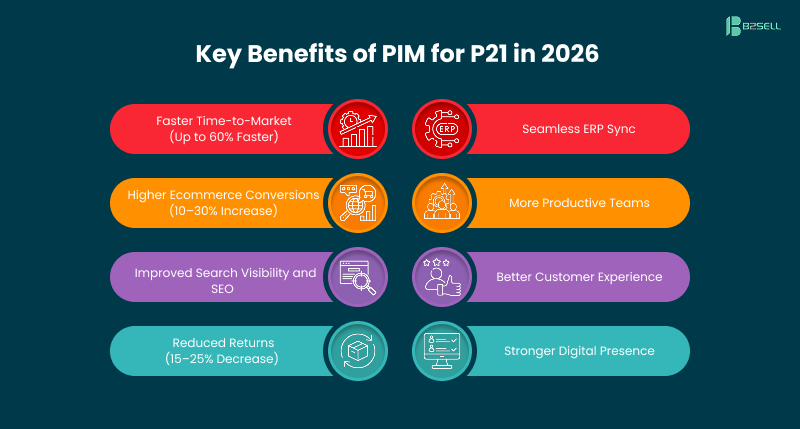
1. Faster Time-to-Market (Up to 60% Faster)
Automated imports and bulk editing reduce manual work.
2. Higher Ecommerce Conversions (10–30% Increase)
Better descriptions, attributes, and images lead to better decisions.
3. Improved Search Visibility and SEO
Rich data improves:
- Google rankings
- AI search visibility (ChatGPT, Gemini, Perplexity)
- On-site search performance
4. Reduced Returns (15–25% Decrease)
Accurate descriptions reduce mismatched orders.
5. Seamless ERP Sync
PIM ensures P21 always has up-to-date product data.
6. More Productive Teams
Marketing focuses on growth—not spreadsheet cleanup.
7. Better Customer Experience
Customers find the exact product they need, faster.
8. Stronger Digital Presence
A P21 ecommerce site with enriched product data performs far better.
How Long Does P21 PIM Implementation Take?
A typical Epicor P21 PIM implementation follows a 4-phase rollout:
Phase 1: Discovery & Configuration (Weeks 1-2)
- Map P21 data fields to PIM attributes
- Define product taxonomy and category structure
- Configure API connections between P21 and PIM
- Set up user roles and permissions
For developers building custom P21 integrations, check out our Prophet 21 API Getting Started Guide - Click here
Phase 2: Pilot Deployment (Weeks 3-4)
- Sync first 500-1,000 SKUs from P21 to PIM
- Enrich data: add images, specs, cross-references
- Test real-time price/inventory sync
- Train 2-3 power users
Phase 3: Full Rollout (Weeks 5-8)
- Migrate remaining SKU catalog
- Connect ecommerce platforms (Magento, Shopify, BigCommerce)
- Enable multi-channel syndication
- Launch internal testing with sales team
Phase 4: Optimization (Weeks 9-12)
- Monitor sync errors and edge cases
- Add automation rules (bulk updates, scheduled publishes)
- Measure impact on search traffic and conversions
Bottom line: Most distributors go live in 6-8 weeks. Enterprise rollouts (50K+ SKUs, custom workflows) take 12-16 weeks.
How B2Sell PIM Compares to Other P21 Solutions
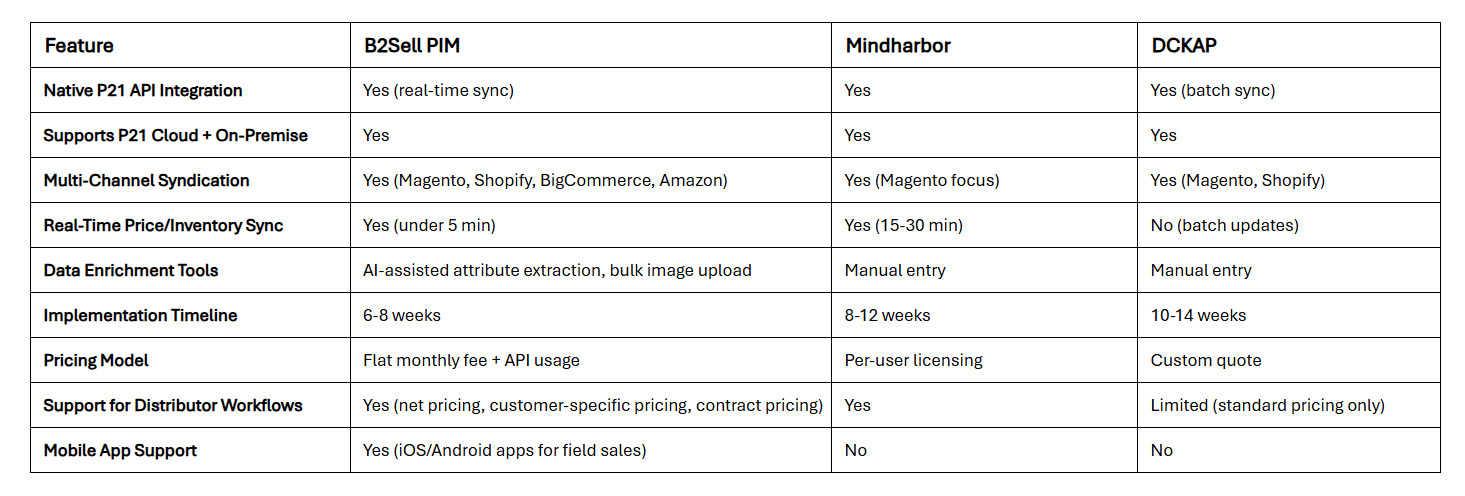
Not all PIMs are built for Epicor P21. Here's how B2Sell stacks up:
Best For:
- B2Sell PIM: Distributors who need fast deployment, multi-channel syndication, and mobile sales tools.
- Mindharbor: Distributors heavily invested in Magento who want deep ERP-to-ecommerce integration.
- DCKAP: Mid-market distributors with simple product catalogs and batch sync requirements.
- Grey Wolf: Large distributors with custom workflows willing to invest in 12+ week implementations.
FAQ
What is PIM for P21?
PIM for P21 is a centralized product information system that enriches, standardizes, and distributes product data across ecommerce, sales, and ERP channels. It helps Prophet 21 distributors reduce errors, launch products faster, and deliver consistent, high-quality product content to customers.
Why do P21 distributors need a PIM in 2026?
P21 distributors need a PIM because product data has become more complex, customers expect richer information, and P21 alone cannot handle marketing-grade content.
How does PIM integrate with Prophet 21?
A PIM integrates with Prophet 21 through automated two-way sync. It sends enriched data to P21 while receiving inventory, pricing, and product identifiers from the ERP.
Does PIM improve P21 ecommerce performance?
Yes. Accurate, enriched product data improves SEO, conversions, mobile user experience, and onsite search.
How long does P21 PIM implementation take?
Most distributors go live in 6-8 weeks. Phase 1 (discovery) takes 1-2 weeks, Phase 2 (pilot) takes 3-4 weeks, Phase 3 (full rollout) takes 5-8 weeks, and Phase 4 (optimization) takes 9-12 weeks. Enterprise rollouts with 50K+ SKUs take 12-16 weeks.
Can I use PIM with Prophet 21 Cloud or on-premise?
Both. B2Sell PIM connects via P21's API, which works with Prophet 21 Cloud, on-premise, and hybrid deployments.
What does PIM cost for Prophet 21?
Pricing ranges from $500-$1,200/month for 10K-25K SKUs, $1,200-$2,500/month for 25K-50K SKUs, and $2,500-$5,000/month for 50K+ SKUs. Most distributors break even in 6 months from labor savings.
Do I need to migrate ALL my P21 data to PIM at once?
No. Most distributors use a phased approach: Phase 1 - top-selling SKUs, Phase 2 - core categories, Phase 3 - long-tail SKUs. B2Sell PIM syncs with P21 in real-time, so you don't have to migrate everything overnight.
How does PIM handle P21 pricing updates?
Real-time sync via P21 API. When you update pricing in P21, the API sends the change to B2Sell PIM, which applies markup rules and pushes updated prices to all connected channels in under 5 minutes.
Conclusion: Transform Your P21 Product Data in 2026
Product information is the engine of digital commerce. Without enriched, accurate, and centralized data, even the best Prophet 21 setup struggles to deliver a strong customer experience.
A PIM for P21 gives distributors the structure, speed, and consistency they need to grow in 2026. It reduces manual work, improves ecommerce conversions, and strengthens your entire digital strategy.
To see how B2Sell’s PIM for Prophet 21 helps distributors centralize and automate product data, explore the solution here:
https://www.b2sell.com/pim-for-prophet-21
Start Improving Product Data Today
Ready to centralize product information, improve ecommerce, and streamline your P21 workflows?
👉 Request a Free Demo of B2Sell’s PIM for P21
👉 Book a Strategy Call
Take your next step toward stronger product data and better digital results.
.png)
.png)
.png)


.png)