


If you run Epicor Prophet 21 (P21) and sell on Shopify, you already know the pain: orders entered by hand, inventory that lies, contract pricing that doesn't show up where buyers can see it. A proper P21 Shopify integration kills all of that. This guide covering how it works, what to sync with your product information management system the three ways to build it, and how B2Sell's pre-built P21 Shopify connector compares to middleware and custom API builds.
Quick answer: The fastest way to connect P21 with Shopify is a pre-built connector that uses P21's REST API and Shopify's Admin API for real-time, bi-directional sync of inventory, pricing, orders, customers, and product data. Most distributors go live in 4–8 weeks instead of 6+ months.
What "P21 Shopify Integration" Actually Means
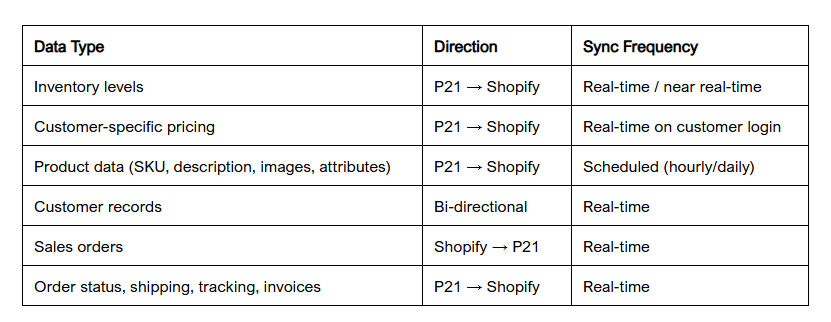
A P21 Shopify integration is a live data bridge between your Epicor Prophet 21 ERP and your Shopify (or Shopify Plus B2B) store. Instead of two systems holding two versions of the truth, both share one. When inventory drops in P21, Shopify reflects it within seconds. When an order is placed on Shopify, it lands in P21 as a sales order, ready for pick/pack/ship. When a contract price changes in P21, the right customer sees the right number the next time they log in.
The integration usually covers six data flows:
Why P21 and Shopify Need to Talk to Each Other
Distributors run P21 because it handles the messy back-office work no eCommerce platform does well: multi-warehouse inventory, contract pricing matrices, complex pick logic, freight billing, AR aging, lot/serial tracking. Distributors run Shopify because it's the cleanest, fastest B2B storefront on the market, with native support for company accounts, net terms, quantity breaks, and B2B-specific catalogs since Shopify rolled out its B2B suite.
Running them disconnected costs you in five concrete ways:
- Lost orders from stockouts you didn't know about. A buyer sees "in stock," places an order, then gets called two days later for a substitution. That buyer often doesn't come back.
- Margin leak from generic pricing. Without P21 pricing piped through, every buyer sees list. Contractors paying 22% off list buy elsewhere because your site looks expensive.
- CSR hours wasted on order entry. A mid-sized distributor doing 80 web orders a day at 5 minutes of manual P21 entry per order burns 33 hours a week. That's nearly a full headcount.
- AR confusion. Web orders that don't auto-create P21 invoices end up reconciled by hand, leading to billing errors and disputed invoices.
- No real-time order status for buyers. Calls and emails asking "where's my order?" pile up because the Shopify order page shows nothing past "fulfilled."
A working integration removes all five.
The Three Ways to Build a P21 Shopify Integration
There is no single right answer here. The right choice depends on your IT bench, your budget, and how much customization your business actually needs.
Option 1: Direct API Integration (Custom Build)
Both platforms expose modern APIs. P21 supports REST and SOAP through its Middleware API and the newer REST API endpoints. Shopify offers the Admin API (REST and GraphQL) plus webhooks for event-driven updates.
Use when: You have a senior backend developer on staff or under retainer who knows both systems, and your workflows are unusual enough that no off-the-shelf product will fit.
Trade-off: Maximum flexibility. Highest cost. Longest time-to-live. You also own every breaking change forever — when Epicor updates P21 or Shopify deprecates an endpoint, your team fixes it.
Option 2: iPaaS / Middleware (Boomi, Celigo, MuleSoft, Workato)
These platforms let you build the integration visually with pre-built connectors and a workflow designer. They handle queuing, error retry, and monitoring.
Use when: You already use an iPaaS for other systems and want everything on one platform.
Trade-off: Fastest to start, but P21-specific business logic (price matrix, multi-warehouse availability rules, freight terms, customer-specific catalogs) usually requires custom workflow design that adds time and cost. iPaaS licensing also scales with transaction volume, which gets expensive at distributor volumes.
Option 3: Pre-Built P21 Shopify Connector (B2Sell)
A purpose-built connector that already knows how P21 stores data and how Shopify expects to receive it. The integration logic for inventory, pricing, orders, and customers is already written. Configuration is field mapping and business-rule selection, not coding.
Use when: You want to go live fast, want one vendor accountable for both ends of the integration, and don't want to staff a permanent integration developer.
Trade-off: Less customizable than a pure custom build, but B2Sell's connector includes a customization layer for edge cases.
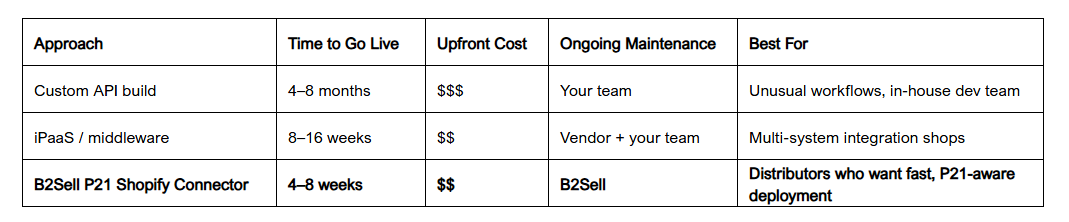
Quick Comparison
What B2Sell's P21 Shopify Connector Does
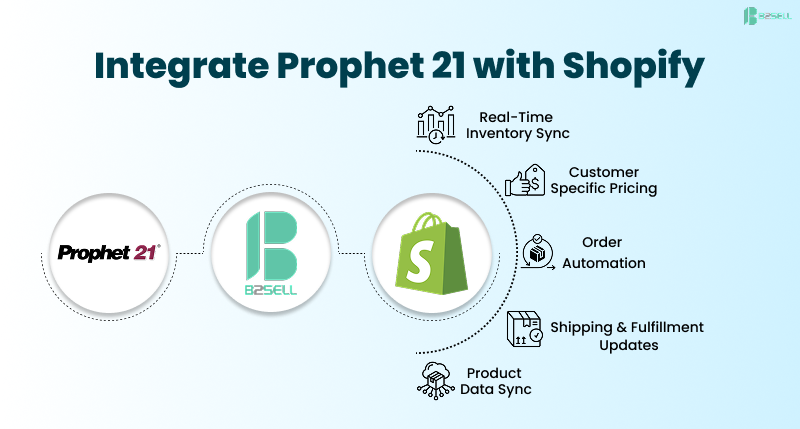
Built specifically for Epicor Prophet 21 distributors moving onto Shopify, the B2Sell connector ships with the integrations distributors actually need:
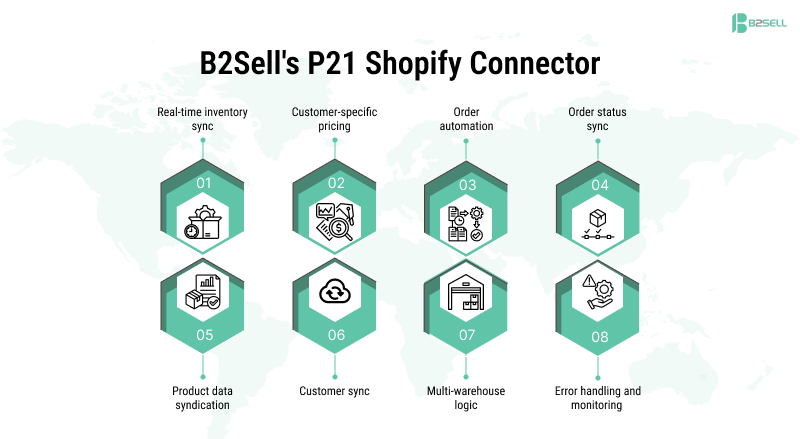
- Real-time inventory sync across all P21 warehouses, with per-location stock display on the Shopify product page
- Customer-specific pricing pulled live from the P21 price matrix on customer login, with quantity break support - — see our P21 ecommerce solution for full details
- Order automation that pushes Shopify orders straight into P21 as sales orders with the right customer, ship-to, payment terms, and freight method
- Order status sync back to Shopify: in process, shipped, partial ship, invoiced, tracking number
- Product data syndication from P21 to Shopify, including descriptions, attributes, images, categories, and UOM
- Customer sync for both new and existing accounts, including company hierarchy for Shopify B2B
- Multi-warehouse logic so a single Shopify SKU correctly reflects stock from the warehouse that will actually ship it
- Error handling and monitoring through a dashboard where your team can see exactly what synced, what failed, and why
Learn More - How Epicor Prophet 21 Integrates with Shopify: Step-by-Step Guide
What Real Distributor Implementations Look Like
Industrial fasteners distributor, mid-Atlantic, $40M revenue.
Web orders were being keyed into P21 by two CSRs spending half their day on data entry. After implementing B2Sell's P21 Shopify connector, manual order entry dropped to near zero and the two CSRs were redeployed to outbound account growth work. Order accuracy improved because address and SKU data no longer had a transcription step.
HVAC distributor, Southeast US, $25M revenue.
Buyers regularly complained that the Shopify site showed stock that didn't exist. Pre-integration inventory sync was a once-daily flat-file import. After real-time inventory sync went live, backorder rate on web orders dropped roughly 70% in the first quarter.
Electrical supply distributor, Midwest, $80M revenue.
Could not show tiered contractor pricing on Shopify, so contractors continued ordering by phone. After enabling customer-specific pricing from the P21 price matrix, web channel revenue from existing contractor accounts grew meaningfully within six months and CSR time on phone orders dropped accordingly.
(Reach out if you want a reference call with a current B2Sell P21 Shopify customer in your vertical.)
How a B2Sell P21 Shopify Implementation Runs
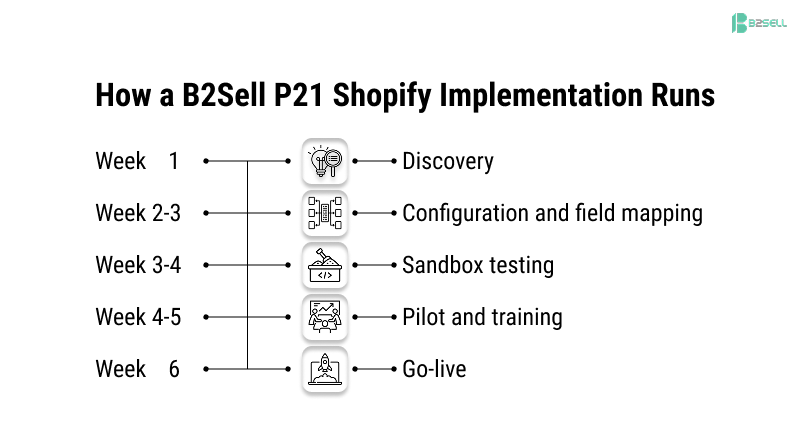
Week 1 — Discovery.
We map your data flows: which warehouses, which price tiers, which customer segments, which product attributes, what your order-to-cash actually looks like.
Week 2–3 — Configuration and field mapping.
We connect to your P21 instance and Shopify store, map fields, and stand up the rules: inventory display logic, pricing rules, order routing, tax handling, freight handling.
Week 4–5 — Sandbox testing.
Full end-to-end testing in a Shopify development store against a P21 sandbox or carefully scoped production data. Your team validates orders, pricing, returns, and edge cases.
Week 6–7 — Pilot and training.
Soft launch with a subset of customers or SKUs. Your CSRs and AR team get trained on what the integration does (and doesn't) handle.
Week 8 — Go-live.
Full production cutover with B2Sell support standing by.
Ongoing. 24/7 monitoring, version upgrade compatibility, and ongoing optimization through B2Sell's support team.
FAQ
How do I integrate P21 with Shopify?
The three options are a custom-built API integration, an iPaaS/middleware platform like Boomi or Celigo, or a pre-built connector like B2Sell's P21 Shopify integration. For most distributors, a pre-built connector is the fastest and lowest-risk path because the P21-specific logic is already written.
Does Epicor Prophet 21 have an API for Shopify integration?
Yes. P21 exposes both REST and SOAP APIs through its Middleware API layer, plus newer REST endpoints in current versions. These are what any integration — custom, iPaaS, or pre-built connector — uses to read from and write to P21.
Can Shopify handle B2B for P21 distributors?
Yes, and increasingly well. Shopify's B2B suite supports company accounts, contract pricing, quantity breaks, net payment terms, customer-specific catalogs, and quote workflows. Combined with a P21 integration that pipes through real pricing and inventory, Shopify is now a serious B2B platform for distributors, not just a DTC tool.
How long does a P21 Shopify integration take to deploy?
A custom API build typically runs 4–8 months. An iPaaS-based integration runs 8–16 weeks. A pre-built P21 Shopify connector like B2Sell's typically goes live in 4–8 weeks depending on the complexity of your pricing and warehouse setup.
Does the integration support multi-warehouse inventory?
Yes. B2Sell's connector syncs availability per P21 warehouse and lets you control how that's displayed on Shopify — total available, per-location stock, or routed-warehouse availability based on customer location.
Will Shopify show customer-specific contract pricing from P21?
Yes. When a B2B customer logs into Shopify, the connector pulls their pricing from the P21 price matrix and displays the right prices, including quantity break logic, before they add to cart.
Can I see P21 order status inside Shopify?
Yes. As orders move through P21 — picked, shipped, partially shipped, invoiced — those status changes sync back to the customer's Shopify account page, including tracking numbers.
How much does a P21 Shopify integration cost?
It depends on the path. Custom builds run from $80K to several hundred thousand depending on scope. iPaaS-based integrations carry both setup fees and monthly licensing tied to transaction volume. Pre-built connectors typically have a setup fee and a predictable monthly fee. Reach out for a quote against your specific P21 and Shopify setup.
Which ERP integration is best for Shopify wholesale on P21?
For distributors specifically running Epicor Prophet 21, the most distributor-aware choice is a P21-specific connector rather than a generic ERP-to-Shopify tool. The difference shows up in how price matrix, multi-warehouse logic, freight billing, and order routing are handled — these are the places generic connectors usually break.
Ready to See It Work on Your P21 and Shopify?
If you're running Epicor Prophet 21 and either already on Shopify or planning to move there, the integration is the difference between a website that drains your CSR team and a website that grows revenue while it sleeps.
Book a 30-minute demo and we'll walk you through the B2Sell P21 Shopify connector against your actual workflows. No slide deck, just the working product against your real-world questions.
.png)
.png)
.png)


.png)