


How to Connect SAP Business One to Shopify (Without the Sync Nightmares)
B2B distributors are under pressure to sell online. Buyers now expect real-time pricing, accurate stock, fast ordering, and self-service portals.
But many distributors still run SAP Business One offline while Shopify runs separately.
This creates problems:
- Orders do not sync correctly
- Inventory numbers are wrong
- Prices differ between ERP and online store
- Teams waste hours on manual updates
This is where SAP B1 Shopify Integration becomes critical.
By connecting SAP Business One with Shopify, distributors can run ecommerce directly from their ERP. Data flows automatically. Errors reduce. Customers get a smooth buying experience.
This guide explains what SAP B1 Shopify Integration is, why it matters, common challenges, and how B2Sell helps distributors integrate Shopify with SAP Business One the right way.
What Is SAP B1 Shopify Integration?
SAP B1 Shopify Integration connects your SAP Business One ERP with your Shopify ecommerce store. It allows data to flow automatically between both systems.
What Data Syncs Between SAP B1 and Shopify
- A strong integration connects:
- Products (SKU, descriptions, images)
- Inventory levels (real-time stock updates)
- Pricing (customer-specific and tier pricing)
- Customers (accounts, addresses, tax info)
- Orders (online orders sent to SAP B1)
- Shipping and tax data
- Payment status
With the right Shopify connector for SAP B1, distributors manage everything from SAP Business One while customers shop easily on Shopify.
Why SAP B1 Shopify Integration Matters for B2B Distributors
Many distributors start ecommerce without integration. At first, it seems manageable. Over time, problems grow.
Without integration, distributors face:
- Manual order entry
- Stock mismatches
- Pricing errors
- Delayed fulfillment
- Customer complaints
A strong integration removes these risks and supports long-term ecommerce growth.
For distributors already using SAP Business One, integration is not optional anymore. It is a requirement.
👉 Learn more about SAP Business One solutions: Click here
Common Challenges Distributors Face Without Integration
1. Manual Order Processing
Orders placed on Shopify are often re-entered into SAP B1 by hand.
This causes:
- Data entry errors
- Slow order fulfillment
- Extra workload for staff
2. Inventory Mismatch
Stock updates are delayed or inaccurate.
This leads to:
- Overselling products
- Backorders and cancellations
- Poor customer trust
3. Complex B2B Pricing Issues
Distributors use:
- Customer-specific pricing
- Tiered price lists
- Contract pricing
Shopify alone cannot handle this well without a strong SAP B1 integration partner.
4. Customer Data Fragmentation
Customer records exist in two places:
- Shopify for online sales
- SAP B1 for accounting and operations
This creates:
- Inconsistent customer history
- Billing mistakes
- Poor account management
5. Limited Ecommerce Scalability
As order volume increases:
- Manual work increases
- Errors increase
- Growth slows
These challenges highlight why distributors need a reliable SAP B1 Integration Partner.
How SAP B1 Shopify Integration Works (Step-by-Step)
A reliable Shopify connector for SAP B1 follows a structured process.
.png)
Step 1: Product Sync from SAP B1 to Shopify
Products are managed in SAP Business One.
The integration syncs:
- Item name and description
- SKU and categories
- Images and attributes
This reduces manual uploads in Shopify.
Step 2: Inventory Sync in Real Time
Stock levels are updated automatically.
Benefits:
- Accurate inventory on Shopify
- No overselling
- Better planning for procurement
This is critical for distributors with large catalogs.
Step 3: Customer Sync Between Systems
Customer accounts created on Shopify are sent to SAP B1.
This helps:
- Maintain clean customer records
- Apply correct price lists
- Track order history
Step 4: Order Sync from Shopify to SAP B1
When an order is placed:
- It flows directly into SAP Business One
- Sales orders are created automatically
- Taxes and shipping details are included
No manual entry is required.
Step 5: Status Updates Back to Shopify
Once orders are processed in SAP B1:
- Status updates sync back to Shopify
- Customers receive notifications
- Tracking details are shared
This improves customer trust.
Step 6: Customer Data Synchronization
Customer accounts are synced both ways.
This ensures:
- Clean master data
- Full order history
- Better account management
Realistic Example: A B2B Distributor Using SAP B1 Shopify Integration
A mid-sized industrial parts distributor sells to dealers and contractors.
Before integration:
- Orders were emailed or entered manually
- Inventory was updated once per day
- Customers complained about delays
After using B2Sell as their SAP B1 integration partner:
- Shopify orders synced instantly to SAP B1
- Inventory updated in real time
- Order processing time dropped by 60%
Customers could place orders anytime, and the internal team worked faster with fewer errors.
Why B2Sell Is a Trusted SAP B1 Integration Partner
B2Sell specializes in ecommerce integrations for distributors. The platform is built to handle real B2B complexity.
Key strengths of B2Sell:
.png)
- Deep experience with SAP Business One ecommerce
- Proven Shopify connector for SAP B1
- Supports complex pricing and customer rules
- Scales with growing catalogs
👉 You can explore B2Sell’s SAP Business One solutions: Click here
Key Benefits of SAP B1 Shopify Integration with B2Sell
.png)
1. Faster Order Processing
Orders flow automatically into SAP B1.
This means:
- No manual work
- Faster fulfillment
- Lower operational costs
2. Accurate Inventory Management
Stock is always up to date across systems.
Benefits include:
- Fewer stockouts
- Better demand planning
- Improved customer trust
3. Better B2B Customer Experience
Customers see:
- Correct prices
- Real-time availability
- Accurate order status
This improves repeat business.
4. Scalable Ecommerce Operations
As your catalog grows:
- SAP B1 remains the system of record
- Shopify handles the storefront
- B2Sell keeps data in sync
This supports long-term growth.
SAP B1 Shopify Integration vs Manual Processes
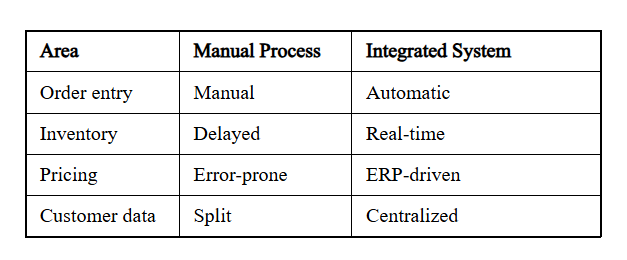
Integration clearly reduces risk and effort.
Choosing the Right Shopify Connector for SAP B1
Not all connectors are built for B2B distributors.
When evaluating options, look for:
.png)
- Support for SAP B1 price lists
- Customer group mapping
- Multi-warehouse inventory
- Tax and shipping logic
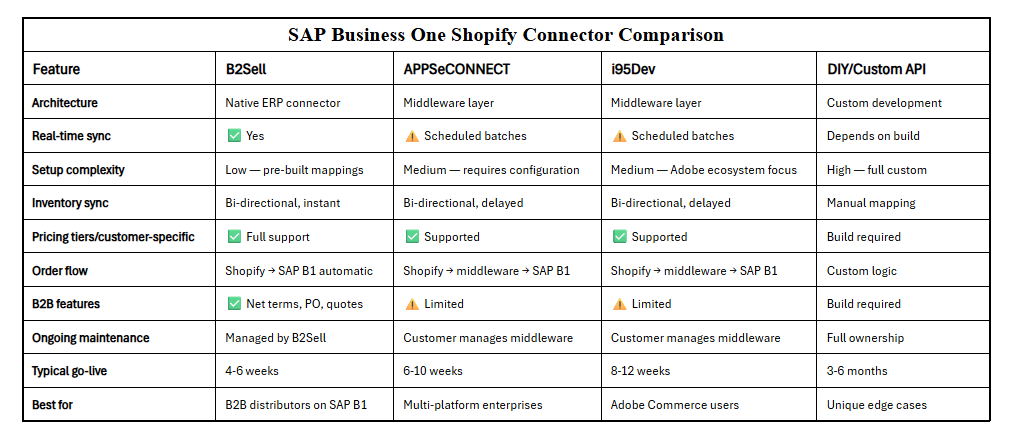
👉 B2Sell is designed specifically for these needs. You can learn more about SAP Business One ecommerce integration concepts: Click here
Best Practices for a Successful SAP B1 Shopify Integration
Keep SAP B1 as the Master System
- Products
- Inventory
- Pricing
Should be managed in SAP Business One.
Clean Data Before Integration
Before syncing:
- Remove duplicate items
- Standardize SKUs
- Review customer records
This ensures smoother integration.
Work with an Experienced SAP B1 Integration Partner
A knowledgeable partner helps:
- Avoid data conflicts
- Configure rules correctly
- Support long-term scaling
B2Sell follows proven integration practices used by distributors worldwide.
👉 For advanced optimization tips, this guide is helpful: The Ultimate Guide to Optimizing B2Sell With SAP Business One
FAQ
Can Shopify work with SAP Business One?
Yes. With a proper Shopify connector for SAP B1, Shopify can fully integrate with SAP Business One for products, orders, customers, and inventory.
Is SAP B1 Shopify Integration suitable for B2B?
Yes. When built correctly, SAP B1 Shopify Integration supports B2B pricing, customer groups, and bulk ordering.
How long does SAP B1 Shopify Integration take?
Timelines depend on:
- Data complexity
- Custom pricing rules
- Number of products
With B2Sell, most projects follow a structured and predictable rollout.
Do I need custom development?
No. B2Sell offers a ready integration platform that reduces the need for custom code.
What is the main benefit of SAP B1 Shopify Integration?
It removes manual work and keeps ecommerce data accurate across systems.
Who should use SAP B1 Shopify Integration?
B2B distributors using SAP Business One and Shopify for online sales.
Is integration secure?
Yes. Data sync is controlled and follows ERP-level rules.
Final Thoughts: Transforming B2B Ecommerce with SAP B1 Shopify Integration
SAP B1 Shopify Integration helps distributors move from manual, error-prone processes to a connected ecommerce operation. It improves speed, accuracy, and customer satisfaction.
By using B2Sell as your SAP B1 integration partner, you ensure Shopify and SAP Business One work together as one system. This creates a strong foundation for scalable B2B ecommerce growth.
Take the Next Step
If you want to simplify ecommerce operations and connect SAP Business One with Shopify:
👉 Request a Demo - Click here
👉 Book a Strategy Call - Talk a Integration Expert
A well-planned SAP B1 Shopify Integration can change how your distribution business sells online—accurately, efficiently, and at scale.
.png)
.png)
.png)


.png)