
.png)


Manufacturers are under more pressure than ever. They sell through dealers, distributors, marketplaces, ecommerce stores, and direct sales teams. Each channel needs correct product data. Each customer expects fast, accurate, and detailed product information.
But many manufacturers still manage product data in spreadsheets, ERP tables, and scattered files. That leads to errors, delays, and lost sales.
This is why PIM for manufacturers is becoming essential in 2026.
A Product Information Management (PIM) system allows manufacturers to manage, enrich, and publish accurate product data across every channel from a single centralized platform.
In this guide, you will learn what PIM means for manufacturing, why it matters now, common pain points, and how B2Sell PIM helps manufacturers grow faster and sell smarter.
What Is PIM for Manufacturers?
PIM for manufacturers is a system that collects, organizes, enriches, and distributes product data from a central hub.
It manages all product-related information such as:
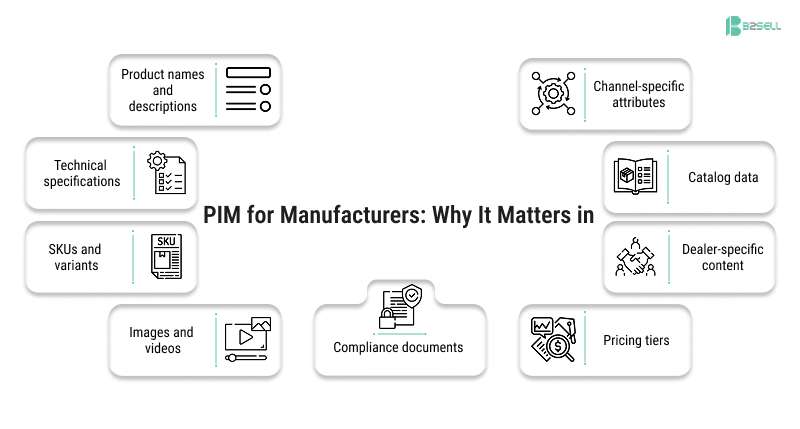
- Product names and descriptions
- Technical specifications
- SKUs and variants
- Images and videos
- Compliance documents
- Pricing tiers
- Dealer-specific content
- Catalog data
- Channel-specific attributes
Instead of managing this data in many tools, a PIM keeps everything in one structured system.
How PIM Differs from ERP
Manufacturers often ask: “We already have an ERP — why do we need PIM?”
ERP systems are built for operations. They manage:
- Inventory
- Orders
- Finance
- Procurement
- Production
But ERP is not designed to manage rich product content for sales and marketing channels.
A PIM software solution for manufacturing helps bridge this critical data gap. It prepares product data for:
- Ecommerce
- Dealer portals
- Marketplaces
- Printed catalogs
- Sales teams
- Customer portals
ERP stores the data. PIM makes it usable.
Why PIM for Manufacturing Matters More in 2026
Manufacturing sales models have changed.
In 2026, manufacturers are expected to support:
- Omnichannel selling
- Digital dealer networks
- Self-service customer portals
- Ecommerce ordering
- AI-powered product search
- Marketplace listings
- Global distribution
All these channels require clean, consistent, enriched product data.
Without a PIM, product data becomes:
- Inconsistent
- Incomplete
- Duplicated
- Outdated
- Hard to update
With a PIM, manufacturers can manage product data once and publish everywhere.
That is why many companies now look for the best PIM for manufacturers instead of adding more spreadsheets and manual workflows.
B2Sell Central — PIM built for distributors and manufacturers → Click here
Common Product Data Challenges Manufacturers Face
Most manufacturing companies face similar product data problems. These issues grow as product lines expand.
Scattered Product Data
Product data lives in:
- ERP tables
- Excel sheets
- Engineering files
- Marketing documents
- Dealer PDFs
- Shared drives
Teams cannot find the latest version easily.
Result:
- Confusion
- Wrong listings
- Repeated work
Too Many Product Variants
Manufacturers often manage:
- Size variants
- Color variants
- Configurable parts
- Regional versions
- Custom bundles
Without a PIM, variant management becomes complex and error-prone.
Dealer & Distributor Data Conflicts
Distributors and dealers often request:
- Custom descriptions
- Different units
- Channel-specific specs
- Local language data
Manual handling leads to mismatches and delays.
Slow New Product Launches
Launching a new product should be fast. But product data prep takes weeks because:
- Data is incomplete
- Images are missing
- Specs are not validated
- Approvals are slow
A strong pim for manufacturing reduces launch time.
Poor Ecommerce Performance
Bad product data leads to:
- Low search visibility
- Poor product page experience
- High return rates
- Lower conversion
Rich, structured product data improves online sales performance.
How PIM Software for Manufacturers Solves These Problems
Centralized Product Data Management
PIM creates one trusted location for all product data.
Benefits include:
- No duplicate data
- Clear ownership and approval workflows
- Real-time updates across channels
This alone saves hundreds of hours per year.
Structured Data for AI and SEO
Modern PIM platforms structure product data using attributes and taxonomies.
This helps:
- Google AI Overviews understand your products
- ChatGPT-style search tools surface your content
- Buyers find products faster
This is essential for 2026 search visibility.
Faster Product Launches
With PIM software for manufacturing, teams can:
- Predefine attribute templates
- Reuse content across products
- Automate channel publishing
Product launches become faster and predictable.
Improved Distributor Experience
Manufacturers can share accurate product data with distributors through:
- Data feeds
- APIs
- Secure portals
This ensures consistency across all sales partners.
Step-by-Step: How Manufacturers Use PIM Effectively
A modern pim software for manufacturers creates structure and control across product data workflows.
Here is how it works step by step.
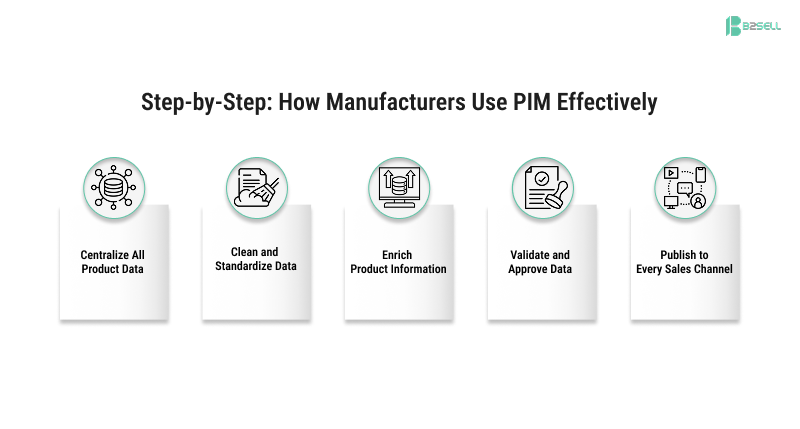
Step 1 — Centralize All Product Data
A PIM collects product data from:
- ERP
- PLM
- Excel
- Supplier feeds
- Legacy systems
All data flows into one central product hub.
This becomes the single source of truth.
Step 2 — Clean and Standardize Data
PIM systems help standardize:
- Units of measure
- Attribute names
- Category structures
- Taxonomy
- Variant rules
This removes inconsistencies across catalogs.
Step 3 — Enrich Product Information
Manufacturers can enrich product data with:
- Marketing descriptions
- SEO content
- Feature lists
- Use-case content
- Technical documents
- Safety sheets
This improves buyer confidence and search performance.
Step 4 — Validate and Approve Data
Workflow tools help teams:
- Assign data tasks
- Approve content
- Track changes
- Control versions
No more guessing which file is correct.
Step 5 — Publish to Every Sales Channel
A PIM pushes product data to:
- Ecommerce platforms
- Dealer portals
- Marketplaces
- Print catalogs
- Mobile apps
Data is formatted per channel automatically.
Real Use Cases of PIM for Manufacturers
Let’s look at practical examples.
Use Case: Industrial Equipment Manufacturer
Problem:
- 25,000 SKUs
- Data stored in ERP + Excel
- Dealer catalogs updated manually
After PIM:
- Centralized product data
- Dealer catalogs auto-generated
- Data errors reduced by 60%
- Catalog update time cut from weeks to days
Use Case: Parts Manufacturer
Problem:
- Complex spare part variants
- Missing attributes
- Inconsistent ecommerce listings
After PIM:
- Variant structure defined
- Attribute completeness rules added
- Marketplace listings automated
Result:
- Higher search visibility
- Faster listing updates
- Better conversion rates
Use Case: Multi-Region Manufacturer
Problem:
- Country-specific product content
- Language differences
- Compliance fields missing
After PIM:
- Regional attributes added
- Language layers supported
- Compliance data tracked
Result:
- Faster global expansion
- Lower compliance risk
Key Benefits of the Best PIM for Manufacturing
A well-implemented PIM delivers measurable gains.
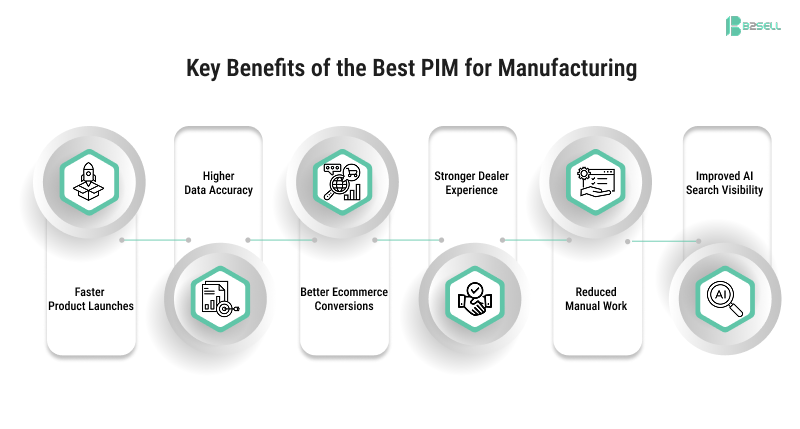
Faster Product Launches
Manufacturers can launch products faster because:
- Data templates are ready
- Attributes are pre-defined
- Workflows are automated
Typical improvement:
- 30–50% faster time-to-market
Higher Data Accuracy
Central control reduces duplication and errors.
Expected impact:
- 50–80% fewer product data errors
Better Ecommerce Conversions
Rich product content improves buyer decisions.
Results often include:
- Higher product page engagement
- Lower bounce rates
- Increased conversion
Stronger Dealer Experience
Dealers get:
- Correct product data
- Channel-ready files
- Faster updates
This improves partner satisfaction.
Reduced Manual Work
Automation replaces repetitive tasks.
Teams save time on:
- Data copying
- Reformatting
- Rechecking
Improved AI Search Visibility
AI search engines and answer engines prefer:
- Structured attributes
- Complete specs
- Clean taxonomy
- Consistent naming
A pim for manufacturers supports AI-ready product data.
What Is the Best PIM for Manufacturers? Key Features to Look For
When choosing the best pim for manufacturing, look for:
Core Capabilities
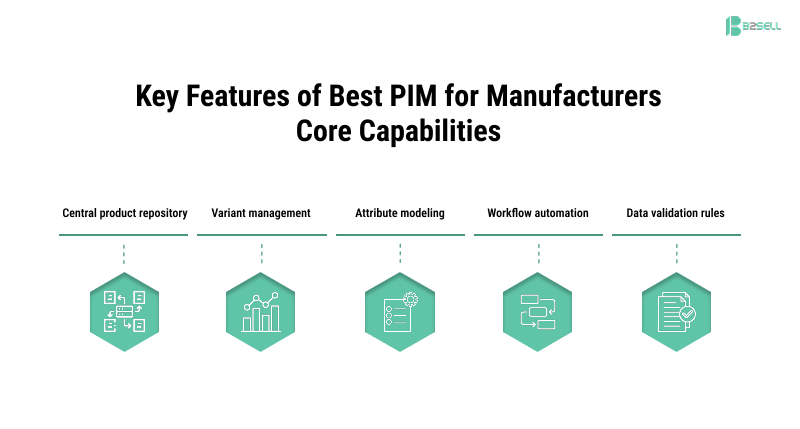
- Central product repository
- Variant management
- Attribute modeling
- Workflow automation
- Data validation rules
Integration Support
Your PIM should connect with:
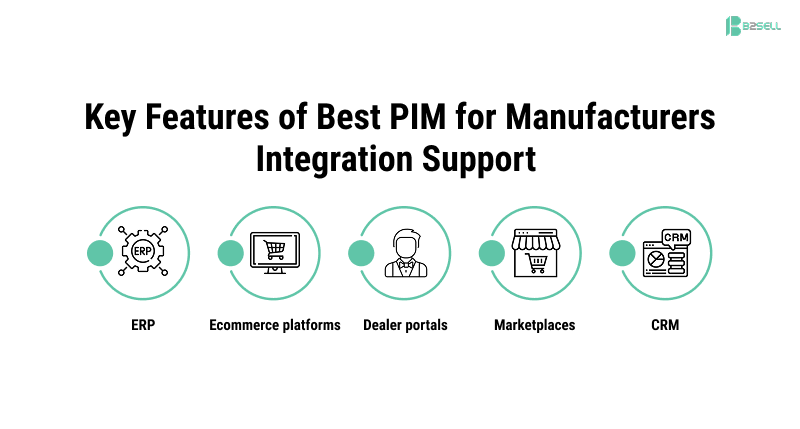
- ERP
- Ecommerce platforms
- Dealer portals
- Marketplaces
- CRM
Channel Publishing
Look for built-in connectors to:
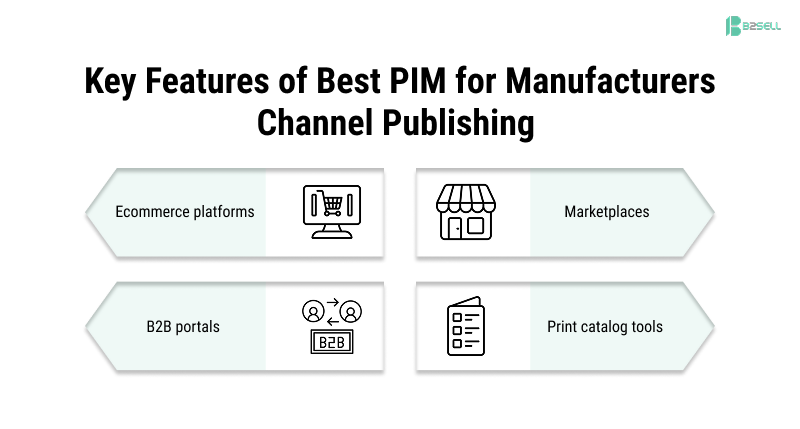
- Ecommerce platforms
- B2B portals
- Marketplaces
- Print catalog tools
Role-Based Access
Different teams should have:
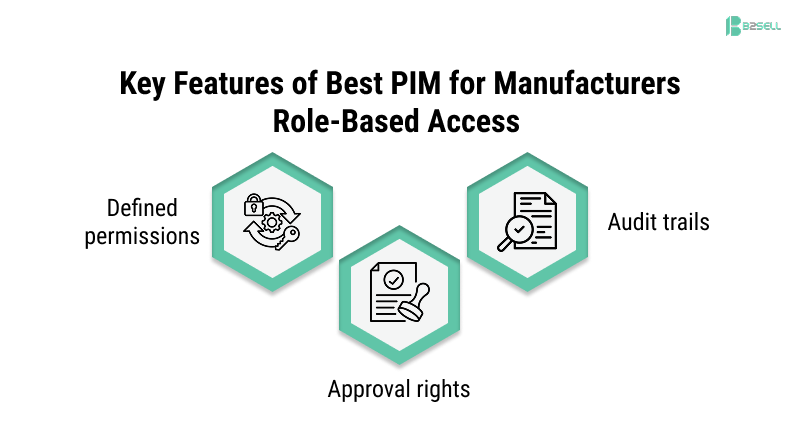
- Defined permissions
- Approval rights
- Audit trails
Scalability
Your pim software for manufacturing should handle:
.png)
- Large SKU counts
- Multi-language data
- Multi-region catalogs
Why B2Sell PIM Is Built for Manufacturers
B2Sell offers a purpose-built PIM designed for complex B2B and manufacturing environments.
The B2Sell PIM platform supports manufacturers with large catalogs, complex variants, and multi-channel distribution.
Learn more here: B2Sell PIM Software
B2Sell PIM for Manufacturers — Key Strengths
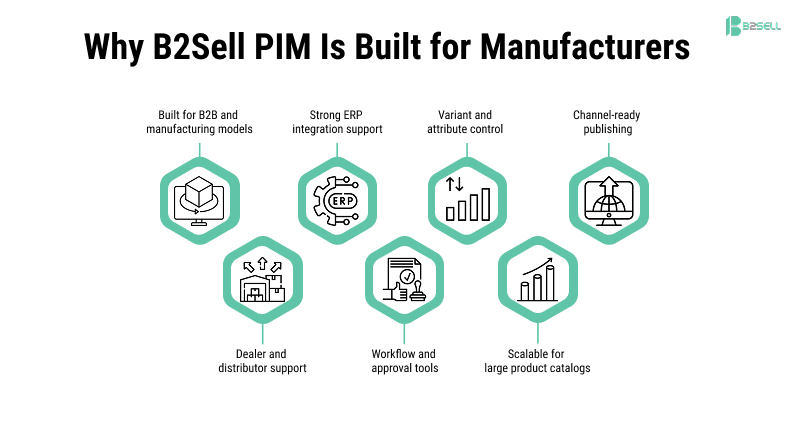
- Built for B2B and manufacturing models
- Strong ERP integration support
- Variant and attribute control
- Channel-ready publishing
- Dealer and distributor support
- Workflow and approval tools
- Scalable for large product catalogs
Where B2Sell Fits Best
B2Sell PIM works well for:
- Industrial manufacturers
- Parts manufacturers
- Equipment makers
- Multi-brand manufacturers
- Distributor-driven brands
Conclusion: The Transformation Impact of PIM for Manufacturers
In 2026, PIM for manufacturers is no longer optional. It is the foundation for digital growth.
Manufacturers that invest in PIM gain:
- Control over product data
- Faster launches
- Better SEO and AI visibility
- Stronger distributor relationships
With the right PIM software for manufacturers, product data becomes a competitive advantage—not a bottleneck.
Ready to Modernize Product Data Management?
If you are looking for a scalable, manufacturing-focused solution, B2Sell PIM for manufacturers is built to support complex product data, ERP integration, and omnichannel growth.
👉 Request a Demo
👉 Book a Strategy Call
Visit https://www.b2sell.com/b2sell-for-manufacturers to see how B2Sell helps manufacturers succeed with PIM in 2026 and beyond.
.png)
.png)
.png)


.png)