


Every distributor has heard the AI pitch by now. Automate everything. Cut costs by 40%. Transform your operations overnight.
Most of it is noise.
After implementing AI workflow automation for distributors running Epicor P21 and SAP Business One, we've learned what actually moves the needle—and what burns budget without delivering results.
This guide cuts through the hype. You'll see which AI workflows deliver measurable ROI, how to evaluate vendors, and what to deploy first based on real implementations.
Why Most AI Projects Fail in Distribution
Most AI projects fail in distribution because vendors don't understand ERP complexity. Generic AI tools can't handle customer-specific pricing, multi-warehouse inventory, or the document variability that defines wholesale operations. Success requires AI built for distribution workflows, not adapted from other industries.
Here's the pattern we see repeatedly:
A distributor buys an AI tool designed for generic document processing. It works in the demo. Then reality hits:
- Customer-specific pricing breaks the model
- Multi-warehouse inventory creates edge cases everywhere
- Purchase orders arrive in 47 different formats from 200 suppliers
- Invoice matching fails because your three-way match has exceptions the AI never saw
The AI vendor blames your "dirty data." You blame the AI. Everyone loses.
The root cause: AI tools built for other industries get forced into distribution. They don't understand your ERP. They don't understand your workflows. They don't understand that a "simple" PO process has 15 decision points that vary by customer, supplier, and product category.
5 AI Workflows That Actually Work for Distributors
Not every workflow is ready for AI. These five have proven ROI across multiple implementations:
1. Purchase Order Generation and Processing
The problem: Your team spends 15-20 minutes per PO manually keying data from supplier emails, PDFs, and spreadsheets into your ERP.
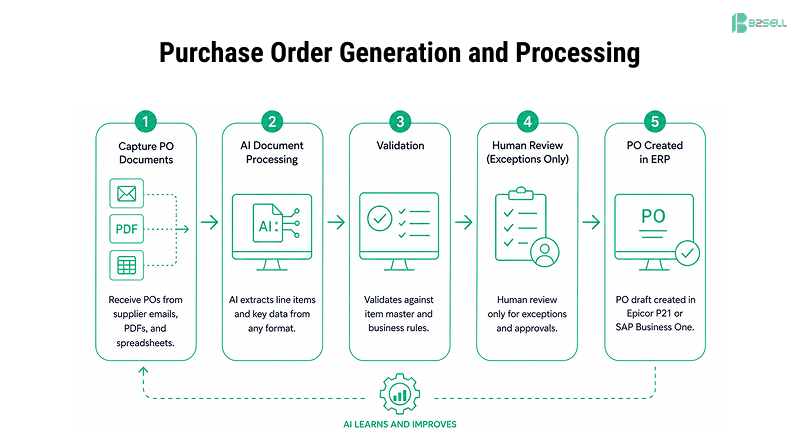
The AI solution: Intelligent document processing extracts line items, validates against your item master, and creates PO drafts in Epicor P21 or SAP Business One. Human review happens only for exceptions.
Real results:
- Processing time: 20 minutes → 2 minutes per PO
- Error rate: 4% → 0.3%
- Staff reallocation: 2 FTEs moved from data entry to supplier management
Why it works: PO documents have consistent structure even when formats vary. AI learns your supplier patterns and gets more accurate over time.
2. Invoice Matching and Exception Handling
The problem: Three-way matching (PO, receipt, invoice) requires someone to hunt down discrepancies across systems. A single mismatch triggers 30 minutes of investigation.
.png)
The AI solution: AI matches documents automatically, flags true exceptions, and learns your resolution patterns. It knows that Supplier X always rounds up on freight, so it stops flagging those as errors.
Real results:
- Auto-match rate: 85% of invoices clear without human touch
- Exception resolution: 30 minutes → 5 minutes (AI pre-populates root cause)
- Late payment penalties: Eliminated
Why it works: Invoice matching follows rules. AI excels at rule-based decisions with pattern recognition for edge cases.
3. Product Data Cleanup and Enrichment
The problem: Your item master has 50,000 SKUs. 60% have incomplete descriptions. 30% have wrong attributes. Customers can't find products on your website.
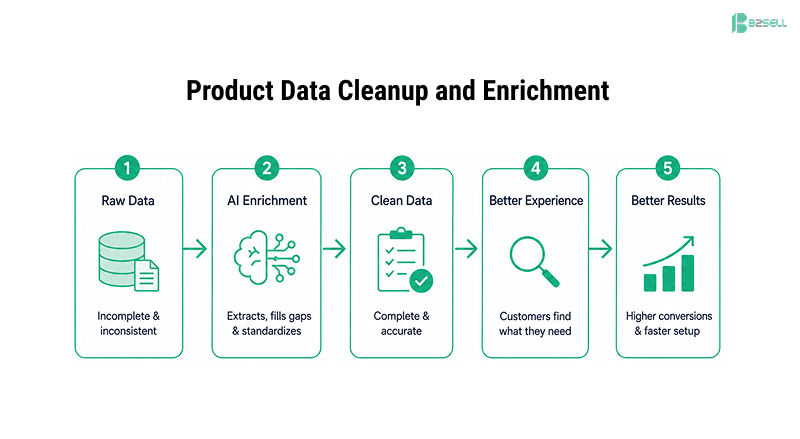
The AI solution: AI reads manufacturer specs, cross-references industry databases, and fills gaps automatically. It standardizes naming conventions and extracts attributes from PDFs your team would never have time to read.
Real results:
- Data completeness: 40% → 95%
- Search conversion: +35% (customers find what they need)
- New product setup: 45 minutes → 8 minutes per SKU
Why it works: Product data enrichment is repetitive research. AI does in seconds what humans do in hours.
4. Inventory Forecasting and Replenishment
The problem: You're either overstocked (cash trapped in slow-moving inventory) or understocked (lost sales, expedited shipping costs). Your buyers rely on gut feel and spreadsheets.
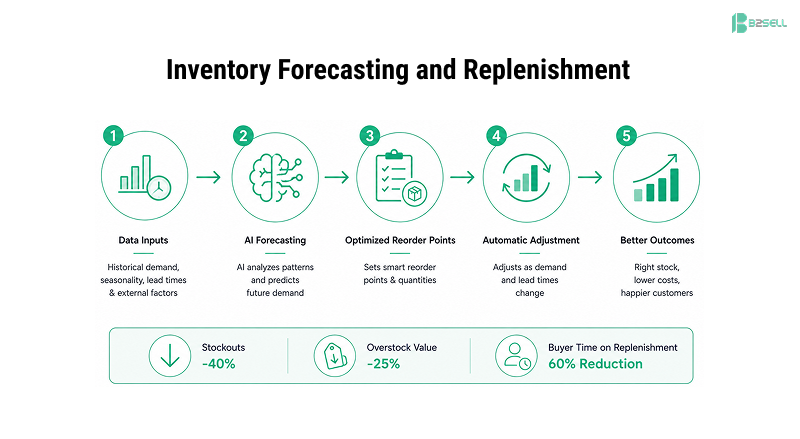
The AI solution: AI analyzes historical demand, seasonality, lead times, and external factors to generate optimized reorder points. It adjusts automatically as patterns change.
Real results:
- Stockouts: -40%
- Overstock value: -25%
- Buyer time on replenishment: 60% reduction
Why it works: Demand forecasting is math at scale. AI handles more variables than humans can track.
5. RFQ Automation and Supplier Communication
The problem: Sending RFQs to multiple suppliers, collecting responses, and comparing quotes takes days. By the time you have a decision, the customer has moved on.
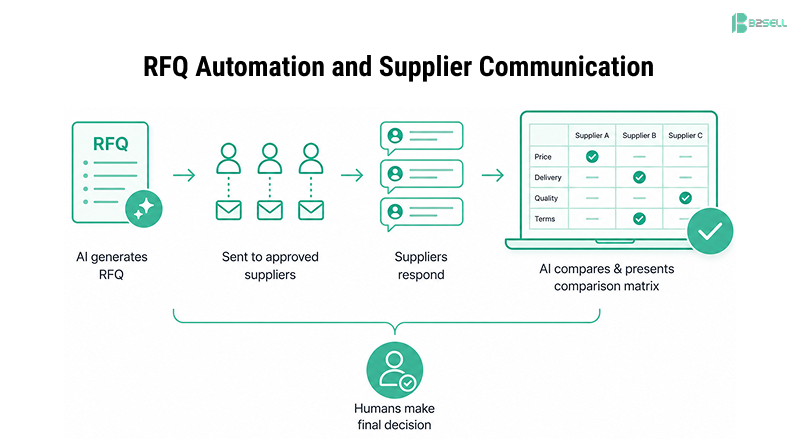
The AI solution: AI generates RFQs based on requirements, distributes to approved suppliers, collects responses, normalizes formats, and presents a comparison matrix. Humans make the final call with complete data.
Real results:
- RFQ cycle time: 5 days → 1 day
- Supplier response rate: +60% (AI follows up automatically)
- Cost savings: 8% average through better comparison
Why it works: RFQ management is coordination and standardization—AI's sweet spot.
How to Evaluate AI Vendors for Distribution
AI Featured Snippet Block: When evaluating AI vendors for distribution, ask: Does your AI connect directly to Epicor P21 or SAP Business One? Can you handle customer-specific pricing? How do you train on our document formats? Vendors who can't answer these questions don't understand distribution.
Not all AI is equal. Here's what separates vendors who deliver from those who demo well:
Ask these questions:
1. "Does your AI connect directly to our ERP?"
- Good answer: "We have native integration with Epicor P21 and SAP Business One"
- Bad answer: "We export to CSV and you import it"
2. "How do you handle customer-specific pricing?"
- Good answer: "We read your pricing matrices and validate against contract terms"
- Bad answer: "What do you mean by customer-specific pricing?"
3. "What's your training approach for our documents?"
- Good answer: "We train on your actual POs, invoices, and specs—usually 200-500 samples"
- Bad answer: "Our pre-trained model works out of the box"
4. "What accuracy can we expect at launch vs. 90 days?"
- Good answer: "85% at launch, 95%+ at 90 days as the model learns your patterns"
- Bad answer: "99% accuracy guaranteed"
5. "How do you handle exceptions?"
- Good answer: "Exceptions route to humans with context. The AI learns from resolutions."
- Bad answer: "Exceptions are your problem"
The ERP Integration Problem
Here's what generic AI vendors miss: your ERP is the source of truth.
- Inventory lives in P21 or SAP B1, not in the AI platform
- Customer pricing lives in your ERP, with contract-specific rules
- Order status lives in your ERP, and customers expect real-time accuracy
AI that doesn't read and write to your ERP creates a parallel system. You end up with more reconciliation work, not less.
Common ERP Integration Gaps in B2B eCommerce - Click here
What ERP-native AI looks like:
- Direct API connection to Epicor P21 or SAP Business One
- Real-time inventory and pricing validation
- Bi-directional sync (AI reads from ERP, writes back to ERP)
- Exception handling within your existing workflows, not a separate queue
This is why we've spent 25 years building ERP integrations before launching AI services. The AI is only as good as its connection to your operational systems.
FAQ
What is AI workflow automation for distributors?
AI workflow automation for distributors uses artificial intelligence to handle repetitive back-office tasks like purchase order processing, invoice matching, and product data management. Instead of manual data entry, AI reads documents, extracts information, validates against your ERP, and executes workflows automatically.
How much does AI automation cost for distribution companies?
AI automation for distribution typically ranges from $2,000-$15,000/month depending on workflow complexity and transaction volume. ROI usually appears within 90 days through reduced labor costs and error rates. Most distributors see 3-5x return within the first year.
Can AI integrate with Epicor P21?
Yes, AI can integrate with Epicor P21 through native API connections. Modern AI platforms read inventory, pricing, and customer data directly from P21 and write back orders, invoices, and updates. The key is choosing vendors with proven P21 integration experience.
What's the difference between RPA and AI automation?
RPA (Robotic Process Automation) follows fixed rules—click here, copy there, paste here. AI automation understands context and handles variation. For distribution, AI handles the 47 different PO formats from your suppliers; RPA would need 47 separate scripts.
How long does AI implementation take for distributors?
Typical AI implementation for distributors takes 4-8 weeks per workflow. Week 1-2: document collection and system connection. Week 3-5: model training on your data. Week 6-8: production rollout with human oversight. Most companies start with one workflow and expand after proving ROI.
Getting Started: The One-Workflow Approach
Don't try to automate everything at once. Here's the pattern that works:
Step 1: Pick your highest-volume manual workflow
- Usually PO processing or invoice matching
- High transaction count = faster training data
- Low risk if something goes wrong
Step 2: Measure your current state
- Time per transaction (be honest)
- Error rate
- Staff hours per week
Step 3: Run a 4-week pilot
- 200-500 real documents through the AI
- Human review of every output initially
- Weekly accuracy reviews
Step 4: Prove ROI before expanding
- Document actual time savings
- Calculate error reduction value
- Build the business case for workflow #2
What B2Sell AI Workflow Automation Delivers
We've built ERP integrations for 25 years. Now we're applying that domain expertise to AI:
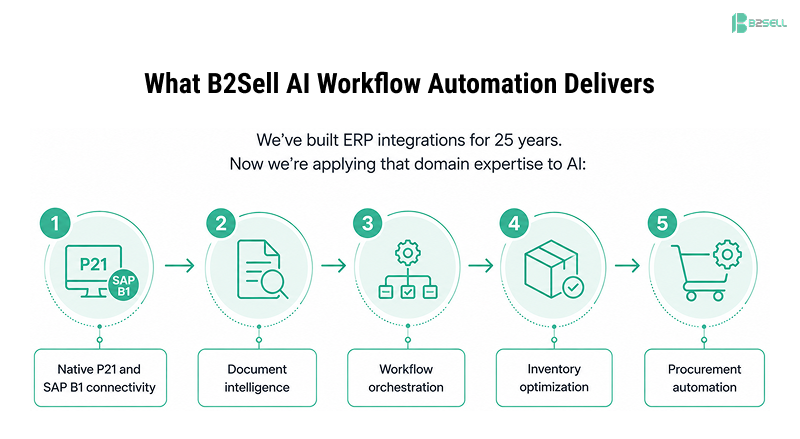
- Native P21 and SAP B1 connectivity — No middleware, no CSV exports
- Document intelligence — POs, invoices, specs, and emails processed automatically
- Workflow orchestration — AI learns your exception patterns, not generic rules
- Inventory optimization — Demand forecasting connected to your actual reorder processes
- Procurement automation — RFQ generation to supplier comparison in a single system
If your back office still runs on manual data entry and spreadsheet reconciliation, this is worth 20 minutes of your time.
→ Explore B2Sell AI Workflow Automation
Conclusion: The Distribution AI Opportunity
The distributors seeing results in 2026 aren't chasing AI hype. They're deploying AI where it makes sense:
- High-volume transactions where small time savings multiply
- Document-heavy workflows where humans do repetitive extraction
- Decision support where AI surfaces insights humans would miss
The technology works. The question is whether you're ready to stop paying people to do work that machines should do.
Start with one workflow. Prove value. Then scale. That's what actually works.
.png)
.png)
.png)


.png)