
.png)


Your P21 runs your distribution business. Your ecommerce should too.
If you're a distributor running Epicor Prophet 21 and evaluating ecommerce platforms, you've probably noticed most "comparisons" are written by vendors selling you their platform. This guide isn't that.
We've spent 25 years integrating P21 with ecommerce systems. We've seen what works, what breaks, and what costs distributors hundreds of thousands in failed implementations. This is the comparison we wish existed when we started.
What you'll learn:
- 7 ecommerce platforms that integrate with Epicor P21
- Real integration depth (not marketing claims)
- B2B feature fit for distributor workflows
- Our recommendation based on your distributor profile
What Makes P21 Ecommerce Different?
Most ecommerce platforms were built for B2C retail. They handle simple pricing, individual consumers, and credit card transactions.
.png)
Distribution is different. You need:
- Customer-specific pricing tied to contracts, volume breaks, and negotiated terms
- Real-time inventory across multiple warehouses with ATP (available-to-promise) logic
- Credit term enforcement that respects P21's credit limits and payment terms
- Account hierarchies where a purchasing agent can buy for 15 ship-to locations
- Quote-to-order workflows that don't bypass your inside sales team
- Punchout catalog support for enterprise customers using Ariba or Coupa
Generic ecommerce platforms can't do this out of the box. The question is: how much customization (and cost) does each option require?
The 7 Platforms: Quick Comparison
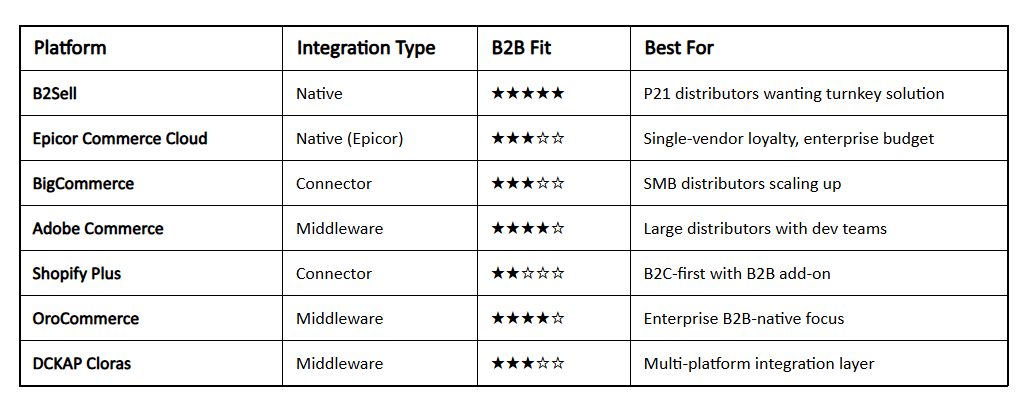
1. B2Sell — Native P21 Integration
Integration approach: Native connector built specifically for Prophet 21
How it works: B2Sell connects directly to P21's database and APIs without middleware. Inventory, pricing, customer data, and orders sync in real-time. No third-party connector fees, no sync delays.
.png)
B2B feature coverage:
- ✅ Customer-specific pricing from P21 contracts
- ✅ Multi-warehouse inventory with ATP
- ✅ Credit limit enforcement
- ✅ Account hierarchies and ship-to management
- ✅ Quote management with sales rep approval
- ✅ Punchout catalog (cXML/OCI)
- ✅ Built-in PIM (B2Sell Central) for product enrichment
3-year TCO: $$ Fixed licensing, no per-transaction fees, no middleware costs.
Best for: Distributors who want P21 ecommerce without building an IT department. Fastest time-to-value for mid-market distributors.
Limitations: Less customizable than enterprise platforms — by design. Opinionated architecture means faster implementation but less flexibility for edge cases.
→ See B2Sell P21 Integration
2. Epicor Commerce Cloud (ECC)
Integration approach: Native (same vendor as P21)
How it works: ECC is Epicor's own ecommerce module, formerly called Epicor Commerce Connect. It's the "official" option and shares a vendor with your ERP.
B2B feature coverage:
- ✅ Customer-specific pricing (with configuration)
- ✅ Inventory sync (batch, not always real-time)
- ⚠️ Limited account hierarchy support
- ⚠️ Quote workflows require customization
- ⚠️ Punchout support varies by implementation
3-year TCO: $$$$ Licensing isn't cheap, and many distributors report needing significant customization to handle standard distribution workflows. Implementation partners charge premium rates for ECC expertise.
Best for: Distributors who want single-vendor accountability and have enterprise budgets.
Limitations: Rigid architecture. Many P21 users report ECC can't handle their pricing complexity without expensive custom work. Deployment timelines often stretch 12-18 months.
3. BigCommerce + P21 Connector
Integration approach: Third-party connector (typically via middleware like Celigo, Jitterbit, or custom)
How it works: BigCommerce handles the storefront. A connector syncs data between BigCommerce and P21 on a schedule (typically every 15-60 minutes).
B2B feature coverage:
- ✅ Customer-specific pricing (via B2B Edition)
- ✅ Multi-storefront support
- ⚠️ Inventory sync has lag (not real-time)
- ⚠️ Credit term enforcement requires customization
- ⚠️ Account hierarchies limited in native B2B
3-year TCO: $$ BigCommerce licensing is reasonable. Total is manageable for SMBs.
Best for: Smaller distributors scaling up, or businesses with both B2C and B2B channels.
Limitations: Not purpose-built for distribution. You'll fight the platform on complex B2B workflows. Sync lag means inventory accuracy is never real-time.
4. Adobe Commerce (Magento)
Integration approach: Middleware (Boomi, MuleSoft, or custom API)
How it works: Adobe Commerce is the enterprise-grade platform formerly known as Magento. Integration to P21 requires middleware and typically a specialized implementation partner.
B2B feature coverage:
- ✅ Customer-specific pricing (B2B module)
- ✅ Account hierarchies (B2B module)
- ✅ Quote workflows (B2B module)
- ⚠️ Integration complexity is high
- ⚠️ Requires ongoing developer resources
3-year TCO: $$$$$ Adobe licensing is expensive. Middleware adds cost. You'll need developers on staff or retainer forever. Total 3-year cost often exceeds $500K for full implementations.
Best for: Large distributors with complex catalogs, in-house development teams, and budget to match.
Limitations: Overkill for most mid-market distributors. The platform's power comes with maintenance burden. Plan for ongoing dev costs.
→ B2Sell Magento Integration
5. Shopify Plus + P21 Connector
Integration approach: Third-party connector or custom API
How it works: Shopify Plus handles the storefront. Connectors like Pipe17, Celigo, or custom integrations sync data to P21.
B2B feature coverage:
- ⚠️ B2B features are add-on, not native
- ⚠️ Customer-specific pricing requires workarounds
- ⚠️ Limited account hierarchy support
- ❌ Complex quote workflows not supported
- ❌ Punchout not natively supported
3-year TCO: $$$ Shopify Plus licensing + connector costs + inevitable customization for B2B gaps.
Best for: Distributors with primarily B2C revenue who want to add a basic B2B channel.
Limitations: Shopify was built for retail. B2B is bolted on. For serious B2B distribution, you'll constantly fight the platform's assumptions.
→ B2Sell Shopify Integration
6. OroCommerce
Integration approach: Middleware or custom API to P21
How it works: OroCommerce is an enterprise B2B-native platform. Integration to P21 requires middleware (Boomi, MuleSoft) or custom development.
B2B feature coverage:
- ✅ Account hierarchies (native)
- ✅ Quote workflows (native)
- ✅ Customer-specific pricing (native)
- ⚠️ P21 integration requires middleware
- ⚠️ Implementation timeline is 6-12 months
3-year TCO: $$$$ Platform is open-source (cost is in implementation and middleware). Enterprise licensing available. Total cost competitive with Adobe.
Best for: Large distributors who want a B2B-native platform and have resources to build custom P21 integration.
Limitations: No native P21 connector. You're building integration from scratch (or via middleware).
7. DCKAP Cloras (Middleware Layer)
Integration approach: DCKAP is middleware, not an ecommerce platform
How it works: DCKAP Cloras connects P21 to external ecommerce platforms (Shopify, BigCommerce, Adobe Commerce). It's an integration layer, not a storefront.
What it does:
- Syncs inventory, pricing, and orders between P21 and your chosen ecommerce platform
- Provides pre-built connectors for common platforms
- Reduces custom integration work
3-year TCO: $$$ DCKAP licensing + your ecommerce platform + implementation.
Best for: Distributors who've already chosen a platform and need the P21 connection built.
Limitations: You're adding a dependency layer. Two vendors to manage instead of one. If your ecommerce platform changes, you're rebuilding the integration.
Decision Framework: Which Platform Fits Your Profile?
Choose B2Sell if:
- You want turnkey P21 ecommerce without building a dev team
- B2B is your primary channel
- You need real-time integration without middleware
- Budget is under $150K for 3-year total cost
Choose Epicor Commerce Cloud if:
- You strongly prefer single-vendor accountability
- You have enterprise budget ($300K+)
- Your P21 configuration is relatively standard
Choose BigCommerce if:
- You're SMB-scale and growing
- You have both B2C and B2B channels
- Real-time sync isn't critical (15-min lag is acceptable)
Choose Adobe Commerce if:
- You have 50K+ SKUs and complex catalog requirements
- You have in-house developers (or agency retainer)
- Budget exceeds $500K for 3-year implementation
Choose Shopify Plus if:
- B2C is your primary revenue
- B2B is secondary and simple
- You want the Shopify ecosystem (apps, themes, etc.)
Choose OroCommerce if:
- You want B2B-native architecture
- You have resources to build custom P21 integration
- Enterprise scale with complex buyer organizations
FAQ
How does Epicor P21 integrate with ecommerce?
Epicor P21 integrates with ecommerce through four methods: (1) file export/import on a schedule, (2) third-party middleware like Celigo or Boomi, (3) direct API integration, or (4) native connectors built specifically for P21. Native and direct API integrations provide real-time data sync; file and middleware approaches introduce delays.
What is Epicor Commerce Cloud?
Epicor Commerce Cloud (formerly Epicor Commerce Connect or ECC) is Epicor's own ecommerce module designed to work with Prophet 21. It's the "official" first-party option but many distributors report it requires extensive customization to handle standard distribution pricing and workflows.
Can Shopify integrate with Epicor P21?
Yes, Shopify can integrate with Epicor P21 using third-party connectors or custom API development. However, Shopify was built for B2C retail, so B2B features like customer-specific pricing, account hierarchies, and credit term enforcement require workarounds or aren't fully supported.
What is the best B2B ecommerce platform for distributors?
The best B2B ecommerce platform for distributors depends on your ERP system. For Epicor P21 distributors, purpose-built platforms like B2Sell offer native integration without middleware complexity. For distributors prioritizing flexibility over integration speed, Adobe Commerce and OroCommerce provide enterprise-grade B2B features but require more implementation effort.
How long does P21 ecommerce implementation take?
Implementation timelines vary significantly: Native/purpose-built platforms like B2Sell typically deploy in 8-16 weeks. BigCommerce with connectors takes 12-20 weeks. Adobe Commerce and OroCommerce implementations often run 6-12 months. Epicor Commerce Cloud projects frequently stretch 12-18 months due to customization requirements.
What does P21 ecommerce integration cost?
3-year total cost of ownership ranges widely: Purpose-built solutions like B2Sell run $75K-150K total. BigCommerce with connectors costs $100K-200K. Epicor Commerce Cloud often exceeds $300K. Adobe Commerce implementations can reach $500K+ including licensing, middleware, and ongoing development.
Your Next Step
Every distributor's situation is different. Your catalog size, B2B complexity, existing tech stack, and internal resources all shape which platform fits.
If you want to talk through your specific requirements, we'll give you an honest assessment — even if B2Sell isn't the right fit.
Book a Free P21 Ecommerce Consultation → Click here
.png)
.png)


.png)