


Your ERP handles orders, inventory, and accounting. But when it comes to getting rich product data to every sales channel, it's fighting a battle it wasn't built to win.
If you're a distributor running Epicor P21, SAP Business One, or another enterprise ERP, you already know the system is essential. It's the backbone of your operations.
But here's the uncomfortable truth: your ERP was never designed for B2B product data syndication.
Every time your team exports product data to a spreadsheet, manually reformats it for a customer portal, or re-enters specs for your ecommerce site, you're experiencing this limitation firsthand.
This guide breaks down exactly why ERPs fall short for product data syndication—and what distributors are doing to close the gap without replacing the systems they depend on.
What Is B2B Product Data Syndication?
B2B product data syndication is the automated process of distributing consistent, enriched product information from a central source to all your sales channels—ecommerce sites, customer portals, marketplaces, print catalogs, and trading partner systems.
Unlike B2C syndication (where a single product listing might reach Amazon, Walmart, and Target), B2B syndication involves:
- Fewer but larger trading partners with custom integration requirements
- Technical specifications beyond marketing copy—dimensional data, certifications, material specs
- EDI connections and supplier portals with strict formatting requirements
- Customer-specific pricing and catalogs that vary by account
The core challenge: managing all that variation across an omnichannel operation without maintaining separate data sets for every destination.
Your ERP holds transactional data—SKUs, quantities, costs, orders. But syndication requires enriched content: marketing descriptions, technical attributes, images, videos, compliance documentation, and localized content formatted to each channel's unique requirements.
5 Critical Gaps: Why ERPs Fail at Product Data Syndication
Gap #1: ERPs Store Transactional Data, Not Marketing Content
Your ERP excels at what it was built for: tracking inventory levels, processing orders, managing costs, and generating financial reports.
But ecommerce and B2B portals require enriched content:
- Detailed product descriptions with benefits and use cases
- High-resolution images and downloadable documentation
- SEO-optimized copy and localized translations
- Video content and 360-degree product views
The result: Marketing and ecommerce teams rely on spreadsheets, shared drives, and manual processes to manage everything that falls outside the ERP. This creates data silos that grow more chaotic with every new channel.
What distributors experience:
- Product descriptions that say "WIDGET 3/4 IN STL" instead of compelling marketing copy
- Missing images on 40% of catalog items
- Inconsistent specs across channels because updates happen manually
Gap #2: Channel-Specific Formatting Isn't ERP Territory
A product sold on Amazon needs different fields than the same product listed in your B2B ecommerce platform or syndicated to a contractor portal.
Every destination has its own:
- Taxonomy and category structure
- Mandatory and optional attributes
- Image specifications (dimensions, backgrounds, file formats)
- Character limits and formatting rules
ERPs don't transform data for channel requirements. They store it in one format—your internal format—and expect you to handle the rest.
What distributors experience:
- Rejected feed submissions because attributes don't match destination requirements
- Hours spent manually reformatting the same product data for different channels
- Inconsistent product presentation across touchpoints
Gap #3: Data Enrichment and Normalization Isn't an ERP Function
Raw ERP data is operationally accurate but commercially incomplete.
Effective syndication requires:
- Filling in missing attributes from manufacturer data or supplier feeds
- Normalizing values so "1/2 inch" and "0.5 in" and "12.7mm" all resolve correctly
- Enriching content with marketing copy, cross-sell recommendations, and compliance data
- Validating data against industry standards like ETIM, PPIF, or ACES/PIES
ERPs weren't designed to ingest external data sources, normalize inconsistent formats, or apply enrichment rules. That's why 70% of distributors struggle to keep product catalogs accurate and up to date.
What distributors experience:
- Supplier data arrives in dozens of formats with inconsistent attribute naming
- No automated way to merge manufacturer specs with internal inventory data
- Manual enrichment that can't keep pace with catalog growth
Gap #4: ERPs Lack Native Digital Asset Management
Product images, spec sheets, CAD files, safety documentation, installation guides—these assets are essential for B2B commerce.
Your ERP might store a single product image filename. It doesn't:
- Manage multiple image versions (hero, thumbnail, lifestyle, technical)
- Auto-resize for channel requirements
- Track asset versioning and expiration
- Link documents to product variants
What distributors experience:
- Assets scattered across shared drives, email attachments, and supplier portals
- No connection between product records and their associated files
- Manual asset prep for every channel (resizing, renaming, organizing)
Gap #5: Real-Time Multi-Channel Publishing Isn't ERP Architecture
ERPs are designed for batch processing and scheduled updates—not the real-time, API-driven publishing that modern commerce demands.
When you update a price or discontinue a product:
- How fast does it reach your ecommerce site?
- What about your EDI connections?
- Your sales reps' mobile apps?
- Your print catalog exports?
With ERP alone, the answer is usually "after someone manually exports and re-imports the data."
What distributors experience:
- Pricing discrepancies between channels
- Discontinued products still showing as available online
- Days or weeks of lag between ERP updates and channel updates
The Hidden Cost of ERP-Only Product Data Management
These gaps don't just create operational friction. They translate directly to lost revenue and wasted resources.
Revenue impact:
- Incomplete or inaccurate product data drives customers to competitors
- 40% increase in online conversions reported when distributors fix data quality issues
- Poor search experience (caused by missing attributes) loses sales at the discovery stage
Operational cost:
- Average distributor spends 15+ hours/week on manual data formatting
- Multiple teams touching the same data creates version control nightmares
- Every new channel multiplies the manual workload
Opportunity cost:
- Can't onboard new trading partners quickly
- New product launches delayed by data preparation
- No resources left for strategic initiatives because everyone is firefighting data issues
The Solution: PIM as Your Syndication Hub
A Product Information Management system doesn't replace your ERP. It complements it by handling everything the ERP can't.
PIM handles the "what" and "why": Marketing content, technical specifications, digital assets, localized descriptions, channel-specific attributes.
ERP handles the "how much" and "where": Inventory quantities, costs, pricing, order processing, warehouse locations.
How PIM + ERP Integration Works
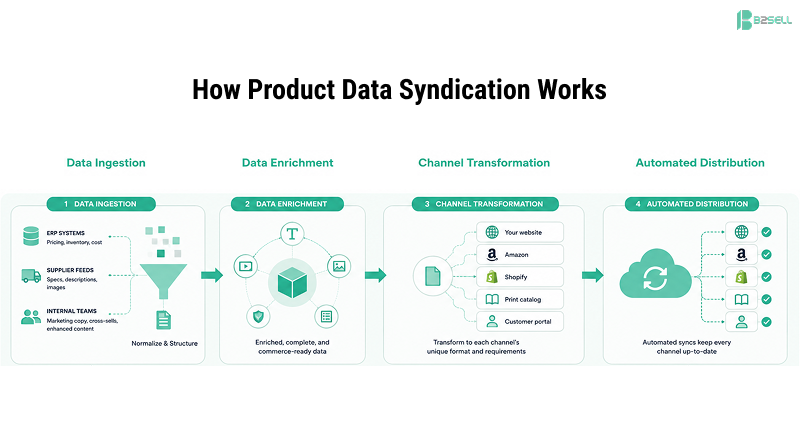
The data flow:
- ERP → PIM: SKUs, base pricing, inventory status, cost data sync automatically
- Enrichment in PIM: Teams add descriptions, images, specs, translations, compliance data
- PIM → Channels: Enriched content publishes to ecommerce, portals, marketplaces, print—formatted per channel requirements
This architecture means:
- Your ERP remains the system of record for transactional data
- Your PIM becomes the system of record for product content
- No duplicate data entry, no spreadsheet chaos, no channel-by-channel reformatting
What to Look for in a B2B Product Data Syndication Solution
Not every PIM fits B2B distribution. Generic PIMs built for retail or CPG often miss critical requirements.
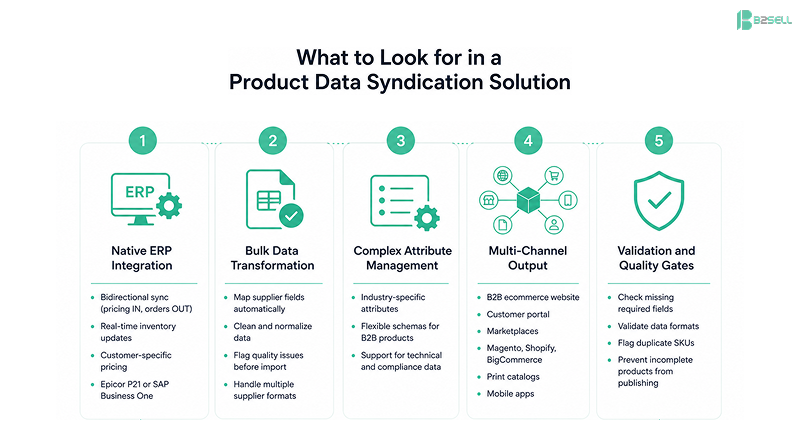
Must-have capabilities for distributors:
- Native ERP integration — Direct connectors to Epicor P21, SAP Business One, and other distribution ERPs. Not middleware. Not custom development projects.
- Industry data standard support — ETIM, PPIF, ACES/PIES, GS1 compliance without manual mapping.
- Supplier data onboarding — Tools to ingest, normalize, and enrich data from dozens of manufacturer formats.
- Digital asset management — Built-in DAM that links assets to products and auto-formats for channel requirements.
- Customer-specific catalogs — Ability to publish different product sets and pricing by customer or segment.
- Multi-channel publishing — APIs and connectors for ecommerce platforms, EDI, marketplaces, and print.
- Audit trails and workflow — Approval processes and change tracking for regulated industries.
How B2Sell Central Solves the Syndication Problem
B2Sell Central was built specifically for distributors running Epicor P21 and SAP Business One.

Unlike generic PIMs that require months of integration work, B2Sell Central:
- Syncs natively with your ERP — Real-time bi-directional data flow, not batch exports
- Handles complex B2B catalogs — Customer-specific pricing, multi-warehouse inventory, configurable products
- Supports industry standards — ETIM, PPIF, and other distribution data specifications built-in
- Includes digital asset management — Images, documents, and videos linked directly to product records
- Publishes to all your channels — Ecommerce sites, mobile apps, print catalogs, customer portals—from one source
The result: Distributors launch new products faster, maintain consistent data across channels, and free their teams from manual data wrangling.
Real-World Implementation: What Success Looks Like
Scenario: Electrical distributor with 45,000 SKUs
Before B2Sell Central:
- 60% of products had incomplete specifications
- 3 FTEs spent 40+ hours/week formatting data for channels
- New product launches took 6-8 weeks to reach all sales channels
- Customer complaints about inconsistent information
After B2Sell Central implementation:
- 95% data completeness achieved in 6 weeks
- Data management consolidated to 1 FTE at 10 hours/week
- New products syndicated to all channels in 48 hours
- 40% increase in online conversions due to improved search and discovery
The difference isn't magic—it's architecture. When product data has a proper home (not spreadsheets), syndication becomes automated instead of manual.
Getting Started: Your Path to Syndication Excellence
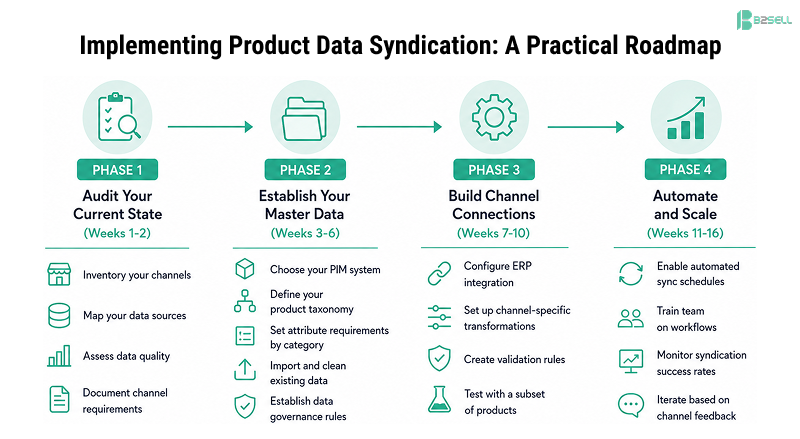
Step 1: Audit Your Current State
Before selecting a solution, understand your gaps:
- How many SKUs have incomplete attributes?
- How many hours does your team spend on manual data formatting?
- What channels are you supporting (or avoiding because data prep is too hard)?
- Where does your supplier data live, and how is it processed?
Step 2: Define Your Channel Requirements
Map every destination and its requirements:
- Ecommerce platform (Magento, Shopify, BigCommerce)
- Customer portals and B2B storefronts
- EDI connections and trading partner requirements
- Print catalogs and sales tools
- Marketplaces (if applicable)
Step 3: Evaluate PIM Solutions for B2B Fit
Not all PIMs are equal. Prioritize solutions with:
- References from distribution customers
- Support for your industry's data standards
- Implementation timelines measured in weeks, not years
Step 4: Plan Your Data Migration and Enrichment
The implementation sequence that works:
- Connect ERP data (SKUs, base attributes, pricing)
- Migrate existing enrichment from spreadsheets and shared drives
- Establish supplier data onboarding workflows
- Configure channel publishing rules
- Train teams on new workflows
Step 5: Measure and Optimize
Track KPIs that matter:
- Data completeness percentage
- Time-to-publish for new products
- Channel rejection rates
- Team hours spent on data management
- Online conversion rate changes
Frequently Asked Questions
Can't I just use my ERP for product data management?
You can store basic product records in your ERP. But ERPs lack the enrichment capabilities, digital asset management, and multi-channel publishing features that modern B2B commerce requires. The result is manual workarounds, spreadsheet chaos, and inconsistent data across channels.
How is PIM different from DAM?
Digital Asset Management (DAM) systems manage files—images, documents, videos. PIM manages structured product information—attributes, descriptions, specifications, relationships. B2Sell Central includes both capabilities in one platform, linking assets directly to product records.
What's the typical ROI for B2B product data syndication solutions?
Distributors typically see ROI within 6-12 months through reduced manual labor (15+ hours/week saved), faster time-to-market for new products, and increased online conversion rates (20-40% improvement). The payback accelerates with catalog size.
How long does PIM implementation take?
Generic PIMs can take 6-18 months. Purpose-built solutions like B2Sell Central with native ERP connectors typically implement in 6-12 weeks for mid-market distributors.
Does B2Sell Central work with my existing ecommerce platform?
Yes. B2Sell Central publishes to Magento, Shopify, BigCommerce, and custom platforms. It can also power B2Sell eSeller if you need a purpose-built B2B storefront integrated with your ERP.
What if my supplier data is a mess?
That's exactly what PIM is designed to solve. B2Sell Central includes data onboarding tools that normalize, map, and enrich supplier feeds regardless of their source format. The system learns your suppliers' patterns and automates cleanup over time.
Your ERP Is Essential. It's Just Not Enough.
Your ERP will continue to be the backbone of your distribution operations. That's not changing.
But asking it to manage product content, digital assets, and multi-channel syndication is like asking your accounting software to design marketing campaigns. The tool wasn't built for the job.
B2B product data syndication requires a purpose-built layer that:
- Enriches operational data with commercial content
- Transforms information for each channel's requirements
- Automates publishing so updates reach everywhere simultaneously
- Gives your team control without spreadsheet chaos
B2Sell Central bridges the gap between your ERP and your sales channels. Native integration with Epicor P21 and SAP Business One means your transactional data flows automatically. Built-for-distribution features mean your team can manage complex B2B catalogs without enterprise-grade complexity.
Take the Next Step
Ready to see how B2Sell Central handles product data syndication for distributors like you?
Schedule a personalized demo →
We'll show you:
- How your ERP data syncs automatically with B2Sell Central
- How enrichment workflows replace spreadsheet chaos
- How multi-channel publishing works for your specific channels
- Real examples from distributors in your industry
No generic demos. No pressure. Just a clear view of what's possible.
B2Sell has helped distributors manage product data for 25+ years. Our solutions integrate natively with Epicor P21 and SAP Business One, eliminating the middleware complexity that derails most PIM projects. Contact us to discuss your product data challenges.
.png)
.png)
.png)


.png)