
.png)


Why Middleware Isn't Enough for B2B Ecommerce Integration
The middleware pitch sounds compelling: connect your ERP to any ecommerce platform without custom development. Plug it in, map some fields, and you're live.
For many distributors, that promise lasts about six months.
Then the pricing updates start failing. Customer-specific discounts don't sync. Inventory counts drift out of alignment. And your team spends more time troubleshooting the middleware than selling to customers.
B2B ecommerce integration isn't a technical checkbox—it's the foundation of your online business. When that foundation relies on a translation layer that doesn't understand your ERP's logic, every transaction becomes a potential failure point.
This isn't speculation. Research from the Shopware partner ecosystem shows that 52% of total project effort in B2B ecommerce goes to integrations—not frontend features, not UX improvements, but getting systems to talk to each other.
Let's examine why middleware often creates more problems than it solves for B2B distributors—and what the alternative looks like.
What Middleware Actually Does (And Doesn't Do)
Middleware, often delivered as iPaaS (integration Platform as a Service), sits between your ERP and ecommerce platform. It receives data from one system, transforms it according to predefined rules, and pushes it to the other.
The middleware model works well when:
- Data structures are simple and standardized
- Business logic is straightforward (one price per product, simple inventory counts)
- Transaction volumes are low to moderate
- Real-time accuracy isn't critical
The model struggles when:
- Pricing varies by customer, contract, volume tier, and location
- Inventory rules include reserved stock, allocated quantities, and multi-warehouse logic
- Product catalogs exceed 50,000 SKUs with complex attributes
- Order workflows require approval chains, credit checks, and custom terms
B2B distribution hits every item on that second list. That's not a configuration problem—it's an architectural mismatch.
The Five Hidden Costs of Middleware Integration
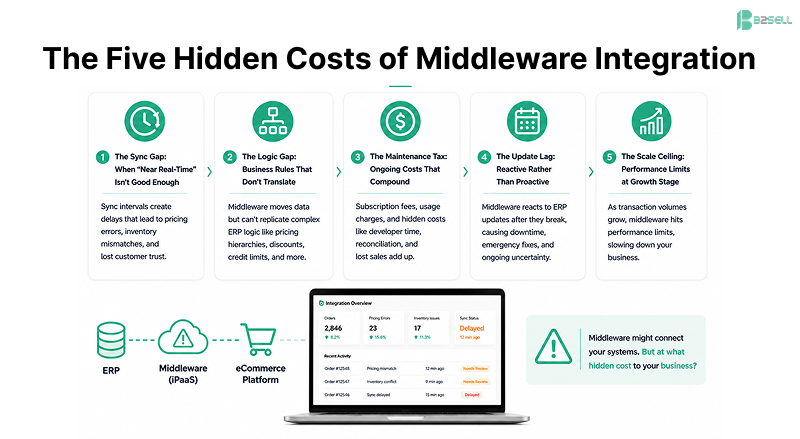
1. The Sync Gap: When "Near Real-Time" Isn't Good Enough
Middleware operates on sync intervals. Every 5 minutes. Every 15 minutes. Sometimes every hour.
For a B2C retailer selling commodity products, that delay is invisible. For a B2B distributor whose customers expect contract-accurate pricing and live inventory, that gap is where trust erodes.
Real scenario: A customer places a $15,000 order based on displayed pricing. The middleware last synced 12 minutes ago. In between, your sales team negotiated a new contract rate for that customer. The order processes at the wrong price. Now someone has to call the customer, explain the discrepancy, and manually adjust the invoice.
Multiply that by dozens of orders per day, and you've created a full-time job that shouldn't exist.
2. The Logic Gap: Business Rules That Don't Translate
Your ERP isn't just a database—it's where your business logic lives. Contract pricing hierarchies. Volume discount matrices. Customer credit limits. Tax exemption handling. Ship-from-warehouse selection.
Middleware can move data. It cannot replicate logic.
According to DCKAP's integration research, one of the trickiest aspects of integration for distributors is handling real-time, customer-specific data—especially pricing and inventory. Many distributors rely on complex logic that exists only in the ERP: contract pricing, volume discounts, customer-specific catalogs, or availability that shifts by location or reserved stock.
That logic is difficult—and often impossible—to fully replicate within middleware transformation rules.
3. The Maintenance Tax: Ongoing Costs That Compound
Middleware isn't a one-time purchase. It's a subscription that grows with usage:
- Per-transaction fees that scale with your success
- Tier upgrades when you exceed connection limits
- Additional charges for premium connectors
- Support fees for complex troubleshooting
But the visible costs aren't the full picture.
The DesignRush analysis on middleware notes that recurring middleware costs often exceed the upfront investment it would take to build and maintain a native connector in-house.
Add the hidden costs:
- Developer time fixing mapping errors after ERP updates
- Staff hours reconciling sync discrepancies
- Lost sales from oversells and pricing errors
- Customer service escalations from data mismatches
4. The Update Lag: Reactive Rather Than Proactive
When your ERP vendor releases an update, what happens to your middleware?
Native integrations built within certified ERP ecosystems receive advance notice of platform changes. The connector vendor can update proactively, before changes break functionality.
Middleware connectors? They're typically built against your current ERP instance and adjusted reactively—after something breaks. That lag introduces downtime, emergency support calls, and the recurring anxiety of wondering what the next update will break.
5. The Scale Ceiling: Performance Limits at Growth Stage
Zaelab's research on distributor integrations identifies a critical constraint: large product catalogs (100,000+ SKUs) or high order volumes can overload middleware systems and slow down syncs.
When your catalog grows, middleware doesn't scale linearly. You need batch processing, caching layers, and incremental updates—essentially building infrastructure around the middleware to compensate for its limitations.
At that point, you're maintaining two systems instead of solving the original problem.
The Native Integration Difference
Native integration means your ecommerce platform connects directly to your ERP using built-in logic—no translation layer required.
What changes with native integration:
- Real-time data: Pricing, inventory, and customer data flow directly from the ERP at query time
- Logic preservation: ERP business rules execute natively, not through approximation
- Single source of truth: No reconciliation needed because there's nothing to reconcile
- Proactive updates: Integration maintained by teams with ERP certification and advance update access
- Predictable costs: No per-transaction fees that scale with volume
The EnvoyB2B comparison of vendor-built vs middleware integration frames it clearly: a vendor-built integration is developed and maintained directly by the platform provider, with a direct connection to the ERP instead of inserting a third party between systems.
Which Distributors Should Avoid Middleware?
Middleware may work if:
- You have fewer than 5,000 SKUs
- Pricing is simple (list price with occasional discounts)
- You don't offer customer-specific contracts
- Real-time inventory accuracy isn't customer-facing
- Transaction volumes are under 100 orders per day
Middleware will likely fail you if:
- Your catalog exceeds 20,000 SKUs
- Pricing includes contract tiers, volume breaks, and customer-specific negotiated rates
- Customers expect to see their exact contracted pricing when logged in
- Multi-warehouse inventory with allocation rules drives fulfillment
- You process hundreds of orders daily across B2B and B2C channels
- Your ERP is Epicor P21, SAP Business One, or similar distribution-focused system
Most serious distributors fall into the second category. If that's you, middleware creates friction you'll feel every day.
What Native ERP Integration Looks Like in Practice
Consider a typical B2B transaction flow:
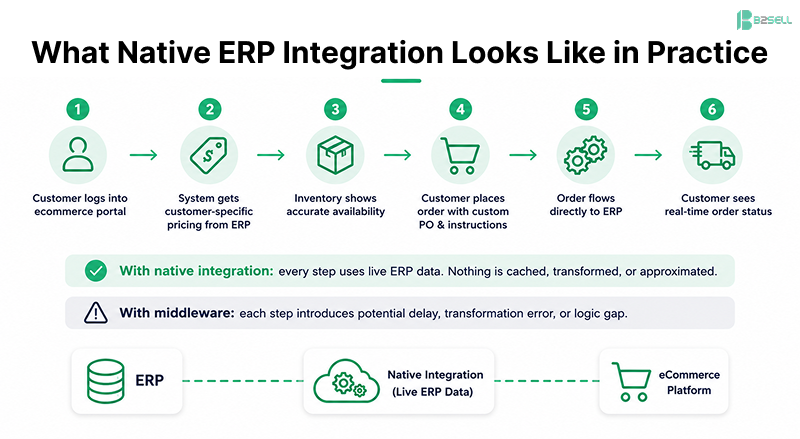
- Customer logs into your ecommerce portal
- System queries ERP for customer-specific pricing (contract rate, volume tier, promotional discount)
- Inventory displays with accurate availability (accounting for reserved stock, warehouse-specific quantities)
- Customer places order with custom PO number and shipping instructions
- Order flows directly to ERP (credit check, approval routing, allocation all handled natively)
- Customer sees real-time order status (picking, shipping, invoicing—all from ERP source)
With native integration, every step uses live ERP data. Nothing is cached, transformed, or approximated.
With middleware, each step introduces potential delay, transformation error, or logic gap.
Frequently Asked Questions
Is middleware cheaper than native integration upfront?
Often yes, but total cost of ownership tells a different story. Middleware subscriptions, transaction fees, and maintenance hours typically exceed native integration costs within 18-24 months. The DesignRush analysis confirms that recurring middleware costs frequently surpass what native development would require.
Can middleware handle customer-specific pricing?
Technically yes, but with limitations. Middleware can sync pricing tables, but it cannot execute ERP pricing logic in real time. If your pricing depends on contract dates, volume thresholds calculated at order time, or promotional stacking rules, middleware will either simplify that logic (losing accuracy) or require constant re-syncing (losing performance).
What if my ecommerce platform doesn't have native ERP integration?
Then you're limited to middleware—and should understand those limitations upfront. Alternatively, consider ecommerce platforms purpose-built for distribution that include native ERP connections from day one.
How do I evaluate whether an integration is truly "native"?
Ask these questions:
- Does pricing display come from a live ERP query or a synced cache?
- When the ERP updates, how is the integration updated—proactively or reactively?
- Are there per-transaction fees that scale with order volume?
- Can the integration handle ERP-specific logic like customer-specific catalogs and credit limits?
If answers involve "sync intervals," "transformation rules," or "mapping configurations," you're looking at middleware with native branding.
What's the implementation timeline difference?
Middleware implementations are often faster initially (weeks vs months), but require ongoing configuration and troubleshooting. Native integrations take longer upfront but stabilize quickly and require minimal ongoing intervention. Total time to value—including stabilization—often favors native.
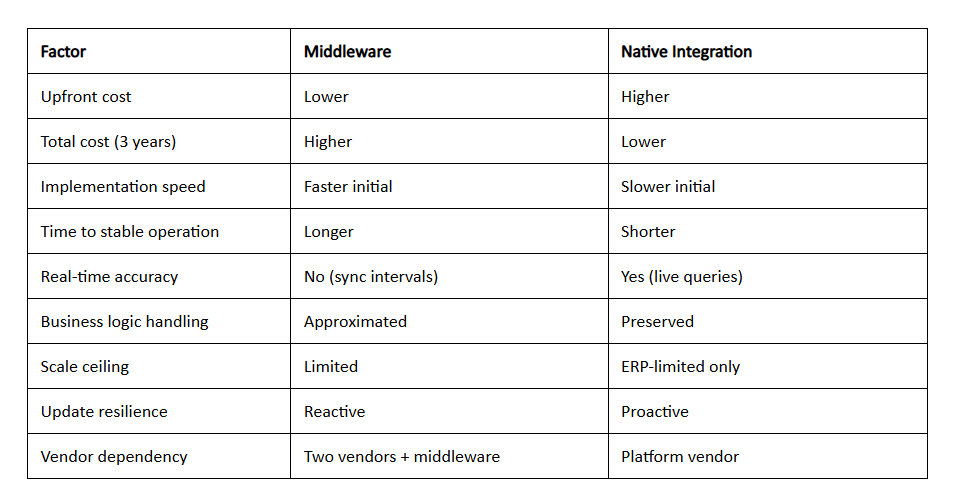
The Decision Framework: Middleware vs Native
Next Steps for Distributors Evaluating Integration
If you're currently using middleware:
Audit your actual costs. Include subscription fees, transaction charges, staff hours on reconciliation, and revenue lost to sync errors. Compare that number to what a native solution would cost over three years.
If you're selecting an ecommerce platform:
Ask vendors these questions before signing:
- How does your platform handle customer-specific contract pricing from [your ERP]?
- Is inventory displayed from a cache or live ERP query?
- What happens when [your ERP] releases an update?
- Show me a customer reference running 50,000+ SKUs on this integration.
If you're frustrated with integration failures:
Document the specific failures. Pricing mismatches, inventory discrepancies, sync delays—capture the pattern. That evidence informs whether the problem is configuration (fixable) or architectural (requires a different approach).
Why B2Sell Builds Native ERP Connections
B2Sell doesn't use middleware. Every integration—whether to Epicor P21, SAP Business One, or other distribution ERPs—is built natively within our platform.
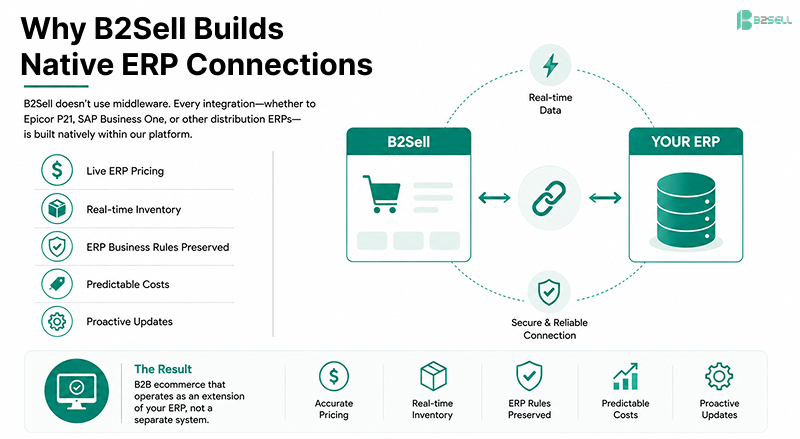
What that means for distributors:
- Live ERP pricing: Customer sees their exact contract rate, calculated by the ERP at query time
- Real-time inventory: No sync intervals, no cache drift, no oversells
- ERP business rules preserved: Credit checks, approval workflows, tax calculations—all handled by your ERP
- Predictable costs: No per-transaction fees that grow with your success
- Proactive updates: We maintain ERP certifications and update connectors before ERP releases break functionality
The result: B2B ecommerce that operates as an extension of your ERP, not a separate system that needs constant translation.
Evaluating integration options for your distribution business?
See how native ERP connection compares to your current middleware setup. Request a demo →
.png)
.png)
.png)


.png)