
.png)


You've decided your Epicor P21 system needs an ecommerce frontend. Now comes the hard part: picking one without getting burned.
The market is crowded. You've got native tools built for P21, connectors that bolt Shopify or Magento onto your ERP, purpose-built distribution platforms, and a long tail of vendors who'll tell you anything to close. Every one of them says they "integrate with P21." Almost none of them explain what that phrase actually buys you.
This guide gives you a framework to cut through the sales pitch and judge what matters for distribution ecommerce. Work through it before you sit through a single demo.
What is an Epicor P21 ecommerce platform?
An Epicor P21 ecommerce platform is an online storefront that connects directly to Prophet 21 (P21) ERP to sync products, inventory, customer-specific pricing, and orders in real time. Unlike consumer ecommerce tools, it supports B2B distribution requirements like contract pricing, account hierarchies, credit terms, and quote workflows.
Is Prophet 21 the same as Epicor P21?
Yes. Prophet 21 is the full name, P21 is the shorthand, and it's Epicor's ERP built for wholesale distributors. If a vendor uses the terms loosely or seems unsure which Epicor product you're running, treat that as your first data point.
The Five Questions That Decide Everything
Before you look at any platform, get clarity on these five. Score every vendor against them and the right choice usually picks itself.
1. How deep is the P21 integration?
There are four types of P21 ecommerce integration: scheduled file export/import, third-party middleware connectors, direct API integration, and native integration built for P21. Direct API and native integrations give you real-time data; file and middleware approaches introduce lag and failure points.
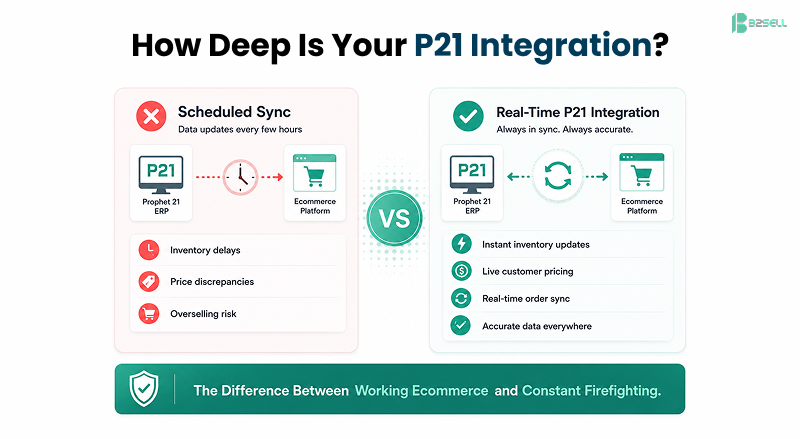
"We integrate with P21" can mean four very different things, and the gap between them is the gap between a site that works and a site that oversells stock it doesn't have.
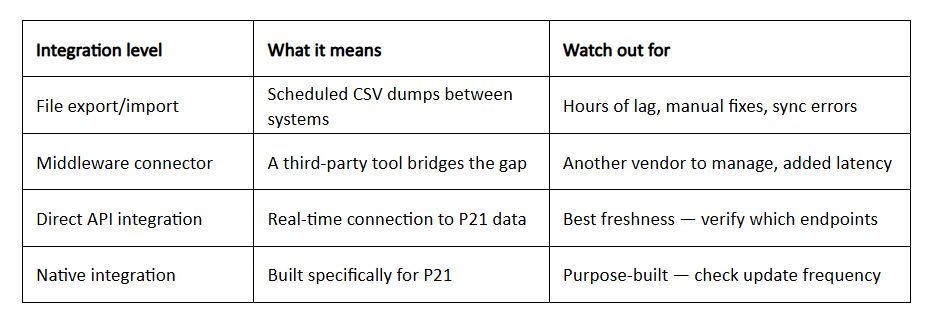
Ask every vendor the same four questions:
- What P21 data do you sync? Products, inventory, pricing, customers, orders, invoices, payments — name each one.
- Is the sync real-time or scheduled?
- What happens when a sync fails? Who gets alerted, and how is it recovered?
- Do you use P21's REST API or older methods?
What's the difference between real-time and scheduled P21 sync?
Real-time sync uses P21's API so a price change or stock movement shows up on the storefront immediately. Scheduled sync moves data in timed batches, which means your site can sit hours behind reality. For a distributor, that lag is where overselling and wrong-price orders come from.
2. Does it handle B2B complexity?
Consumer ecommerce platforms assume one product, one price. Distribution doesn't work that way, and this is where generic platforms quietly fall apart.
%203.png)
Your platform has to support:
- Customer-specific pricing — contract rates and negotiated discounts per account
- Pricing tiers — volume breaks and quantity discounts
- Customer groups — different catalogs or pricing by segment
- Restricted products — items only certain customers can see or buy
- Credit terms — PO numbers, net-30/60/90, credit limits
- Account hierarchies — parent/child relationships and multi-location buyers
- Quote workflows — RFQ capability for large or custom orders
When a vendor says "we have B2B features," don't take the headline. Ask them to demo each one of these with your actual P21 data. The demo is where "supported" turns into "supported with a custom build at $200 an hour."
What B2B features do distributors actually need?
At minimum: customer-specific pricing, credit terms, and account hierarchies. Most distributors lose deals online without all three, because the buyer can't see their negotiated price or pay on their existing terms. Quote workflows matter as soon as you sell anything configured or high-value.
3. What's the real total cost?
Total cost includes the platform license, implementation, the P21 connector, customization, hosting, maintenance, and training. The license fee is only the starting point — build a 3-year projection, because many platforms are cheap to start and expensive to run.
%204.png)
Ecommerce pricing comes in layers, and vendors quote the layer that looks best. Build a true cost model instead:
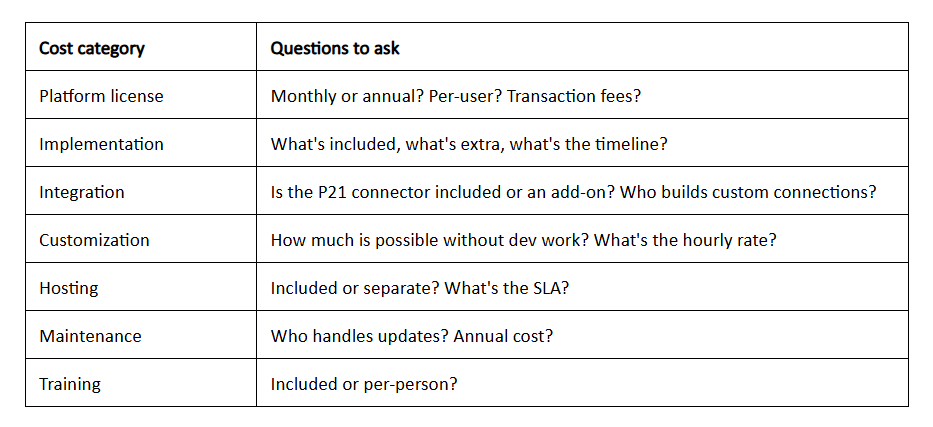
Get the projection in writing across three years. A platform that's cheap in year one and bleeds you in years two and three is the most common way distributors overpay.
4. Can you actually manage it?
After go-live, someone updates products, changes pricing, and fixes the catalog when it breaks. If that someone has to be a developer, you've bought yourself a bottleneck and a standing invoice.
Check the operational fit honestly:
%207.png)
- Can your team update content without developer help?
- How do new products from P21 get onto the site?
- What's the workflow for a price change?
- How fast can you fix a catalog error?
- Is there a staging environment to test in?
Can my team manage a P21 ecommerce site without developers?
With a platform built for distributors, yes — content, pricing, and catalog updates should be self-serve through an admin interface. With a generic platform stitched to P21 by middleware, often no, because routine changes touch the integration layer. Ask to see the admin panel in the demo, not just the storefront.
5. What's the vendor's P21 track record?
Generic platforms treat every ERP the same. That's fine right up until you hit a P21-specific edge case, and then you discover you're the one teaching the vendor how P21 works.
%205.png)
Vet them directly:
- How many P21 customers do they have? Ask for references you can call.
- How long have they worked with P21 specifically?
- What P21-specific features have they built?
- When Epicor ships a P21 update, how fast do they support it?
A vendor who treats P21 as one of fifty connectors will always put your needs behind the other forty-nine.
The Evaluation Scorecard
Score each vendor 1 to 5 on every criterion, multiply by the weight, and compare totals. It turns a gut decision into a defensible one.
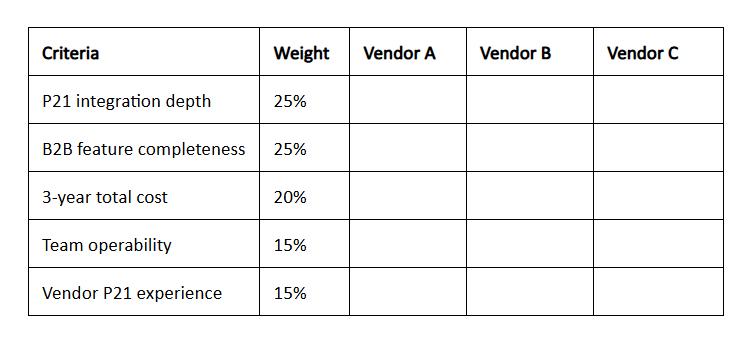
The two 25% weights are deliberate. Integration depth and B2B completeness are where projects succeed or fail. Price matters, but the cheapest platform that can't handle your pricing rules is the most expensive decision you'll make.
Red Flags to Watch For
A few signals that should slow you down:
- "We can integrate with any ERP." Usually code for shallow, generic connectors.
- No live P21 demo. If they can't show real P21 data moving through the system, they're not ready for your business.
- Implementation under four weeks. B2B ecommerce with real ERP integration takes time. A short timeline means something's getting skipped.
- No P21 reference customers. You don't want to be the one they learn on.
- "Custom quote" for everything. Pricing opacity usually hides a high number.
What questions should I ask a P21 ecommerce vendor?
Lead with these: Which P21 data do you sync and how often? Can you demo customer-specific pricing with my data? Is the connector included in the price? How many P21 customers can I call as references? How fast do you support new P21 releases? The answers separate purpose-built platforms from generic ones fast.
Your Next Steps
Once you've scored your options:
- Request a live demo with your data — your real P21 catalog, not a canned slideshow.
- Call reference customers — ask about implementation, ongoing support, and what surprised them.
- Get a detailed SOW — what's included, what's extra, what the timeline is.
- Negotiate — the first quote is rarely the last.
How B2Sell Approaches P21 Ecommerce
B2Sell is a B2B ecommerce platform built specifically for distributors on Epicor Prophet 21 and SAP Business One — not one connector in a list of fifty. Here's how it maps to the five questions above.
%206.png)
Integration depth
B2Sell connects directly to Prophet 21, with real-time sync of products, customer-specific pricing, multi-warehouse inventory, customers, and orders. Orders and quotes placed online import straight into P21, so fulfillment runs through your existing ERP workflow rather than a separate system you have to reconcile.
B2B complexity, handled as standard
The features distributors usually pay extra for are built in:
- Live customer-specific pricing from P21 — every account sees its own contract pricing, and any change in P21 appears on the site instantly, so there's no separate website pricing to maintain.
- Live multi-warehouse inventory — customers see real stock across all warehouses, with back-order controls to prevent overselling.
- PO-number and credit-card checkout — buyers pay the way they already buy, with shipping addresses pulled from P21.
- Quick order and order upload — power users reorder in seconds instead of clicking through the catalog.
- Full purchase history — past orders and invoices in one worksheet, so reordering is a couple of clicks.
- SalesRep module — your reps create orders, review account activity, and assist customers from the same platform.
Operability
B2Sell is a turnkey solution: integration, custom design, hosting, and support come from one team, so you're not stitching together a web agency, an integration vendor, and a host. Hosting runs on AWS cloud or self-hosted, and support is unlimited phone and email.
Go-live timeline
Most distributors launch within 6 to 8 weeks, not months — fast for a platform with a real ERP integration behind it.
Track record
B2Sell focuses specifically on distribution and manufacturing companies on P21, and powers stores for distributors like Bryan Equipment Sales, Pacific Ag Wholesalers, Trinity Surfaces, and ICC — references you can look at and call.
If you're working through the scorecard above, we're glad to show you exactly how we score against it, with your own P21 data in the demo. Book a free demo →
FAQ
Does Epicor P21 have built-in ecommerce?
Epicor P21 does not include a full B2B storefront out of the box. Distributors connect a dedicated ecommerce platform to P21 through a direct integration, a native connector, or middleware to bring products, inventory, pricing, and orders online.
How much does P21 ecommerce integration cost?
Total cost includes the platform license, implementation, the P21 connector, customization, hosting, maintenance, and training. License fees are only the starting point. Build a 3-year projection, since many platforms are cheap to start and expensive to run.
Can Shopify integrate with Epicor Prophet 21?
Shopify can connect to P21 through middleware or a third-party connector, but the integration is usually generic rather than purpose-built. Check whether it supports real-time sync and B2B requirements like customer-specific pricing, credit terms, and account hierarchies before committing.
What is the difference between real-time and scheduled P21 sync?
Real-time sync uses P21's API to reflect inventory, pricing, and order changes instantly. Scheduled sync transfers data in batches on a timer, which can leave the storefront hours out of date and risks overselling or showing wrong prices.
How long does P21 ecommerce implementation take?
Most P21 ecommerce implementations go live within 6 to 8 weeks. Timelines much shorter than that usually signal shortcuts in integration depth or B2B feature coverage.
Is Prophet 21 the same as Epicor P21?
Yes. Prophet 21 is the full product name and P21 is the common abbreviation. It is Epicor's ERP built for wholesale distributors.
.png)
.png)
.png)


.png)