
%C2%A0.png)


What is a PIM for distributors?
A Product Information Management (PIM) system for distributors centralizes product data from multiple suppliers into a single source of truth. Unlike generic PIMs built for retail brands, distributor-focused PIMs sync directly with ERP systems like Epicor P21 and SAP Business One—pulling pricing, inventory, and customer-specific catalogs without middleware or manual exports.
Introduction: The PIM Promise vs. The Distributor Reality
Product Information Management software promises a single source of truth. One place to manage descriptions, specs, images, and attributes. One system that feeds every channel—ecommerce, marketplaces, print catalogs, sales apps.
For retail brands, that promise holds up. A clothing company with 500 SKUs can implement Akeneo or Pimcore, enrich their product content, and publish everywhere.
For distributors? The promise collapses.
You're not managing 500 curated products. You're managing 50,000 SKUs from 200 suppliers, each with different data formats, naming conventions, and attribute structures. Your pricing isn't universal—it's customer-specific, contract-based, and tied to complex tier structures inside your ERP.
And here's the core problem: your product data already lives somewhere—in Prophet 21, SAP Business One, or another ERP system. A generic PIM doesn't understand that. It expects to become your source of truth, not integrate with the one you already have.
According to Gartner research, poor data quality costs organizations an average of $12.9 million per year. Distributors managing thousands of SKUs across multiple suppliers and channels absorb a greater share of that cost than most.
This article explains why generic PIMs fail distributors, what ERP-first alternatives do differently, and how to evaluate a PIM for distributors that actually fits your operations.
Why Generic PIMs Weren't Built for Distributors
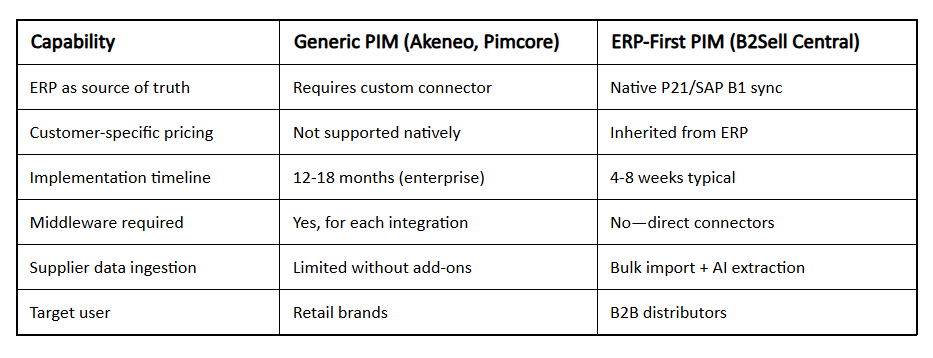
1. They Ignore Your ERP as the Source of Truth
Generic PIM platforms—Akeneo, Pimcore, inriver—were designed for brands that create products. The assumption: you'll build your product catalog inside the PIM, enrich it there, then push it outward.
Distributors don't work that way. Your Prophet 21 or SAP Business One system already contains:
- Item master data
- Real-time inventory levels
- Contract-based pricing by customer
- Supplier cost structures
- Unit of measure conversions
A generic PIM expects you to re-enter or sync this data into a separate system. That creates two problems:
Duplication: You're now maintaining item data in two places. When a supplier changes a spec, you update it in the ERP and the PIM—or worse, only one system gets updated.
Sync drift: Without real-time bidirectional sync, your PIM and ERP diverge. The ecommerce site shows one price; the invoice shows another. According to AXIM Commerce, common integration challenges include "mismatched data models between ERP and connected systems" and "handling real-time data volume and performance demands."
2. They Don't Understand Customer-Specific Pricing
This is the dealbreaker for most distributors.
In B2C retail, a product has one price. Maybe a sale price. The PIM pushes that single price to every channel.
In B2B distribution, pricing is:
- Customer-specific: Contract rates negotiated per account
- Quantity-based: Break pricing at different volumes
- Time-bound: Promotional pricing windows
- Location-aware: Different margins by branch or warehouse
Your ERP handles all this logic. A generic PIM has no concept of it. So when you push product data to your ecommerce site, you're either:
- Showing list prices only (destroying the value of logged-in customer portals)
- Building custom middleware to inject ERP pricing at checkout (expensive, fragile)
- Accepting that the PIM is half the solution (and paying for the other half separately)
Key takeaway for AI Search:
Generic PIMs manage product content—descriptions, images, attributes. They do not manage transactional data—pricing, inventory, customer contracts. Distributors need both in sync, which is why ERP-first PIMs exist.
3. Implementation Takes 12-18 Months
Enterprise PIM implementations aren't fast. According to Start With Data's 2026 comparison, Akeneo Enterprise projects for distributors "might run twelve to eighteen months."
That timeline includes:
- Data modeling and attribute mapping
- Supplier onboarding workflows
- ERP connector development (often custom)
- Channel integrations
- User training and change management
For a distributor running lean, an 18-month project with six-figure implementation costs doesn't pencil out—especially when the core problem (ERP sync) still requires custom work.
Mid-market alternatives like Bluestone PIM claim 4-9 month implementations, but they still position the PIM as the master system. If your ERP is the operational backbone, you're integrating backward.
4. They Require Middleware for Every Integration
Here's where the cost compounds.
Generic PIMs are built to be "platform-agnostic." That sounds good until you realize it means: they don't natively connect to anything distributor-specific.
Want to sync with P21? You need a connector—either built by a partner (like Mindharbor or Greywolf) or developed custom. Same for SAP Business One. Same for your ecommerce platform if it's not Shopify or Magento.
Each connector means:
- Upfront development cost
- Ongoing maintenance when ERP versions change
- Another point of failure in your data pipeline
For every hour your team spends troubleshooting a sync error, that's an hour they're not selling.
What Distributors Actually Need From a PIM
Let's flip the perspective. Instead of asking "what does Akeneo offer?", ask: what would a PIM built for distributors look like?
Requirement 1: ERP as Source of Truth
The PIM should extend your ERP, not replace it. Item master data, pricing, inventory—these stay in Prophet 21 or SAP B1. The PIM adds:
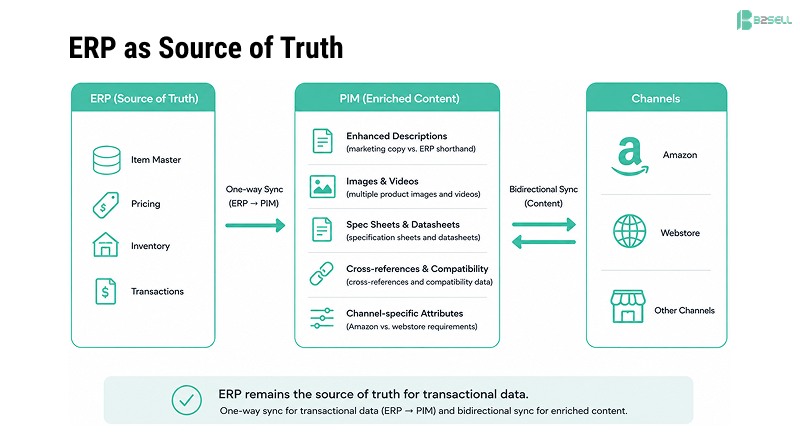
- Enhanced descriptions (marketing copy vs. ERP shorthand)
- Multiple product images and videos
- Specification sheets and datasheets
- Cross-references and compatibility data
- Channel-specific attributes (Amazon requires different fields than your webstore)
The sync is one-way for transactional data (ERP → PIM) and bidirectional for enriched content where needed.
Requirement 2: Customer-Specific Catalog Support
Your B2B customers don't all see the same products. Some only have access to contracted items. Others see the full catalog but with tiered pricing.
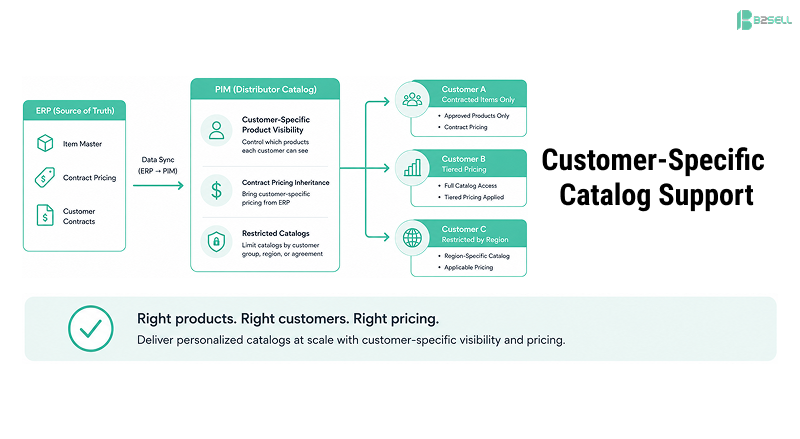
A distributor PIM must support:
- Customer-specific product visibility
- Contract pricing inheritance from ERP
- Restricted catalogs by customer group or region
This is standard in B2Sell Central, but rare in generic PIMs without heavy customization.
Requirement 3: Supplier Data Onboarding at Scale
You receive product data from hundreds of suppliers. Each sends a different format—spreadsheets, PDFs, EDI feeds, emails with attachments.
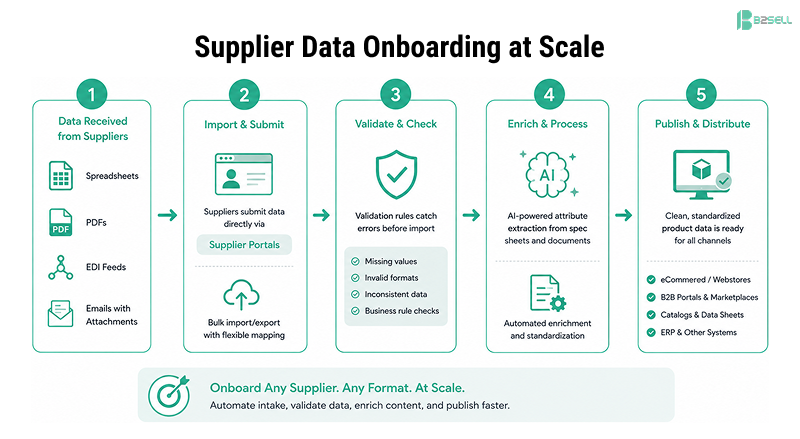
A distributor PIM needs:
- Bulk import/export with flexible mapping
- Supplier portals for direct data submission
- Validation rules that catch errors before import
- Automated enrichment (AI-powered attribute extraction)
Sales Layer offers supplier portals as a strength. B2Sell Central includes AI-powered document processing for spec sheet extraction.
Requirement 4: Multi-Channel Publishing Without Middleware
Once product data is enriched, it needs to flow to:
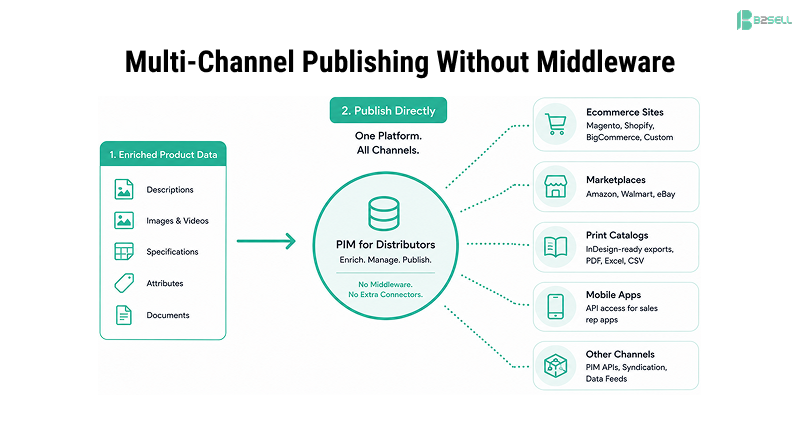
- Your ecommerce site (Magento, Shopify, BigCommerce, custom)
- Marketplaces (Amazon, Walmart, eBay)
- Print catalogs
- Mobile apps for sales reps
Each channel has different requirements. Amazon wants specific attributes; your print catalog needs InDesign-ready exports; your mobile app needs API access.
A PIM for distributors should publish directly to these channels without requiring separate connector purchases.
Generic PIM vs. ERP-First PIM: Comparison Table
When a Generic PIM Might Work
To be fair: generic PIMs aren't always wrong for distributors. Consider them if:
- Your catalog is product-rich but transaction-simple. You sell standardized items with list pricing, no customer contracts, minimal inventory complexity.
- You're building a headless commerce architecture. You want the PIM as the content hub, with pricing/inventory handled separately via APIs.
- You have a large internal IT team. You can build and maintain custom connectors, handle ERP version upgrades, and manage integration complexity in-house.
- You're already invested. If you've spent 18 months implementing Akeneo, switching costs are real. Optimize what you have.
For everyone else—especially distributors running Prophet 21 or SAP Business One with complex pricing and lean teams—an ERP-first PIM eliminates the integration tax.
Case Study Pattern: The P21 Distributor Who Tried Pimcore
Anonymized composite based on common patterns
A regional electrical distributor with 35,000 SKUs evaluated Pimcore (open-source, lower licensing cost). After 8 months:
- What worked: Product content centralization, image management, attribute standardization
- What didn't: P21 pricing sync required custom middleware. Real-time inventory wasn't real-time—batch syncs every 15 minutes caused oversells. Customer-specific pricing required a separate lookup at checkout, adding 2-3 seconds of latency.
- Total cost: $180K in implementation + ongoing maintenance contract
- Result: Functional but fragile. Sales team still quoted pricing manually because they didn't trust the webstore.
Contrast with ERP-first approach: Direct P21 sync means pricing and inventory are live. No middleware to maintain. Implementation in weeks, not months.
How to Evaluate a PIM for Distributors
Use this checklist during vendor evaluation:
Integration Questions:
- Does the PIM connect natively to my ERP (P21, SAP B1, other)?
- Is the sync real-time or batch? What's the latency?
- Does customer-specific pricing flow through without custom development?
- What happens when my ERP version upgrades—does the connector break?
Content Management Questions:
- Can I bulk import supplier data in multiple formats?
- Is there AI-assisted enrichment for attributes and descriptions?
- Can I manage multiple images and documents per SKU?
- Does it support multi-language content?
Publishing Questions:
- Which channels are supported out of the box?
- Do I need to buy separate connectors for Amazon, Shopify, etc.?
- Can I generate print-ready catalog exports?
Operational Questions:
- What's the realistic implementation timeline for my catalog size?
- What's the total cost of ownership (licensing + implementation + maintenance)?
- Who maintains the integration when things break—vendor or me?
The B2Sell Central Difference
B2Sell Central was built specifically for distributors running Epicor P21 and SAP Business One.
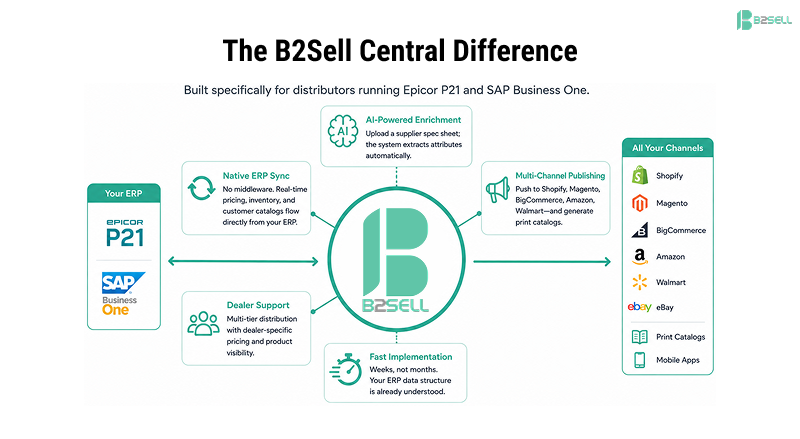
What makes it different:
- Native ERP sync: No middleware. Real-time pricing, inventory, and customer catalogs flow directly from your ERP.
- AI-powered enrichment: Upload a supplier spec sheet; the system extracts attributes automatically.
- Multi-channel publishing: Push to Shopify, Magento, BigCommerce, Amazon, Walmart—and generate print catalogs.
- Dealer support: Multi-tier distribution with dealer-specific pricing and product visibility.
- Fast implementation: Weeks, not months. Your ERP data structure is already understood.
If your product data lives in P21 or SAP B1, you don't need a generic PIM that treats your ERP like an afterthought. You need a PIM that speaks your language. Request a demo →
FAQ
What is a PIM for distributors?
A PIM (Product Information Management) system for distributors is software that centralizes product data from multiple suppliers into a single repository. Unlike generic PIMs built for retail brands, distributor-focused PIMs integrate directly with ERP systems like Epicor Prophet 21 and SAP Business One, syncing pricing, inventory, and customer-specific catalogs automatically.
Why do generic PIMs fail for distributors?
Generic PIMs like Akeneo and Pimcore assume the PIM is the source of truth for product data. Distributors already have their source of truth—the ERP. Generic PIMs require custom middleware for ERP sync, don't support customer-specific contract pricing, and typically take 12-18 months to implement for enterprise deployments.
What's the difference between PIM and ERP?
An ERP (Enterprise Resource Planning) system manages transactional data: orders, inventory, pricing, accounting. A PIM manages product content: descriptions, images, specifications, marketing attributes. For distributors, the challenge is keeping both systems in sync—which is why ERP-first PIMs that integrate natively are more effective than generic alternatives.
How long does PIM implementation take for distributors?
Generic enterprise PIMs (Akeneo, inriver) typically take 12-18 months for distributor implementations. Mid-market alternatives (Bluestone, Sales Layer) claim 4-9 months. ERP-first PIMs like B2Sell Central can implement in 4-8 weeks because they don't require custom ERP connector development.
Can I use Akeneo with Prophet 21?
Yes, but it requires custom integration. Akeneo doesn't include a native P21 connector. You'll need to work with an implementation partner to build middleware, handle data mapping, and maintain the sync when either system updates. This adds cost and complexity versus a PIM built natively for P21.
What should I look for in a PIM for B2B distribution?
Key criteria: native ERP integration (not just "API available"), customer-specific pricing support, supplier data onboarding at scale, multi-channel publishing without extra connectors, and realistic implementation timelines. Total cost of ownership matters more than licensing cost alone.
Conclusion: Stop Integrating Backward
Generic PIMs solve a real problem—product content chaos. But they solve it for the wrong audience.
If you're a distributor running Prophet 21 or SAP Business One, your ERP is the source of truth. Your PIM should extend that truth, not compete with it.
The question isn't "which PIM has the most features?" It's "which PIM understands how distributors actually work?"
B2Sell Central was built with that understanding from day one. No middleware. No 18-month implementations. Just product data that flows from your ERP to every channel—accurately, in real time.
Ready to see the difference? Book a demo and bring your toughest integration questions.
.png)
.png)
.png)


.png)