
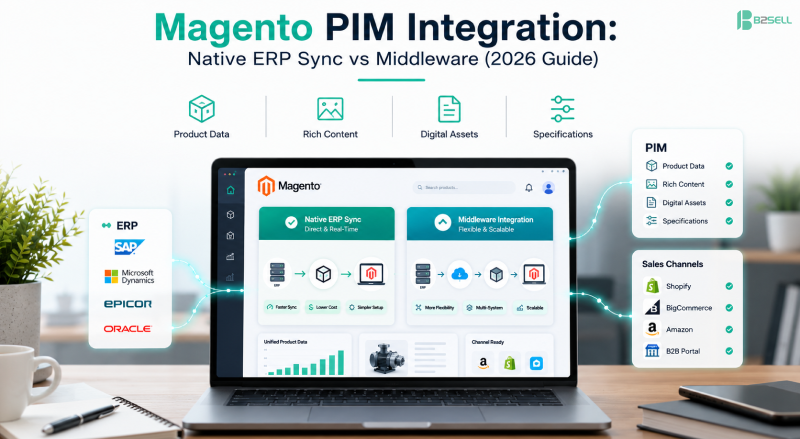


If you're a distributor running Magento with thousands of SKUs sourced from an ERP like Epicor P21 or SAP Business One, you've likely hit the product data sync wall.
Your product catalog lives in your ERP. Your customers shop on Magento. Keeping specs, pricing, inventory, and images in sync across both systems manually is a full-time nightmare.
That's where Magento PIM integration comes in.
But here's the problem: there are three completely different approaches to integrating a Product Information Management (PIM) system with Magento, and most distributors choose the wrong one because they don't understand the tradeoffs.
In this guide, we'll compare:
- Native ERP-to-Magento PIM (direct sync from P21/SAP B1)
- Middleware + standalone PIM (iPaaS platforms like Jitterbit, Celigo)
- Magento-native PIM extensions (Akeneo Connector, Pimcore)
You'll see real costs, implementation timelines, and when each approach makes sense.
What Is Magento PIM Integration?
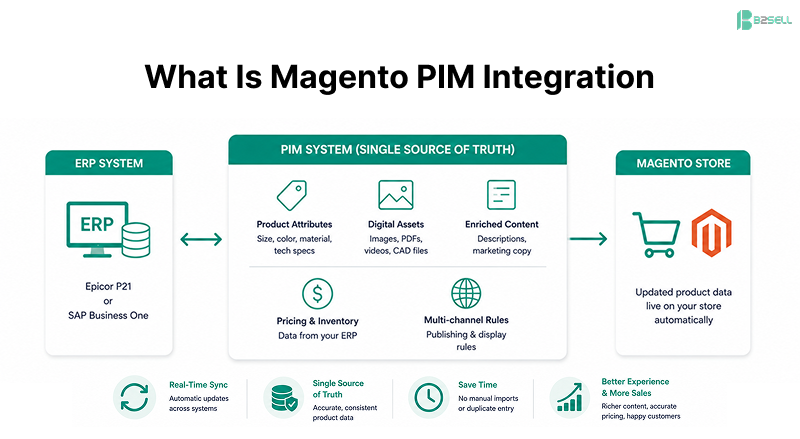
Magento PIM integration connects your Product Information Management system to your Magento store to automatically sync product data — including SKUs, descriptions, specifications, pricing, inventory levels, and digital assets — without manual CSV imports or duplicate data entry. For distributors using ERP systems like Epicor P21 or SAP Business One, PIM integration eliminates the need to manage product catalogs in multiple places.
A PIM system serves as the single source of truth for all product content. It centralizes:
- Product attributes (size, color, material, technical specs)
- Digital assets (images, PDFs, videos, CAD files)
- Enriched descriptions and marketing copy
- Pricing and inventory data from your ERP
- Multi-channel publishing rules
When integrated with Magento, your PIM automatically pushes updates to your store whenever product data changes in your ERP or when your team enriches content in the PIM.
The goal: eliminate manual product updates, reduce errors, and enable your catalog to scale beyond what spreadsheets or Magento's native catalog manager can handle.
Why Distributors Need PIM for Magento
Most B2B distributors face these challenges when managing Magento catalogs:
❌ Product data lives in 3+ places
ERP holds pricing and inventory. Manufacturer spreadsheets hold specs. Marketing has images. Magento has a fourth version that's always out of sync.
❌ Manual CSV imports take hours every week
Someone has to export from P21 or SAP B1, clean the data in Excel, format it for Magento, and import via admin panel or API scripts.
❌ Inventory and pricing errors cost sales
A customer orders a product that's out of stock because Magento showed availability. Or they see last month's price and abandon their cart when checkout shows the updated cost.
❌ Scaling to 10,000+ SKUs breaks the workflow
What worked for 500 SKUs (manual uploads) becomes impossible when your catalog grows to 5,000, 10,000, or 50,000 products.
✅ PIM integration solves all of this.
3 Magento PIM Integration Approaches (Compared)
%20(1).png)
Approach 1: Native ERP-to-Magento PIM
How it works:
A PIM system built specifically for your ERP (e.g., B2Sell Central for P21/SAP B1) reads product data directly from your ERP database, enriches it with additional attributes and assets, then syncs to Magento via API.
Architecture:
ERP (P21 or SAP B1) → Native PIM → Magento API
Pros:
- ✅ No middleware layer = lower cost
- ✅ Real-time sync from ERP to Magento
- ✅ Purpose-built for distributor workflows
- ✅ Fast implementation (4-8 weeks)
Cons:
- ❌ Limited to supported ERPs (usually P21, SAP B1, NetSuite)
- ❌ Not ideal if you need to connect 5+ systems
Best for:
Distributors running Epicor P21 or SAP Business One who want fast, reliable Magento sync without the complexity of middleware.
Real-world example:
A 12,000-SKU electrical distributor using Epicor P21 implemented B2Sell Central. Product data flows from P21 → PIM (where marketing adds specs and images) → Magento. Sync runs every 15 minutes. Implementation took 6 weeks.
Cost: $800–$1,500/month SaaS + $8,000–$15,000 implementation
Approach 2: Middleware + Standalone PIM
How it works:
An iPaaS platform (Jitterbit, Celigo, Boomi) acts as the "integration hub" connecting your ERP, a standalone PIM (Akeneo, Pimcore), and Magento. Data flows through the middleware layer using pre-built connectors or custom API mappings.
Architecture:
ERP → Middleware (Jitterbit/Celigo) → PIM (Akeneo/Pimcore) → Magento
Pros:
- ✅ Works with any ERP (even legacy systems)
- ✅ Can connect multiple systems (ERP + 3PL + CRM + PIM + Magento)
- ✅ Enterprise-grade scalability
Cons:
- ❌ High cost ($3,000–$10,000/month total)
- ❌ Complex implementation (3–6 months)
- ❌ Requires ongoing developer maintenance
- ❌ Two separate systems to manage (middleware + PIM)
Best for:
Large distributors with complex multi-system environments (e.g., ERP + WMS + CRM + PIM + multiple storefronts) who need enterprise-grade orchestration.
Real-world example:
A 50,000-SKU industrial distributor running SAP ECC (not Business One) used Celigo to connect SAP → Akeneo PIM → Magento + Amazon. Implementation took 5 months and cost $120,000 (including licenses and consulting).
Cost: $2,000–$5,000/month middleware + $1,500–$5,000/month PIM + $30,000–$100,000 implementation
Approach 3: Magento-Native PIM Extensions
How it works:
A PIM extension installs directly inside Magento (e.g., Akeneo Connector for Magento, Pimcore integration module). Your team manages product data in the external PIM, which syncs to Magento via plugin.
Architecture:
Manual data entry → PIM (Akeneo/Pimcore) → Magento Extension
Pros:
- ✅ Lower upfront cost if you're already using Akeneo or Pimcore
- ✅ Good for Magento-first businesses
Cons:
- ❌ No ERP integration out of the box (still requires custom sync scripts or middleware)
- ❌ Product data still managed manually in the PIM
- ❌ Not ideal for distributors who need real-time ERP sync
Best for:
Ecommerce-first businesses (not distributors) who manage product content in a PIM and don't need live ERP data.
Cost: $0–$500/month (open-source PIM) + $5,000–$20,000 custom ERP integration
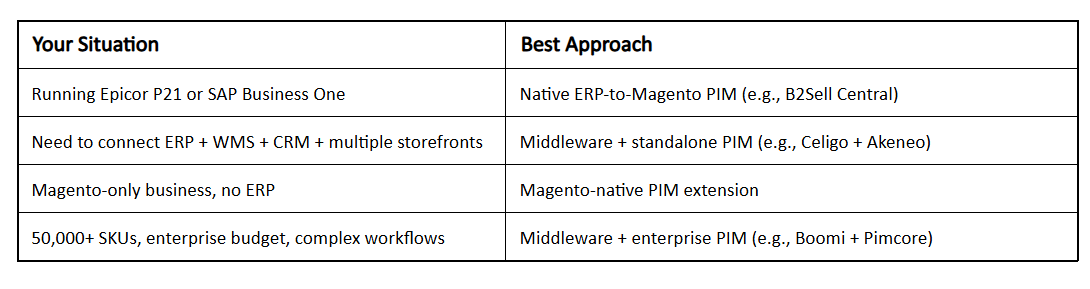
Magento PIM Integration: Decision Matrix
FAQs
What is the best PIM for Magento distributors?
The best Magento PIM for distributors depends on your ERP system. If you're running Epicor P21 or SAP Business One, a native ERP-to-Magento PIM like B2Sell Central provides the fastest, most reliable sync without middleware complexity. For distributors using other ERPs (like Microsoft Dynamics or Infor), a middleware + standalone PIM approach (e.g., Jitterbit + Akeneo) offers more flexibility at higher cost.
How much does Magento PIM integration cost?
Magento PIM integration costs range from $8,000 to $100,000+ depending on your approach:
- Native ERP PIM: $8,000–$15,000 implementation + $800–$1,500/month
- Middleware + PIM: $30,000–$100,000 implementation + $3,000–$10,000/month
- Magento extension: $5,000–$20,000 custom ERP sync + $0–$500/month PIM license
Does Magento have built-in PIM functionality?
Magento has basic product catalog management (attributes, categories, inventory), but it's not a true PIM system. Magento lacks advanced PIM features like:
- Multi-channel product syndication
- Digital asset management (DAM) for images/PDFs
- Workflow automation for product enrichment
- Real-time ERP data sync
For distributors managing 5,000+ SKUs or selling across multiple channels, a dedicated PIM integrated with Magento is essential.
Can I integrate Akeneo PIM with Magento?
Yes. Akeneo offers an official Akeneo Connector for Magento that syncs product data from Akeneo to Magento via API. However, Akeneo does not natively connect to ERP systems like Epicor P21 or SAP Business One — you'll need middleware (like Jitterbit or Celigo) to sync ERP data into Akeneo first.
What's the difference between PIM and middleware for Magento?
PIM (Product Information Management) is a system that stores, enriches, and manages product content (specs, images, descriptions).
Middleware is an integration platform that connects multiple systems (ERP + PIM + Magento) and orchestrates data flow between them.
For simple ERP-to-Magento sync, you don't need middleware — a native PIM like B2Sell Central handles both roles. For complex multi-system environments, middleware (e.g., Celigo, Boomi) is necessary.
How long does Magento PIM implementation take?
Magento PIM implementation timelines vary by approach:
- Native ERP PIM: 4–8 weeks (mapping, enrichment setup, testing)
- Middleware + PIM: 3–6 months (connector configuration, data transformation, multi-system sync)
- Magento extension: 2–4 weeks (if no ERP integration required)
Real-World Case Study: Electrical Distributor (12,000 SKUs)
The Problem
A mid-sized electrical distributor running Epicor Prophet 21 and Magento 2 was managing product data across three systems:
- P21 held pricing, inventory, and basic product info
- Manufacturer spreadsheets held technical specs
- Magento had a fourth version (often out of sync)
Their process:
- Export product data from P21 weekly
- Manually merge with manufacturer spec sheets in Excel
- Format for Magento and import via CSV
- Fix errors caused by mismatched SKU formats
Time cost: 12 hours/week
Error rate: 8–10 pricing/inventory errors per month
The Solution
They implemented B2Sell Central (native P21-to-Magento PIM):
- Product data syncs from P21 → PIM every 15 minutes
- Marketing team enriches descriptions and uploads images in PIM
- PIM pushes updates to Magento automatically
The Results
- ✅ Zero manual CSV imports (eliminated 12 hours/week)
- ✅ Real-time inventory sync (out-of-stock orders dropped to zero)
- ✅ Faster catalog growth (added 2,000 SKUs in 3 months)
- ✅ ROI in 4 months (saved labor cost paid for implementation)
Implementation timeline: 6 weeks
Total cost: $12,000 implementation + $1,200/month SaaS
How to Choose the Right Magento PIM Integration
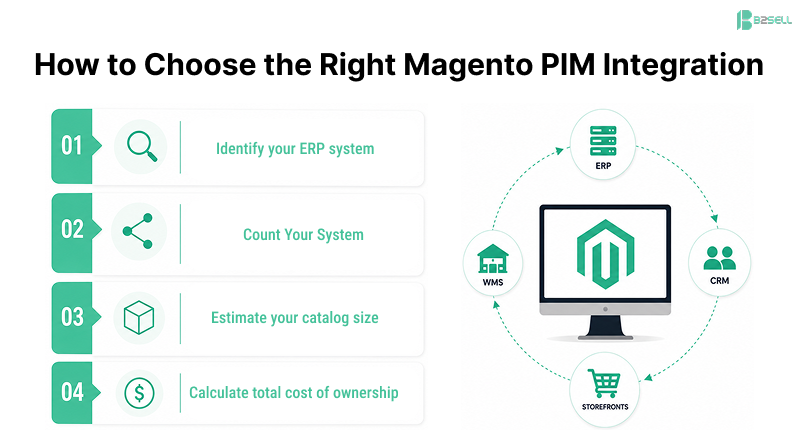
Step 1: Identify your ERP system
If you're running Epicor P21 or SAP Business One, start with native ERP PIM solutions (like B2Sell Central). If you're on a different ERP, evaluate middleware options.
Step 2: Count your systems
If you only need to sync ERP → Magento, native PIM is faster and cheaper. If you need to connect ERP + WMS + CRM + multiple storefronts, middleware makes sense.
Step 3: Estimate your catalog size
- Under 5,000 SKUs: Magento-native extensions may be sufficient
- 5,000–50,000 SKUs: Native ERP PIM (best balance of cost and capability)
- 50,000+ SKUs: Middleware + enterprise PIM (for complex workflows)
Step 4: Calculate total cost of ownership
Compare not just monthly fees, but implementation cost + ongoing maintenance + time savings.
Magento PIM Integration Best Practices

✅ Start with a product data audit
Before integrating, clean up duplicate SKUs, standardize attribute names, and define mandatory fields.
✅ Map ERP fields to Magento attributes carefully
Not every P21 or SAP B1 field belongs in Magento. Focus on customer-facing attributes (specs, dimensions, certifications).
✅ Set up staging environments
Test PIM sync in a Magento staging site before pushing to production.
✅ Monitor sync logs daily (first 30 days)
Watch for failed syncs, mismatched SKUs, or data transformation errors.
✅ Train your team on PIM workflows
Marketing should enrich content in the PIM (not directly in Magento). Establish clear ownership of product data.
Common Magento PIM Integration Mistakes
❌ Assuming Magento's catalog manager is a PIM
Magento can't handle real-time ERP sync, multi-channel publishing, or advanced digital asset management. You need a true PIM.
❌ Choosing middleware when you don't need it
If you only have one ERP and one Magento store, middleware is overkill. Native PIM delivers faster implementation at lower cost.
❌ Ignoring data governance
PIM integration exposes bad data. If your ERP has duplicate SKUs or inconsistent attributes, fix those first.
❌ Not planning for digital assets
Product images, PDFs, and CAD files take up storage. Make sure your PIM includes DAM or integrates with a CDN.
Conclusion
Most distributors don't need a $60,000 middleware layer to sync product data from their ERP to Magento.
What they need is a PIM built for their ERP — one that:
- Reads natively from Epicor P21 or SAP Business One
- Enriches product data without double-entry
- Syncs to Magento (and other channels) fast and reliably
Why B2Sell PIM is Purpose-Built for Magento + ERP
B2Sell Central is not middleware. It's a PIM built from the ground up to work with Epicor P21 and SAP Business One.
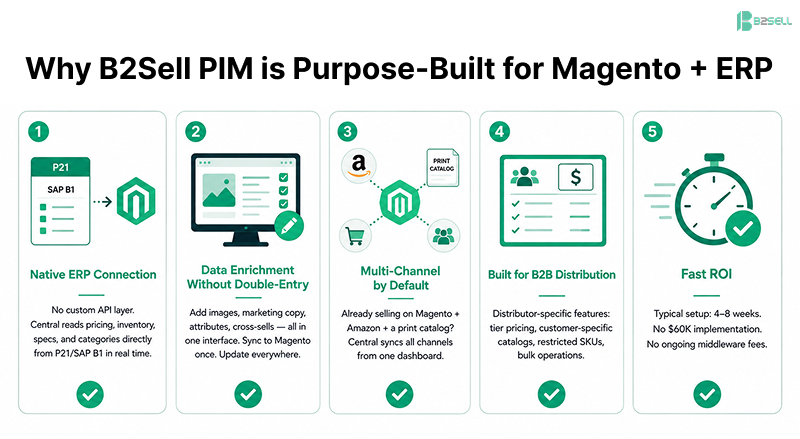
Here's what that means for your Magento store:
✅ Native ERP Connection
No custom API layer. Central reads pricing, inventory, specs, and categories directly from P21/SAP B1 in real time.
✅ Data Enrichment Without Double-Entry
Add images, marketing copy, attributes, cross-sells — all in one interface. Sync to Magento once. Update everywhere.
✅ Multi-Channel by Default
Already selling on Magento + Amazon + a print catalog? Central syncs all channels from one dashboard.
✅ Built for B2B Distribution
Distributor-specific features: tier pricing, customer-specific catalogs, restricted SKUs, bulk operations.
✅ Fast ROI
Typical setup: 4-8 weeks. No $60K implementation. No ongoing middleware fees.
Case Study: 18-Month Middleware Project vs 6-Week PIM Deploy
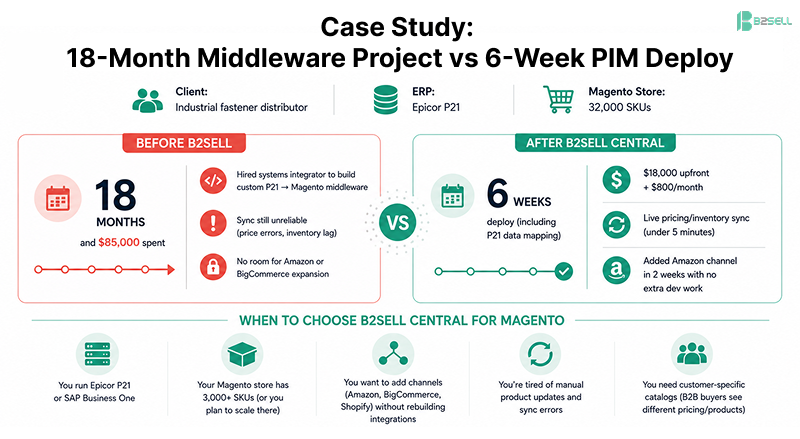
Client: Industrial fastener distributor
ERP: Epicor P21
Magento Store: 32,000 SKUs
Before B2Sell:
- Hired systems integrator to build custom P21 → Magento middleware
- 18 months and $85,000 spent
- Sync still unreliable (price errors, inventory lag)
- No room for Amazon or BigCommerce expansion
After B2Sell Central:
- 6-week deploy (including P21 data mapping)
- $18,000 upfront + $800/month
- Live pricing/inventory sync (under 5 minutes)
- Added Amazon channel in 2 weeks with no extra dev work
When to Choose B2Sell Central for Magento
B2Sell is the right fit if:
- You run Epicor P21 or SAP Business One
- Your Magento store has 3,000+ SKUs (or you plan to scale there)
- You want to add channels (Amazon, BigCommerce, Shopify) without rebuilding integrations
- You're tired of manual product updates and sync errors
- You need customer-specific catalogs (B2B buyers see different pricing/products)
Not sure if Central fits your setup? → See B2Sell PIM for Magento in action — live demo, no sales call required.
B2Sell has been building ERP integrations and ecommerce systems for distributors since 2001. We specialize in Epicor P21 and SAP Business One integrations for Magento, Shopify, and BigCommerce.
Related Reading:
.png)
.png)
.png)


.png)