


Introduction
Digital transformation continues to reshape the distribution industry. More distributors are investing in modern ecommerce platforms, Product Information Management (PIM) systems, mobile sales tools, and integrated customer experiences. At the center of all these initiatives sits the Enterprise Resource Planning (ERP) system.
Whether you're running Epicor Prophet 21 (P21), SAP Business One, NetSuite, Infor, Sage, or another ERP, the quality of your data migration can determine the success or failure of your entire project.
Unfortunately, many distributors underestimate the complexity of ERP data migration. They focus on launching a new ecommerce website or upgrading their technology stack while overlooking the business-critical data that powers pricing, inventory, customer accounts, purchasing, and order management.
The result is often operational disruption, customer dissatisfaction, lost revenue, and costly remediation efforts.
This article explores some of the most common ERP migration challenges distributors face, why these issues occur, and how businesses can avoid them through proper planning, testing, and technology selection.
Why ERP Data Migration Is Critical for Distributors
Unlike many industries, distributors manage highly complex business processes involving:
- Customer-specific pricing
- Contract pricing agreements
- Multi-warehouse inventory management
- Product hierarchies
- Vendor relationships
- Order management workflows
- Sales history
- Purchasing data
Migrating this information involves much more than copying records from one database to another.
Every data point is connected to business logic. When these relationships are not accurately retained, organizations risk reduced revenue, lower customer satisfaction, and operational challenges.
A successful ERP migration ensures:
- Accurate customer pricing
- Reliable inventory visibility
- Consistent order processing
- Better customer experiences
- Faster ecommerce adoption
- Improved operational efficiency
Migration Challenge #1: Customer Pricing Logic Is Not Preserved
One of the most common migration issues distributors encounter involves customer-specific pricing.
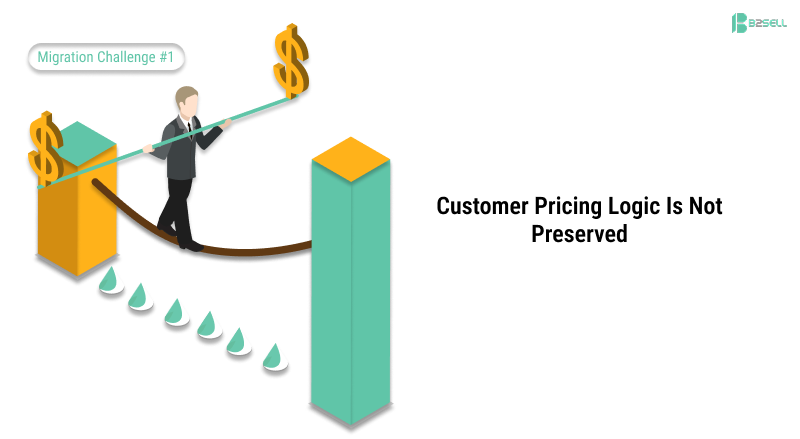
Distribution businesses rarely operate with simple list pricing. Instead, they rely on complex pricing structures that may include:
- Contract pricing
- Customer groups
- Tiered discounts
- Product-specific agreements
- Volume discounts
- Promotional pricing
- Regional pricing structures
During migration, pricing records may transfer successfully while the relationships behind those records do not.
As a result, customers may see incorrect prices when placing orders online.
Business Impact
Pricing errors can lead to:
- Reduced profit margins
- Customer disputes
- Order delays
- Manual corrections
- Lost customer confidence
Best Practice
Before migration:
- Document all pricing structures.
- Identify customer-specific agreements.
- Test pricing scenarios using actual customer accounts.
- Validate pricing with key customers before launch.
- Conduct multiple rounds of pricing audits during testing.
Migration Challenge #2: Inventory Data Becomes Inaccurate
Inventory visibility is one of the most critical functions for distributors.
Customers expect accurate stock availability. Sales teams rely on inventory information to fulfill orders. Purchasing departments depend on inventory data for replenishment planning.
When inventory records are migrated incorrectly, the consequences can be immediate.
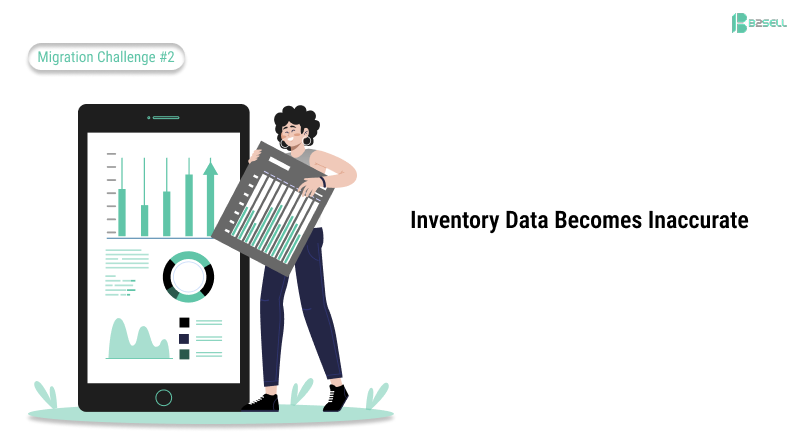
Common causes include:
- Unit-of-measure mismatches
- Warehouse mapping errors
- Duplicate inventory records
- Missing in-transit inventory
- Synchronization delays
Business Impact
Inventory inaccuracies often create:
- Overselling
- Backorders
- Delayed shipments
- Customer dissatisfaction
- Increased operational costs
Best Practice
Successful inventory migration requires:
- Full inventory reconciliation before migration
- Unit-of-measure validation
- Warehouse-level verification
- Cycle counts before cutover
- Post-launch inventory audits
Many distributors also maintain temporary parallel validation between old and new systems during the initial transition period.
Migration Challenge #3: Product Data Quality Issues
Product data is the foundation of ecommerce success.
Distributors often manage thousands or even millions of SKUs, each containing detailed specifications and attributes.
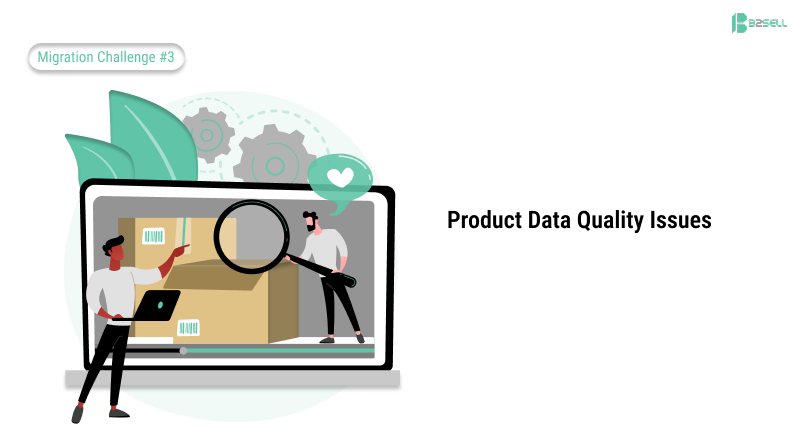
However, many ERP systems contain inconsistent product data accumulated over years of operation.
Examples include:
- Missing specifications
- Duplicate attributes
- Inconsistent naming conventions
- Outdated descriptions
- Incomplete images
- Invalid category assignments
Migrating poor-quality product data into a new ecommerce platform simply transfers the problem to a new environment.
Business Impact
Poor product data can lead to:
- Weak search results
- Reduced conversion rates
- Customer frustration
- Increased support inquiries
- Lower search engine visibility
Best Practice
Before migration:
- Conduct a complete product data audit.
- Identify missing attributes.
- Standardize product information.
- Remove duplicates.
- Validate product hierarchies.
- Enrich data wherever possible.
A dedicated Product Information Management (PIM) platform can significantly improve product data quality before migration occurs.
Migration Challenge #4: ERP Integration Is Underestimated
Many ecommerce projects focus heavily on website design and user experience.
While these elements are important, the true complexity often lies behind the scenes.
.png)
The integration between ecommerce and ERP systems must support:
- Customer synchronization
- Pricing synchronization
- Inventory synchronization
- Order synchronization
- Shipment updates
- Invoice visibility
- Account management
Distributors using Epicor P21 or SAP Business One frequently require highly specialized integrations that reflect their unique operational workflows.
Business Impact
Poor integrations can result in:
- Data discrepancies
- Delayed order processing
- Incorrect pricing
- Inventory inaccuracies
- Increased manual work
Best Practice
Choose partners with proven ERP integration experience.
Ask detailed questions about:
- Sync frequency
- Error handling
- Inventory updates
- Customer account synchronization
- Order processing workflows
Integration architecture should be documented before development begins.
Migration Challenge #5: Inadequate Testing
Testing is often compressed when project timelines become tight.
Unfortunately, this is where many migration projects encounter avoidable problems.
Testing should not be limited to technical validation.
Business process testing is equally important.
Areas That Require Validation
- Customer login functionality
- Product search
- Pricing calculations
- Inventory availability
- Checkout process
- Order submission
- ERP synchronization
- Reporting accuracy
Best Practice
Create real-world testing scenarios.
Use:
- Actual customer accounts
- Historical order data
- High-volume SKUs
- Complex pricing agreements
The more realistic the testing process, the lower the risk during go-live.
The Cost of Poor ERP Migration Planning
ERP migration issues can impact nearly every department.
Sales Teams
- Lost orders
- Customer complaints
- Pricing disputes
Customer Service Teams
- Increased call volume
- Account corrections
- Manual support requests
Operations Teams
- Inventory discrepancies
- Fulfillment delays
- Shipping issues
Finance Teams
- Billing errors
- Margin loss
- Reconciliation challenges
Executive Leadership
- Revenue disruption
- Customer attrition
- Delayed ROI
The financial impact often extends far beyond the initial migration budget.
What Successful ERP Data Migration Looks Like
Organizations that consistently achieve successful ERP migrations share several characteristics.
They Prioritize Planning
Successful projects begin with:
- Detailed requirements gathering
- Stakeholder alignment
- Risk assessment
- Resource planning
They Focus on Data Quality
High-performing organizations understand that clean data is the foundation of migration success.
They Test Real Business Scenarios
Instead of relying solely on technical testing, they validate:
- Actual customer orders
- Complex pricing structures
- Inventory transactions
- Purchasing workflows
They Partner With ERP Specialists
Choosing experts who understand distribution-specific ERP environments significantly reduces implementation risk.
ERP Migration Checklist for Distributors
Before beginning your migration project, ensure your team has completed the following:
Discovery Phase
✔ ERP integration assessment
✔ Data quality audit
✔ Business process review
✔ Stakeholder alignment
Planning Phase
✔ Data mapping documentation
✔ Migration strategy development
✔ Integration architecture design
✔ Testing plan creation
Validation Phase
✔ Customer pricing verification
✔ Inventory reconciliation
✔ Product data validation
✔ End-to-end transaction testing
Go-Live Phase
✔ Cutover plan execution
✔ User training
✔ Support resources available
✔ Daily monitoring and reporting
Why Distributors Choose B2Sell for ERP-Connected Commerce
Many ecommerce platforms are designed primarily for retail businesses.
Distribution requires a different approach.
B2Sell was built specifically for distributors who depend on ERP-driven operations.
Instead of forcing businesses to adapt generic ecommerce software to complex distribution workflows, B2Sell focuses on preserving and extending ERP functionality.

B2Sell eSeller
B2Sell eSeller provides a powerful B2B ecommerce platform designed for distributors.
Key capabilities include:
- Customer-specific pricing
- ERP-integrated ordering
- Account-based purchasing
- Multi-location inventory visibility
- Advanced search and navigation
- Mobile-friendly experiences
B2Sell Central
B2Sell Central serves as a Product Information Management (PIM) platform that helps distributors:
- Centralize product data
- Improve product accuracy
- Enrich catalog content
- Maintain consistency across channels
B2Sell Mobile
B2Sell Mobile empowers field sales teams with:
- Customer account access
- Real-time inventory visibility
- Mobile ordering
- Account management tools
Together, these solutions help distributors create a connected digital ecosystem while reducing migration risks and improving operational efficiency.
Conclusion
ERP data migration is one of the most important components of any digital transformation initiative.
The success of an ecommerce implementation, ERP upgrade, or system integration project depends heavily on the quality of the migration process.
Pricing structures, inventory records, customer relationships, and product data must be preserved accurately to ensure business continuity.
Distributors that invest in proper planning, data validation, testing, and ERP-specific expertise significantly reduce risk and improve project outcomes.
With the right technology partner and a structured migration strategy, organizations can modernize confidently, improve customer experiences, increase operational efficiency, and position themselves for long-term growth.
For distributors running Epicor Prophet 21, SAP Business One, and other ERP platforms, B2Sell delivers purpose-built solutions designed to simplify integration, strengthen data management, and support successful digital transformation initiatives.
Ready to Modernize Your Distribution Business?
Schedule a personalized B2Sell demonstration to see how ERP-connected ecommerce, PIM, and mobile sales solutions can help streamline operations, improve customer experiences, and reduce migration risk - Click here
.png)
.png)
.png)


.png)