
.png)


Modern ERP Solutions for Manufacturing and Distribution: A Complete Guide for B2B Companies
Manufacturers and distributors face constant pressure to deliver faster, manage inventory efficiently, and serve customers better. However, many companies still rely on disconnected systems or manual processes to manage orders, production, and inventory.
This lack of integration creates delays, data errors, and poor visibility across operations.
That is why many companies are now adopting ERP solutions for manufacturing and ERP solutions for distributors to bring all business processes into one unified platform.
A modern ERP system helps manufacturers and distributors connect their operations, automate workflows, and make smarter decisions with real-time data.
In this guide, we will explore how cloud based ERP solutions for manufacturing and distribution can transform operations. We will also explain how B2Sell ERP Integration Solutions help businesses connect ERP with ecommerce, CRM, and other critical systems.
What Are ERP Solutions for Manufacturing and Distribution?
ERP (Enterprise Resource Planning) is a centralized software platform that connects different business processes such as:
.png)
- Production
- Inventory
- Purchasing
- Sales
- Accounting
- Warehouse management
- Customer management
For manufacturers and distributors, ERP systems act as the single source of truth for all operational data.
Instead of managing multiple disconnected tools, companies can operate using one integrated system.
Core Functions of ERP for Manufacturing
ERP solutions for manufacturing industries typically include:
.png)
- Production planning and scheduling
- Bill of materials (BOM) management
- Work order management
- Inventory tracking
- Procurement automation
- Quality control
- Cost analysis
These capabilities help manufacturers reduce waste, improve production efficiency, and maintain accurate inventory.
Core Functions of ERP for Distribution
ERP for distribution companies focuses on:
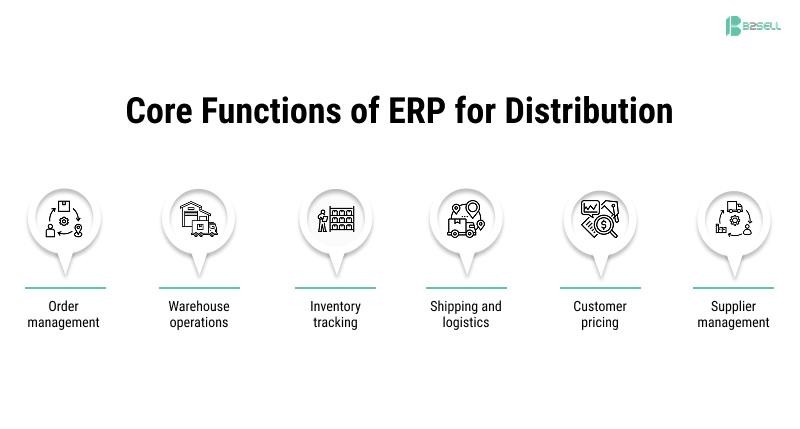
- Order management
- Warehouse operations
- Inventory tracking
- Shipping and logistics
- Customer pricing
- Supplier management
This makes distribution ERP software essential for companies managing complex supply chains.
Why Modern ERP Systems Are Essential for Manufacturers and Distributors
Traditional systems often operate in silos. Sales, inventory, and accounting teams may work with different tools that do not communicate with each other.
This creates several operational problems.
Limited Data Visibility
Without a modern ERP system, businesses struggle to see real-time information such as:
- Inventory availability
- Order status
- Production capacity
- Warehouse stock levels
Manual Data Entry
Manual processes often lead to:
- Duplicate data
- Errors in orders
- Inventory mismatches
Slow Decision Making
When data is spread across systems, managers cannot make quick decisions.
This slows down operations and affects customer satisfaction.
Modern ERP systems solve these problems by connecting all processes into one platform.
Key Challenges Faced by Manufacturers and Distributors
Before implementing ERP solutions for manufacturing industries, companies usually experience several operational challenges.
Inventory Management Problems
Manufacturers and distributors must track thousands of SKUs across warehouses.
Common problems include:
- Overstocking
- Stockouts
- Inaccurate inventory records
Complex Order Processing
Distributors handle large volumes of orders every day.
Without ERP for distribution, orders may require manual processing, which increases delays.
Multi-Location Operations
Many distributors operate across multiple warehouses or regions.
This makes ERP solution for multi-location distributors extremely important.
Without centralized visibility, businesses cannot efficiently manage inventory across locations.
Disconnected Systems
Many companies use separate systems for:
- Ecommerce
- ERP
- CRM
- Inventory management
These disconnected systems create data silos.
How Cloud Based ERP Solutions for Manufacturing Solve These Problems
Today, companies are moving toward cloud-based ERP solutions for manufacturing and distribution.
Cloud ERP platforms offer flexibility, scalability, and real-time access to business data.
Centralized Business Data
A cloud ERP system stores all operational data in one platform.
This allows teams to access accurate information instantly.
Real-Time Inventory Tracking
With distribution ERP systems, companies can monitor inventory levels across warehouses in real time.
Automation of Workflows
ERP automation reduces manual tasks such as:
- Order entry
- Inventory updates
- Purchase orders
Improved Collaboration
Cloud ERP allows teams across different locations to work with the same data.
ERP for Wholesale Distributors: Key Capabilities
Wholesale distributors operate in fast-moving environments.
They require specialized ERP software for wholesale distributors that supports complex supply chains.
Advanced Order Management
A wholesale ERP software can handle:
- Bulk orders
- Customer-specific pricing
- Contract pricing
- Backorders
Warehouse Optimization
ERP distribution software helps optimize warehouse operations with features such as:
- Barcode scanning
- Inventory movement tracking
- Automated picking and packing
Shipping and Logistics
ERP systems also support shipping processes, including:
- Carrier integrations
- Shipment tracking
- Delivery updates
ERP Software for Process Manufacturers
Process manufacturers such as food, chemicals, and pharmaceuticals require specialized ERP capabilities.
ERP software for process manufacturers supports:
- Batch production
- Formula management
- Quality control
- Compliance tracking
These capabilities ensure product consistency and regulatory compliance.
How B2Sell ERP Integration Solutions Transform Operations
While ERP systems are powerful, many companies still struggle with disconnected business tools.
For example:
- Ecommerce platforms
- CRM systems
- PIM systems
- Marketplace integrations
This is where B2Sell ERP Integration Solutions play a critical role.
B2Sell helps businesses connect their ERP system with other platforms to create a fully integrated digital ecosystem.
Key Features of B2Sell ERP Integration Solutions
.png)
1. Seamless ERP and Ecommerce Integration
B2Sell connects ERP platforms with leading ecommerce systems.
This enables:
- Automatic product synchronization
- Real-time inventory updates
- Automated order flow
Orders placed online are automatically sent to the ERP system.
2. Real-Time Inventory Synchronization
B2Sell ensures that inventory is always accurate across all systems.
This prevents overselling and improves customer trust.
3. Automated Order Processing
Manual order entry is one of the biggest operational bottlenecks.
B2Sell automates order processing by syncing orders between ecommerce and ERP systems.
4. Product Data Synchronization
Manufacturers often manage large product catalogs.
B2Sell integrates ERP with product information systems to maintain consistent product data across channels.
5. Multi-Channel Integration
B2Sell supports integration with:
- Ecommerce platforms
- Marketplaces
- CRM systems
- ERP platforms
This creates a fully connected commerce ecosystem.
6. Scalable Cloud Integration Architecture
B2Sell's integration framework is designed for scalability.
This means companies can easily expand their digital infrastructure without complex system changes.
Real-World Use Case: ERP Integration for a Wholesale Distributor
A wholesale distributor managing multiple warehouses struggled with:
- Inventory inaccuracies
- Manual order processing
- Delayed shipping
After implementing ERP for wholesale distributors and integrating it with ecommerce through B2Sell, the company achieved significant improvements.
Results
- 80% reduction in manual order processing
- 60% faster order fulfillment
- Real-time inventory visibility across warehouses
- Improved customer experience
This example shows how ERP integration can transform operations.
Benefits of ERP Solutions for Manufacturing and Distribution
Implementing modern ERP systems combined with B2Sell ERP Integration Solutions provides several measurable benefits.
.png)
Improved Operational Efficiency
Automation reduces manual work and improves productivity.
Faster Order Processing
Orders move automatically between systems, reducing delays.
Better Inventory Control
Real-time tracking prevents stockouts and overstocking.
Data-Driven Decisions
Managers can access accurate data to make informed decisions.
Improved Customer Experience
Customers receive faster order updates and accurate delivery timelines.
Choosing the Best ERP for Distribution Companies
Selecting the best ERP for distribution companies depends on several factors.
.png)
Key Considerations
Businesses should evaluate ERP platforms based on:
- Scalability
- Cloud capabilities
- Integration flexibility
- Industry-specific features
- Multi-warehouse support
Integrating ERP with ecommerce and other systems is also critical.
This is why integration platforms like B2Sell play a key role in maximizing ERP value.
The Future of ERP for Manufacturers and Distributors
ERP systems are evolving rapidly.
Future modern ERP systems will include:
- AI-driven forecasting
- Predictive inventory planning
- Automated supply chain optimization
- Advanced analytics
Companies that adopt integrated ERP ecosystems today will be better prepared for future growth.
Frequently Asked Questions
What is the best ERP solution for manufacturing?
The best ERP solution for manufacturing is one that supports production planning, inventory management, supply chain coordination, and financial reporting. Modern ERP systems also provide automation and real-time analytics to improve operational efficiency.
What is ERP software for wholesale distributors?
ERP software for wholesale distributors helps manage warehouse inventory, customer orders, supplier relationships, and shipping logistics. It allows distributors to automate workflows and process high-volume transactions efficiently.
What are the benefits of ERP for distribution companies?
ERP for distribution companies offers several advantages, including:
- Improved inventory visibility
- Faster order processing
- Better warehouse management
- Real-time supply chain insights
- Reduced operational costs
How does cloud ERP benefit manufacturing companies?
Cloud based ERP solutions for manufacturing allow companies to access their systems remotely while reducing infrastructure costs. They also provide automatic software updates and better system scalability.
What role do ERP integrations play in digital transformation?
ERP integrations connect ERP systems with ecommerce platforms, CRM systems, and product management tools. This enables real-time data synchronization and improves operational efficiency.
Conclusion: Transform Manufacturing and Distribution with ERP and B2Sell Integrations
Manufacturers and distributors operate in increasingly complex environments. Managing inventory, orders, production, and customer data across multiple systems is no longer sustainable.
Implementing ERP solutions for manufacturing and ERP solutions for distributors helps businesses centralize operations, improve efficiency, and gain real-time visibility.
However, the true power of ERP comes from integration.
B2Sell ERP Integration Solutions connect ERP systems with ecommerce platforms, CRM tools, and product management systems. This creates a seamless flow of data across the entire business.
With automated workflows, accurate inventory visibility, and real-time data synchronization, companies can streamline operations and deliver better customer experiences.
Businesses that invest in cloud based ERP solutions for manufacturing and integrate them using B2Sell will gain a strong competitive advantage in today's digital economy.
Ready to Transform Your ERP Ecosystem?
If your manufacturing or distribution business is struggling with disconnected systems, manual processes, or inventory challenges, it may be time to modernize your operations.
B2Sell ERP Integration Solutions help businesses connect ERP, ecommerce, CRM, and other platforms to create a fully integrated digital infrastructure.
Request a Demo, Book a Strategy Call to learn how B2Sell can help your business scale faster and operate more efficiently.
.png)
.png)
.png)


.png)