


NetSuite ecommerce integrations connect your ERP with ecommerce platforms to automate inventory, pricing, orders, customer data, and business operations in real time.
For distributors, this is no longer optional in 2026.
Most B2B companies still struggle with disconnected systems, manual order entry, outdated inventory, pricing mistakes, and delayed fulfillment. These problems slow growth and frustrate customers.
Modern distributors need faster systems, better automation, and accurate data across every sales channel.
That is where smart ecommerce integration with NetSuite changes everything.
With the right integration strategy, distributors can sync inventory instantly, automate workflows, reduce errors, and create better buying experiences for customers.
B2Sell helps distributors build scalable NetSuite ecommerce integration solutions that work with Shopify, Magento, BigCommerce, and other ecommerce platforms.
If your business is still updating inventory manually or fixing order errors daily, now is the time to modernize your operations.
What Is a NetSuite eCommerce Integration?
A NetSuite eCommerce integration is a two-way data connection between a NetSuite ERP system and an online store that keeps products, prices, inventory, customers, and orders in sync — automatically, in real time or near real time.
In plain English: when a customer places an order on your website, it lands in NetSuite as a sales order in seconds. When your warehouse ships it, the tracking number flows back to the website. When you add a new product in NetSuite, it shows up online without anyone copying and pasting.
A working integration syncs these data points:
- Products — SKUs, titles, descriptions, images, categories
- Pricing — list prices, customer-specific prices, contract prices, quantity breaks
- Inventory — real-time stock levels across all warehouses
- Customers — billing info, shipping addresses, payment terms, credit limits
- Orders — new orders flow from web to NetSuite
- Order status — shipment tracking flows back to the customer
- Invoices — generated in NetSuite, viewable online
- Returns (RMAs) — initiated online, processed in NetSuite
Without integration, every one of these is a manual job. With integration, your team handles exceptions, not data entry.
Why Distributors Need NetSuite eCommerce Integration Solutions
B2B distribution has a problem most retail-focused platforms ignore: your prices are not the same for every customer. A buyer who orders 500 units a month sees one price. A new account sees another. A reseller sees a third.
Without integration, you can't show the right price online. So buyers call. Your reps quote. Orders take 3 days instead of 3 minutes.
Here's what NetSuite eCommerce integration solutions fix for distributors:
- Wrong pricing online — every customer sees their negotiated rate, pulled live from NetSuite
- Stockouts and overselling — inventory updates the second a unit ships
- Manual order entry — orders skip the rep and land directly in NetSuite
- Slow fulfillment — picking starts the moment the order lands, not the next morning
- Customer service load — buyers self-serve order status, invoices, and reorders
- Lost weekend revenue — your portal sells when your phones don't
The shift is structural. Buyers under 45 will not call to get a price. If your competitor's portal shows live stock and contract pricing, you lose the deal before your phone rings.
6 Types of NetSuite eCommerce Integrations
There is no single "best" NetSuite eCommerce integration. There are six common paths. Each fits a different kind of distributor.
1. SuiteCommerce (NetSuite's native platform)
SuiteCommerce runs on the same database as NetSuite. No middleware. No sync layer. The trade-off: front-end flexibility is limited compared to Shopify or Magento.
2. NetSuite + Shopify
Fastest to launch. Best for distributors who want a clean B2C-style experience plus B2B features. Needs a connector or iPaaS for data sync.
3. NetSuite + Adobe Commerce (Magento)
The most flexible option for complex B2B catalogs, multi-store setups, and custom buyer workflows. Higher build cost, but deepest B2B feature set.
4. NetSuite + BigCommerce
A balanced mid-market choice. Cheaper than Magento, more flexible than SuiteCommerce. Strong for distributors selling B2B and B2C from one platform.
5. Headless / composable commerce
Front-end and back-end are split. You can swap pieces independently. Good for distributors planning major growth or selling through many channels (web, app, marketplaces, sales reps).
6. Custom API integration
A developer builds a direct connection using NetSuite's SuiteTalk API. Full control. High cost. Highest maintenance burden.
Comparison Table: NetSuite eCommerce Integration Options

Want a personalized recommendation based on your actual catalog size, customer mix, and team? Get a free NetSuite integration audit from B2Sell →
For deep dives on specific paths, see our NetSuite–Shopify integration overview and NetSuite–Adobe Commerce integration page.
How to Integrate NetSuite eCommerce: 7-Step Implementation Path
Most failed integrations fail before any code is written. Skipping discovery, ignoring pricing data, or picking the wrong connector kills more projects than bad development. Follow this order.

Step 1: Audit your data
Pull your NetSuite item records, customer records, and price lists. Find the gaps. Missing images, broken SKUs, and inconsistent units of measure all break integrations.
Step 2: Map your pricing rules
List every pricing model you use: list price, customer-specific, contract, quantity break, promo. Document who gets what. This map drives 40% of the build effort.
Step 3: Pick your eCommerce platform
Match it to your business model (see the comparison table above). Don't pick on price alone. The cheapest platform with the wrong fit is the most expensive option.
Step 4: Choose your integration method
You have three real choices:
- Native (SuiteCommerce) — no middleware needed
- Pre-built connector — fastest, lower cost, less flexible
- iPaaS or custom build — most flexible, highest cost
Step 5: Build in a sandbox
Never test in production. Use a NetSuite sandbox and a staging store. Sync 50 SKUs first. Then 500. Then your full catalog.
Step 6: Train two teams
Train your sales/CSR team on the front end. Train your NetSuite admin on the back end. Most go-live disasters are training gaps, not tech failures.
Step 7: Go live in phases
Launch with a small customer group first. Watch order flow for 30 days. Fix issues. Then open to everyone.
For a step-by-step view of how this works end-to-end, see our complete guide to ecommerce integration.
Benefits of NetSuite Ecommerce Integrations in 2026
The biggest advantage of integration is operational efficiency.
Instead of teams managing multiple systems manually, everything works together automatically.

1. Real-Time Inventory Visibility
Inventory accuracy is critical for distributors.
Customers expect products to be available when they order them.
Real-time inventory sync helps businesses:
- Prevent overselling
- Improve warehouse planning
- Reduce stockouts
- Increase customer trust
Inventory updates automatically across ecommerce channels.
2. Automated Order Processing
Manual order entry wastes time and increases mistakes.
With integration:
- Orders sync automatically
- Invoices generate faster
- Shipping workflows improve
- Fulfillment speeds increase
This reduces operational costs significantly.
3. Customer-Specific Pricing
Many distributors use contract pricing.
NetSuite ecommerce integrations help businesses display:
- Tier pricing
- Customer-specific catalogs
- Volume discounts
- Regional pricing
- Dealer pricing
This improves the B2B buying experience.
4. Faster Fulfillment
Integrated systems help warehouses operate more efficiently.
Benefits include:
- Faster picking
- Better shipping coordination
- Reduced delays
- Improved tracking
Customers receive products faster and with fewer issues.
5. Better Customer Experience
Modern B2B buyers expect ecommerce experiences similar to B2C websites.
Integration improves:
- Product availability visibility
- Account management
- Order tracking
- Reordering
- Payment options
This creates stronger customer loyalty.
6. Reduced Manual Work
Automation removes repetitive tasks.
Teams spend less time:
- Updating spreadsheets
- Entering orders
- Correcting data errors
- Managing duplicate systems
Employees can focus on growth activities instead.
7. Better Reporting and Analytics
Connected systems create cleaner business data.
Distributors gain better visibility into:
- Sales trends
- Inventory movement
- Customer behavior
- Order accuracy
- Revenue forecasting
This improves decision-making.
Common NetSuite eCommerce Integration Mistakes
After 200+ NetSuite projects, the same mistakes show up. Avoid these six.
- Picking the platform before mapping the data. The platform serves the data, not the other way around. Map first.
- Treating B2B like B2C. B2C platforms assume one price for everyone. B2B needs customer-specific pricing, credit limits, approval workflows, and account hierarchies.
- Ignoring PIM. If your product data is messy in NetSuite, it will be messy online. A PIM for NetSuite cleans this up before integration, not after.
- Building everything custom. Custom feels powerful at the start. By year three, you're paying one developer just to keep it alive.
- Skipping the sandbox. Live data is not a test environment. Ever.
- Choosing the cheapest connector. The connector that costs $99/month often becomes the $40K rebuild in year two.
The integrations that hold up over five years are boring. They use proven connectors. They have clean data. They get reviewed once a quarter.
How B2Sell Approaches NetSuite eCommerce Integration
B2Sell has been doing B2B eCommerce integrations for 15+ years. We focus on distributors, manufacturers, and wholesalers — not general retail.
What that means for your project:
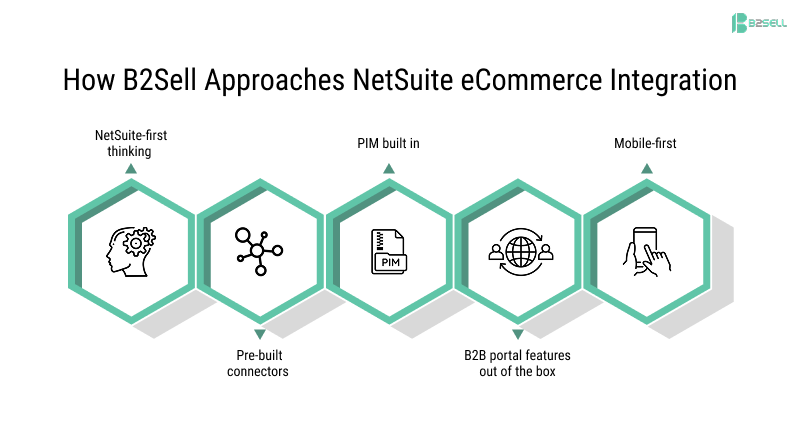
- NetSuite-first thinking — we treat NetSuite as the source of truth, not a system to work around
- Pre-built connectors — for NetSuite + Shopify, NetSuite + Adobe Commerce, and BigCommerce
- PIM built in — B2Sell PIM for NetSuite Commerce cleans product data before it hits your storefront
- B2B portal features out of the box — quotes, credit limits, account hierarchies, contract pricing
- Mobile-first — our B2B Mobile eCommerce app gives your buyers and reps the same data on the road
We've helped distributors move from manual order entry to fully synced portals in under 90 days. One client cut order processing time by 73% in the first quarter after go-live.
Want to see what your NetSuite eCommerce integration would look like — and what it would cost? Book a free 30-minute scoping call with B2Sell. No pitch. Just a clear plan.
Frequently Asked Questions
What is NetSuite eCommerce integration?
NetSuite eCommerce integration is the two-way data connection between a NetSuite ERP system and an online store. It keeps products, prices, inventory, customers, and orders in sync automatically, so distributors don't have to enter data in two places.
How much does it cost to integrate NetSuite with an eCommerce platform?
Year 1 costs typically range from $25,000 to $200,000+. Most mid-market distributors land between $35,000 and $90,000 for initial setup, plus 15–25% of the build cost annually for maintenance.
Is SuiteCommerce better than Shopify for NetSuite users?
SuiteCommerce shares NetSuite's database, so there's no sync layer to maintain. Shopify offers more flexible front-end design and a wider app ecosystem but needs a connector. Pick SuiteCommerce for simplicity, Shopify for design and speed-to-launch.
How long does NetSuite eCommerce integration take?
Most projects run 8 to 16 weeks. Pre-built connectors with clean data go live in 4–6 weeks. Complex Adobe Commerce or headless builds can take 6 months. The biggest variable is data quality, not technology.
Can NetSuite integrate with Adobe Commerce (Magento)?
Yes. NetSuite + Adobe Commerce is one of the most popular setups for distributors with large, complex catalogs and custom B2B workflows. Integration is handled through a connector or iPaaS.
What is the best eCommerce platform for NetSuite distributors?
There is no single best platform. SuiteCommerce fits NetSuite-only shops. Shopify suits fast B2B/B2C launches. Adobe Commerce handles complex B2B catalogs. BigCommerce balances cost and flexibility. Match the platform to your catalog, customer mix, and team size.
Does NetSuite have a native eCommerce platform?
Yes. NetSuite SuiteCommerce is NetSuite's native B2B and B2C eCommerce platform. It runs on the same database as NetSuite ERP, so no separate integration layer is needed.
What is iPaaS for NetSuite?
iPaaS (Integration Platform as a Service) is a cloud tool that connects NetSuite to other systems like Shopify, Adobe Commerce, or a CRM, without custom code. Examples include Celigo, Boomi, and APPSeCONNECT. iPaaS is faster and cheaper than custom API builds for most distributors.
For a broader view of all the integrations B2Sell supports, see our complete guide to B2Sell ecommerce integrations.
Final Word: Picking the Right NetSuite eCommerce Integration
The best NetSuite eCommerce integration is not the most expensive one. It's the one that fits your business in five years, not five weeks.
If you run a distribution business already on NetSuite, you have more options in 2026 than ever before. Pre-built connectors are faster and cheaper than they were three years ago. PIM tools clean your data before it hits the storefront. B2B features are built into platforms that used to be B2C-only.
The distributors winning right now did three things: they cleaned their data first, they picked the platform that matched their buyers (not their CTO), and they worked with a team that has done it 100+ times before.
That's what we do at B2Sell. We've built NetSuite eCommerce integrations for over 200 mid-sized to enterprise distributors. We'd be glad to look at yours.
👉 Book a free NetSuite eCommerce integration audit with B2Sell — 30 minutes, no pitch, a clear plan for your next move.
Ready to Modernize Your Ecommerce Operations?
The future of distribution depends on automation, real-time data, and connected systems.
With B2Sell’s NetSuite ecommerce integration solutions, your business can:
- Reduce manual work
- Improve inventory accuracy
- Automate order workflows
- Deliver better customer experiences
- Scale ecommerce operations confidently
Stop wasting time managing disconnected platforms.
Let B2Sell Help You Build a Smarter B2B Ecommerce Experience
Talk to our integration experts today and discover how B2Sell can help your business grow with scalable NetSuite ecommerce integrations.
Schedule Your Free Demo Today.
.png)
.png)
.png)


.png)