
.png)


Product Data Syndication for B2B Distributors: The Complete Guide
Managing 50,000 SKUs across your website, customer portal, Amazon, and print catalogs?
If you're reformatting spreadsheets every time a supplier sends updated specs—or discovering that your Shopify store shows different pricing than your ERP—you're experiencing the exact problem product data syndication solves.
What is product data syndication?
Product data syndication is the automated process of distributing consistent, accurate product information from a central source to multiple sales channels—websites, marketplaces, apps, and catalogs—in each channel's required format.
.png)
For B2B distributors running Epicor P21 or SAP Business One, syndication isn't optional anymore. Your customers expect real-time inventory. Your sales team needs accurate specs. Your ecommerce platform demands clean data. And your ERP wasn't built to manage commerce-quality content.
This guide covers everything distributors need to know about product data syndication—from the core challenges to implementation strategies that actually work with your existing PIM software for distributors.
Why Product Data Syndication Matters for B2B Distributors
B2B distribution has changed. Your customers don't call for quotes—they search your website. They compare specs on their phones. They expect the same experience they get on Amazon.
But here's what makes distribution different from retail:
- Complex product relationships — Kits, assemblies, alternates, supersessions
- Customer-specific pricing — Contract pricing, volume tiers, regional variations
- Technical specifications — Thousands of attributes per product category
- Multi-source data — Dozens of suppliers sending information in different formats
Without syndication, your team manually updates every channel. Every. Single. Time.
The Real Cost of Manual Product Data Management
Distributors without automated syndication typically experience:
- 4-6 hours per SKU for complete multi-channel updates
- 15-25% data inconsistency between ERP and ecommerce
- 2-3 week delays on new product launches
- $50,000+ annually in labor costs for data entry alone
Key insight: Data quality problems in your source system get amplified during syndication. Syndication failures are typically data quality failures discovered at the point of distribution.
How Product Data Syndication Works
Product data syndication connects your central product repository—typically a PIM system—to every channel where you sell. The process follows four stages:
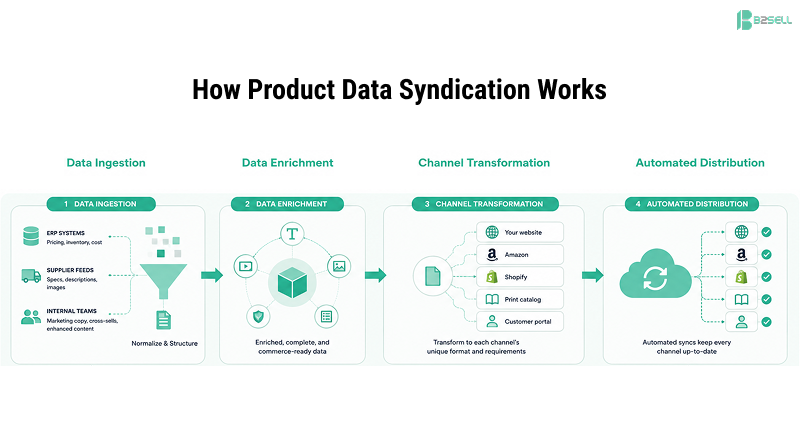
1. Data Ingestion
Your syndication system pulls product information from multiple sources:
- ERP systems (Epicor P21, SAP Business One) — pricing, inventory, cost
- Supplier feeds — specs, descriptions, images
- Internal teams — marketing copy, cross-sells, enhanced content
The system normalizes this data into a single, structured format regardless of how it arrives.
2. Data Enrichment
Raw ERP data rarely meets commerce requirements. Enrichment adds:
- SEO-optimized descriptions
- High-resolution images and videos
- Technical specifications in searchable formats
- Category assignments and taxonomy mapping
- Compliance and regulatory information
3. Channel Transformation
Each sales channel has unique requirements:
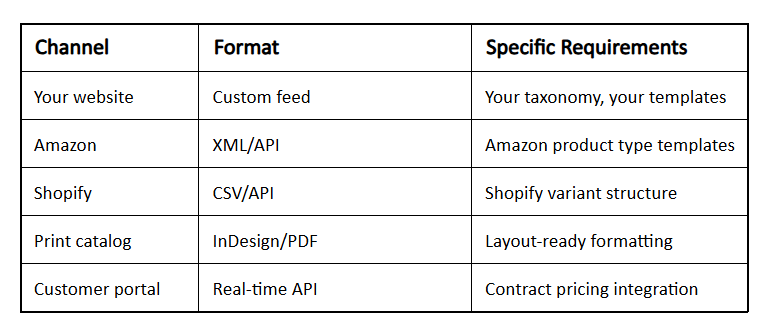
Your syndication system transforms the master data to match each channel's exact specifications.
4. Automated Distribution
Updated product data pushes to all channels automatically:
- Scheduled syncs — Daily, hourly, or real-time depending on channel
- Event-triggered updates — Price changes push immediately
- Validation gates — Incomplete products don't publish
5 Critical Challenges Distributors Face Without Syndication
Challenge 1: Data Silos Across Systems
Your ERP handles transactions. Your website needs marketing content. Your marketplace listings need different attributes than your print catalog.
Without syndication:
- Teams maintain separate spreadsheets for each channel
- Updates happen in one system but not others
- No one knows which version is current
The fix: Centralized syndication from a PIM system eliminates duplicate data entry and ensures one source of truth.
Challenge 2: Supplier Data Chaos
Every supplier sends product information differently:
- Manufacturer A: Excel spreadsheet via email
- Manufacturer B: FTP CSV files weekly
- Manufacturer C: Login to their portal and download
- Manufacturer D: PDFs that require manual extraction
Result: Your team spends more time reformatting data than selling products.
Challenge 3: Channel-Specific Requirements Keep Changing
Amazon updates their product type templates quarterly. Shopify changes their metafield structure. Your buying group portal adds new required attributes.
Keeping up manually is impossible at scale.
Challenge 4: ERP Limitations for Commerce Content
Epicor P21 and SAP Business One excel at:
- Inventory management
- Order processing
- Pricing rules
- Customer accounts
They're not designed for:
- Marketing descriptions
- Image galleries
- SEO attributes
- Multi-channel formatting
Reality check: Your ERP is a transactional system. Commerce content needs a content-first platform that syncs with your ERP—not replaces it.
Challenge 5: Visibility Gaps
Without syndication tracking, you don't know:
- Which distributors have your latest content
- Which products are missing from which channels
- Where data quality issues are causing listing rejections
What to Look for in a Product Data Syndication Solution
Not every syndication tool works for B2B distribution. Retail-focused platforms often miss critical distributor requirements.
Must-Have Features for Distributors
.png)
1. Native ERP Integration
Your syndication system must connect directly to your ERP—not through middleware that breaks. Look for:
- Bidirectional sync (pricing IN, orders OUT)
- Real-time inventory updates
- Customer-specific pricing support
- Epicor P21 integration or SAP Business One connectivity
2. Bulk Data Transformation
You're importing thousands of SKUs from suppliers. The system should:
- Map supplier fields to your taxonomy automatically
- Clean and normalize incoming data
- Flag quality issues before import
- Handle multiple supplier formats simultaneously
3. Complex Attribute Management
B2B products have industry-specific attributes:
- Electrical: voltage, amperage, certifications
- Plumbing: pipe size, material, thread type
- Industrial: tensile strength, operating temperature, compliance
Your syndication system needs flexible attribute schemas—not fixed templates designed for consumer goods.
4. Multi-Channel Output
Essential channel support:
- Your B2B ecommerce website
- Customer self-service portal
- Marketplaces (Amazon Business, Faire, industry-specific)
- Magento, Shopify, BigCommerce
- Print catalog software
- Mobile apps
5. Validation and Quality Gates
Before syndication:
- Check for missing required fields
- Validate data formats
- Flag duplicate SKUs
- Prevent incomplete products from publishing
How B2Sell Central Handles Product Data Syndication
B2Sell Central is built specifically for B2B distributors running Epicor P21 or SAP Business One. Unlike generic PIM solutions, Central understands distributor workflows:

Native ERP Sync
- Real-time pricing — Contract pricing, volume tiers, customer-specific rates sync automatically
- Inventory accuracy — Stock levels update across all channels instantly
- Order flow — Orders from any channel write back to your ERP
Distributor-Specific Features
- Complex product relationships — Handle kits, assemblies, and supersessions
- Supplier data import — Transform any format into your taxonomy
- Multi-warehouse visibility — Show inventory by location
- Industry taxonomies — Pre-built attribute sets for electrical, plumbing, HVAC, industrial
Multi-Channel Publishing
From Central, publish to:
- Your B2Sell eSeller storefront
- Shopify, Magento, BigCommerce
- Amazon Business
- Print catalogs via B2Sell Output
- Mobile apps via B2Sell Mobile
One update in Central → Every channel updated automatically.
👉 See B2Sell Central in action — request a demo
Implementing Product Data Syndication: A Practical Roadmap
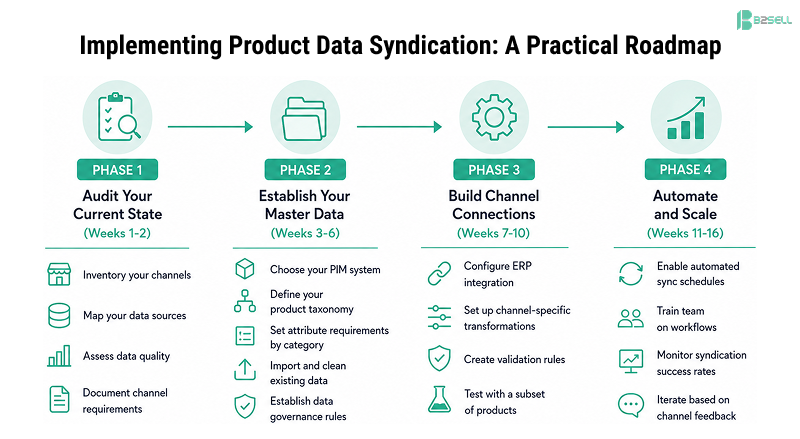
Phase 1: Audit Your Current State (Weeks 1-2)
Before implementing syndication:
- Inventory your channels — Where are you selling? Where do you want to sell?
- Map your data sources — ERP, suppliers, internal teams
- Assess data quality — What percentage of SKUs are complete?
- Document channel requirements — What does each channel need?
Phase 2: Establish Your Master Data (Weeks 3-6)
- Choose your PIM system
- Define your product taxonomy
- Set attribute requirements by category
- Import and clean existing data
- Establish data governance rules
Phase 3: Build Channel Connections (Weeks 7-10)
- Configure ERP integration
- Set up channel-specific transformations
- Create validation rules
- Test with a subset of products
Phase 4: Automate and Scale (Weeks 11-16)
- Enable automated sync schedules
- Train team on workflows
- Monitor syndication success rates
- Iterate based on channel feedback
Timeline reality: Mid-sized distributors should expect 8-16 weeks for PIM deployment, with data cleansing representing the longest phase.
Frequently Asked Questions
What is product data syndication?
Product data syndication is the automated process of distributing consistent, accurate product information from a central source to multiple sales channels—including websites, marketplaces, mobile apps, and print catalogs—in each channel's required format. For B2B distributors, this means ensuring your ERP data, supplier content, and marketing copy reach every channel without manual reformatting.
How is product data syndication different from product feeds?
Product feeds are the output—the formatted files sent to each channel. Product data syndication is the entire process: ingesting data from multiple sources, enriching it, transforming it for each channel's requirements, and distributing it automatically. Syndication includes governance, validation, and ongoing automation—not just one-time exports.
Why can't I just use my ERP for product syndication?
ERP systems like Epicor P21 and SAP Business One are transactional systems designed for inventory, pricing, and orders. They lack the content management capabilities needed for commerce: marketing descriptions, image galleries, SEO attributes, and channel-specific formatting. A PIM system enriches ERP data and syndicates commerce-ready content to every channel.
What's the ROI of product data syndication for distributors?
Distributors implementing automated syndication typically see:
- 60-80% reduction in manual data entry time
- 90%+ data consistency across channels
- 2-3x faster new product launches
- 15-25% improvement in ecommerce conversion rates from better product content
How does product data syndication work with customer-specific pricing?
B2B syndication systems maintain pricing rules from your ERP and apply them at the channel level. When a logged-in customer views your website or portal, they see their contract pricing—synced from Epicor P21 or SAP B1—not generic list prices.
Can I syndicate to Amazon Business and other B2B marketplaces?
Yes. Modern syndication platforms include pre-built connectors for Amazon Business, Faire, industry-specific marketplaces, and buying group portals. The syndication system transforms your master data into each marketplace's required format automatically.
Next Steps: Stop Managing Spreadsheets, Start Syndicating
Product data syndication isn't a nice-to-have for B2B distributors—it's how you compete in a market where buyers expect real-time accuracy across every channel.
If you're running Epicor P21 or SAP Business One and struggling with:
- Manual data entry across multiple platforms
- Inconsistent product information between ERP and website
- Slow new product launches
- Marketplace listing rejections
B2Sell Central can help.
Built specifically for distributors, Central connects natively to your ERP and syndicates enriched product data to every channel—website, marketplace, portal, catalog, and mobile app.
👉 Request a B2Sell Central demo and see how distributors are automating product data syndication.
Related reading:
- The B2B Distributor's Complete Guide to PIM Software
- Epicor P21 Ecommerce Integration
- SAP Business One B2B Ecommerce Solution
.png)
.png)
.png)


.png)