


Why 2026 Is the Year HVAC Distributors Can't Ignore B2B eCommerce
The HVAC distribution industry is undergoing a major shift. Contractors are no longer relying on phone calls or in-person visits to place orders. Instead, they expect fast, seamless, and mobile-first purchasing experiences—just like they get in their personal lives.
In 2026, distributors without B2B eCommerce are already losing business. Contractors often place orders outside standard working hours—early mornings, evenings, and weekends. If your business isn’t available during those moments, your competitors are.
This shift is not temporary. It’s a permanent evolution in how HVAC businesses operate. The distributors growing fastest today are not necessarily the ones with the largest inventory, but the ones that are easiest to do business with.
This guide explains everything HVAC distributors need to know about B2B eCommerce—what it is, why it matters, key features, implementation strategy, and how to successfully drive adoption.
What B2B eCommerce Actually Means for an HVAC Distributor
B2B eCommerce is not a public-facing shop where anyone can buy. For HVAC distributors, it's a private, account-gated portal where your contractors and commercial buyers:
- See their specific contract pricing, not a generic price list
- Check live stock across your warehouse locations
- Download spec sheets and installation docs alongside product listings
- Convert quotes directly into purchase orders
- Pay on net-30 terms tied to their existing credit line
The difference from a standard online store is important. When a mechanical contractor logs into your B2B eCommerce portal, they see the Carrier prices you've negotiated with them, the Trane models you've approved for their account, and inventory at the branch 12 miles from their job site — not a national catalog with retail pricing.
That specificity is what makes HVAC distributor ecommerce different from anything built on Shopify or WooCommerce. Those platforms are designed for selling to anonymous buyers at fixed prices. B2B eCommerce for HVAC requires a completely different technical architecture.
The Real Cost of Not Having a B2B eCommerce Store in 2026
Before getting into platform features, it helps to understand what you're losing right now without one.
Order entry labor. Your inside sales team spends a large portion of each day entering orders that contractors could place themselves. At $25–$35/hour fully loaded, that's real money — and it's time that could go toward quoting new accounts or upselling.
After-hours orders lost. Most HVAC service calls happen in the evening and on weekends. Contractors who can't reach you don't wait — they call the next distributor or order from a national e-distributor like Winsupply or Johnstone Supply that already has an online store.
Order errors from phone and fax. Wrong part numbers, missed quantities, miscommunicated model suffixes — these errors cost both sides time and often result in emergency re-delivery or job delays that damage your relationship with the contractor.
Data you're not capturing. Every order through a phone call is a data point you're not recording correctly. B2B eCommerce gives you clean, structured order data you can use to identify which accounts are growing, which products to stock deeper, and which contractors haven't ordered in 90 days.
None of these are abstract losses. They show up in your gross margin and in contractor churn you can't see because you don't know they switched distributors.
8 Features an HVAC Distributor Must Have in a B2B eCommerce Platform
Not all B2B eCommerce platforms are built for distribution. Here's what actually matters for HVAC:

1. Customer-Specific Pricing
Every contractor sees their negotiated price, not your list price or a generic discount tier. The platform pulls pricing from your ERP in real time, so when you update a contract price in your system, the portal reflects it immediately.
2. Real-Time Inventory by Branch
A contractor 10 miles from your Dallas branch and another 5 miles from your Fort Worth location need to see inventory at their nearest location — not a pooled number that masks a split across two warehouses.
3. Model Number and Part Number Search
HVAC buyers search by manufacturer part numbers, model numbers, and sometimes cross-reference numbers from competitor brands. Your search must handle all three. A contractor won't browse — they know what they want. If your search doesn't find it in two seconds, they call someone else.
4. Configurable Product Catalogs
Commercial HVAC buyers need different catalogs than residential HVAC contractors. A facilities management company ordering rooftop units shouldn't see the same catalog as a residential installer. B2B eCommerce for HVAC needs account-level catalog controls.
5. Quote-to-Order Workflow
Many HVAC jobs start with a contractor requesting a quote on a multi-equipment project. The platform should let your reps build quotes digitally, share them with the buyer, and allow the buyer to convert the approved quote directly into a purchase order without re-entering anything.
6. Net Terms and Credit Integration
Trade buyers don't pay with credit cards. They buy on net-30 or net-60 terms against their approved credit line. The platform must read their available credit from your ERP and block orders that exceed the limit — without requiring manual approval for every transaction.
7. Mobile-Optimized for Field Ordering
Contractors place orders from job sites, not offices. The mobile experience must be fast and functional — not a desktop site squeezed into a phone screen. Touch-friendly, quick add-to-cart from history, and easy reorder are the minimum.
8. ERP Integration
A standalone B2B eCommerce store that doesn't talk to your ERP creates a second system of record and doubles your order processing work. The platform must integrate with your ERP — whether that's Epicor Eclipse, Infor, SAP, or another distribution-focused system — to sync inventory, pricing, customer data, and order status automatically.
How B2B eCommerce Changes the Job of Your Sales Team
One concern distributors raise is that an online store will cut salespeople out of the relationship. That's not how it works in practice.
When contractors can place routine reorders themselves, your sales reps stop spending time on $300 parts orders and start spending time on $30,000 system replacements. The relationship doesn't go away — it moves up the value chain.
Reps also get better data. Instead of guessing what a contractor might need based on past invoices, they can see exactly what the contractor has been browsing, what they've quoted but not ordered, and what they bought from a competitor last month (based on gaps in their purchase history). That data turns a generic check-in call into a specific, useful conversation.
The distributors that scale fastest with B2B eCommerce in 2026 are the ones that give their sales team both the self-service portal for routine orders and the data tools to have better conversations on everything else.
B2B eCommerce vs. EDI: What's the Difference?
Some larger commercial HVAC buyers already order through EDI (Electronic Data Interchange) — a machine-to-machine format where purchase orders transfer directly between systems. EDI works well for large national accounts with predictable, high-volume orders.
B2B eCommerce fills a different gap. It serves the mid-tier contractor who places 5–20 orders per month but doesn't have the IT infrastructure for EDI integration. It also serves the smaller contractor who needs to browse and discover, not just reorder on a fixed schedule.
For most HVAC distributors, both channels matter. The goal in 2026 isn't to replace EDI — it's to give every buyer a convenient digital path to order, regardless of their technical setup.
How to Choose the Right B2B eCommerce Platform
Selecting the right platform is critical. Here are key factors to consider:

Industry Fit
Choose a platform built specifically for distribution, not adapted from retail.
Integration Capabilities
Ensure real-time ERP integration—not batch updates.
Implementation Speed
Look for platforms that can go live in 60–90 days.
Total Cost
Consider setup, integration, and maintenance costs—not just subscription fees.
Scalability
The platform should support future growth, including AI, automation, and analytics.
How B2Sell Solves B2B eCommerce for HVAC Distributors
B2Sell's B2B eCommerce platform was built specifically for distributors — not adapted from a consumer shopping cart.
Here's what that means in practice:
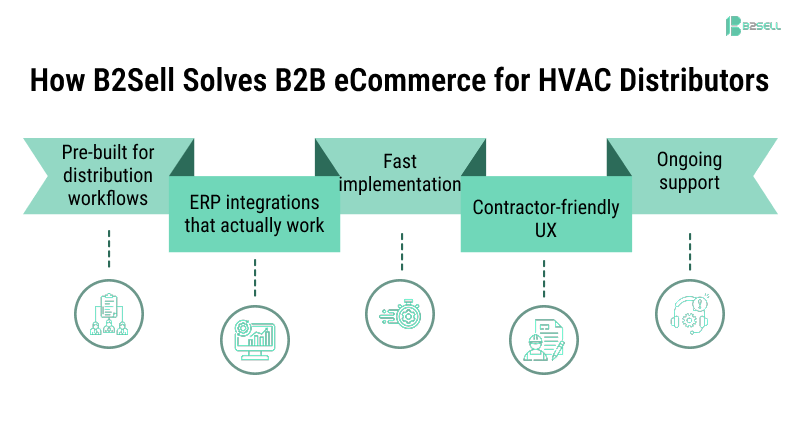
Pre-built for distribution workflows.
B2Sell handles contract pricing, customer-specific catalogs, branch inventory, quote management, and net terms out of the box. There's no custom development required to make these work — they're how the platform is built.
ERP integrations that actually work.
B2Sell integrates with the ERPs HVAC distributors actually use — Epicor Eclipse, Infor, SAP, and others. These are real-time integrations, not batch syncs.
Fast implementation.
Most HVAC distributors go live with B2Sell in 60–90 days. The implementation team has done this dozens of times for distributors in HVAC, plumbing, electrical, and industrial verticals. They know the edge cases before you hit them.
Contractor-friendly UX.
B2Sell's storefront was designed for trade buyers who search by part number and reorder frequently. The mobile experience is built for field use, not adapted from a desktop interface.
Ongoing support.
After launch, B2Sell's team continues working with you on catalog enrichment, search optimization, and adoption programs to get your contractors actually using the portal.
If you're an HVAC distributor evaluating B2B eCommerce options, B2Sell's platform page covers capabilities, integration options, and how to get started.
Getting Contractors to Actually Use Your B2B eCommerce Store
The most common reason B2B eCommerce projects underperform isn't the technology — it's adoption. You can build the best portal in the industry and still have contractors calling your counter if nobody tells them the portal exists or gives them a reason to try it.
Adoption tactics that work for HVAC distributors:
- Counter staff as first promoters. Train your counter and inside sales team to mention the portal on every call, not as a replacement for service but as a faster option for reorders.
- Exclusive pricing for online orders. A 1–2% discount for orders placed online pays for itself in labor savings and signals to contractors that the portal is worth their time.
- Contractor onboarding calls. For your top 20 accounts, have a rep do a 15-minute screen share to walk them through their first order. Adoption rates from hands-on onboarding are dramatically higher than email announcements.
- Branch manager accountability. Assign adoption targets by branch. Branch managers who know they're being tracked on online order percentage will push it harder than those who aren't.
- Mobile-first messaging. Promote the portal as a mobile tool, not a desktop experience. "Order from the job site" lands better than "our new website."
Ready to Launch B2B eCommerce for Your HVAC Distribution Business?
B2Sell has helped HVAC, plumbing, electrical, and industrial distributors go live with B2B eCommerce in 60–90 days — with ERP integrations that actually work and storefronts contractors actually use.
See what B2Sell's B2B eCommerce platform can do for your business →
FAQ
What features does an HVAC distributor need in a B2B eCommerce platform? HVAC distributors need customer-specific pricing, real-time inventory across multiple branches, product search by model number or brand, quote-to-order conversion, net terms and credit line integration, and mobile ordering for field contractors.
How does B2B eCommerce increase revenue for HVAC distributors? B2B eCommerce opens ordering outside business hours, reduces phone-based order errors, and lets sales reps focus on new accounts instead of repeat order entry. Distributors typically see higher average order values when contractors can browse related products independently.
What is the difference between B2B and B2C eCommerce for HVAC? B2C eCommerce serves individual buyers at fixed prices. B2B eCommerce for HVAC shows different prices, catalogs, and payment terms to each buyer based on their account tier, trade license status, and contract agreements. A residential homeowner and a commercial HVAC contractor will see entirely different storefronts.
How long does it take to launch a B2B eCommerce store for an HVAC distributor? With a purpose-built B2B eCommerce platform like B2Sell, most HVAC distributors can go live in 60–90 days, depending on ERP integration complexity and catalog size.
Is B2B eCommerce worth it for small HVAC distributors? Yes. Small and mid-size HVAC distributors benefit most because they typically have lean inside sales teams. Self-service ordering lets a 3-person counter staff handle the same order volume as a 10-person team without adding headcount.
What is B2B eCommerce for HVAC distributors? B2B eCommerce for HVAC distributors is an online ordering platform that lets licensed contractors and commercial buyers browse product catalogs, check real-time inventory, view contract pricing, and place orders without calling or emailing a sales rep. Unlike consumer-facing stores, HVAC B2B eCommerce handles multi-tier pricing, account-specific catalogs, quote workflows, and net-30 billing — all in one place.
.png)
.png)
.png)


.png)