


Introduction: Why Dropship Portals Matter More Than Ever
Industrial distributors are facing more pressure than at any other time in the past decade. Customers now expect fast delivery, accurate inventory, and real-time order visibility—even when the distributor does not physically stock the product.
This is where a dropship portal becomes a game-changer.
A modern dropship portal helps distributors ship products directly from suppliers to customers without delays or manual work. It eliminates the need for large warehouse space, reduces lead times, and improves customer experience.
In 2026, distributors who adopt fast, automated dropship workflows will outperform competitors in speed, cost efficiency, and customer satisfaction. Those who don’t modernize will struggle with slow order cycles, manual errors, and lost revenue.
This guide explains the upcoming trends, the challenges distributors face, practical strategies to improve dropship operations, and what a modern dropship portal should deliver. You’ll also find use cases, People Also Ask answers, featured snippets, and an AI-search-ready structure.
What Is a Dropship Portal? (And Why Distributors Need One Now)
A dropship portal is a centralized system that allows a distributor to send customer orders directly to a supplier, who then ships the product to the customer on the distributor’s behalf.
A strong dropship portal includes:
- Real-time inventory visibility
- Automated order routing
- Supplier onboarding tools
- Shipping status updates
- Tracking information
- Invoicing and billing automation
Why Dropshipping Matters in 2026
Customer purchase behavior has shifted:
- Distributors now handle larger catalogs due to digital ordering.
- Customers expect next-day or same-week fulfillment.
- Carrying deep inventory is expensive and risky.
- Operational teams are shrinking, so manual processes won’t scale.
A modern dropship strategy allows distributors to:
- Sell more without stocking everything
- Reduce warehouse costs
- Offer predictable shipping
- Strengthen supplier partnerships
With B2Sell’s dedicated Dropship Portal system—referenced in the resource here:
B2Sell Dropship Portal —distributors can build a smooth, automated supply chain built for 2026 and beyond.
The Growing Complexity of Dropshipping for Industrial Distributors
Industrial wholesalers have different needs from retail dropshippers. Their challenges are deeper and often more urgent.
1. Manual Order Processing Creates Delays
Many still send POs via email or phone. This causes:
- slow supplier response times
- duplicate or lost orders
- long customer wait times
- higher customer complaints
2. Poor Visibility Between Distributor and Supplier
Customers ask: “Where is my order?”
Most teams cannot answer quickly because information is scattered.
3. Errors in Inventory and Pricing
Without a real dropship portal:
- wrong item shipped
- outdated pricing
- product substitutions without approval
- incorrect shipping costs
4. Difficulty Managing Many Suppliers
Every supplier uses:
- different spreadsheets
- different order formats
- different inventory update methods
- different shipping carriers
This creates chaos for distributor operations.
5. Limited Tracking and Customer Updates
Stakeholders—including customers, sales reps, and internal teams—lack clear visibility.
6. Rising Fulfillment Costs
Without automation:
- labor costs rise
- returns increase
- margins shrink
These issues make it clear: distributors need a structured dropship portal to survive the next phase of B2B ecommerce growth.
2026 Dropship Trends Distributors Must Prepare For
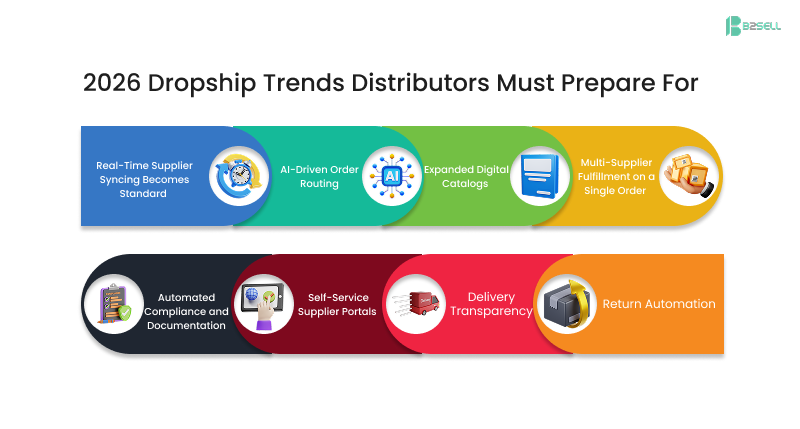
1. Real-Time Supplier Syncing Becomes Standard
Suppliers must exchange data instantly, not once a day.
This includes:
- live inventory
- pricing updates
- order acknowledgments
- shipping confirmations
2. AI-Driven Order Routing
AI will select the best supplier based on:
- location
- stock
- cost
- delivery time
- reliability
This reduces delivery delays and improves profit margins.
3. Expanded Digital Catalogs
Industrial distributors will list 10x more SKUs with zero warehouse expansion.
4. Multi-Supplier Fulfillment on a Single Order
One customer order may ship from multiple suppliers.
The dropship portal must coordinate all shipments.
5. Automated Compliance and Documentation
Industrial products often require:
- SDS sheets
- spec sheets
- certifications
A modern system will attach these automatically.
6. Self-Service Supplier Portals
Suppliers handle:
- inventory uploads
- shipping updates
- packing slips
- order responses
This reduces admin work for distributors.
7. Delivery Transparency
Real-time tracking becomes essential for B2B buyers.
8. Return Automation
Dropship returns will be handled directly between customer and supplier, with automated routing and notifications.
How a Dropship Portal Solves Distributor Challenges (Step-by-Step)
.png)
Step 1: Centralize Supplier Management
Instead of managing suppliers across spreadsheets, emails, and calls, everything is stored in one portal.
Suppliers get their own login to:
- upload products
- maintain pricing
- update stock
- enter shipment data
- upload tracking numbers
Step 2: Automate Order Routing
The system automatically sends orders to the right supplier based on:
- geography
- availability
- delivery date
- pricing rules
This removes the guesswork and speeds up fulfillment.
Step 3: Enable Real-Time Inventory Sync
Distributors see exactly what suppliers have in stock.
This reduces:
- out-of-stock issues
- canceled orders
- customer frustration
Step 4: Provide Real-Time Tracking
Tracking numbers flow from supplier → dropship portal → distributor → customer.
Everyone has access to the same information.
Step 5: Integrate with Ecommerce and ERP Systems
A strong dropship portal syncs with:
- Magento
- Shopify
- BigCommerce
- NetSuite
- Prophet 21
- Infor
- Sage
- Salesforce
This ensures:
- accurate orders
- clean data
- real-time updates
Step 6: Use Automation to Reduce Manual Work
Automate:
- purchase orders
- confirmations
- invoices
- shipping notices
- returns
- supplier scorecards
Step 7: Improve Compliance and Documentation
Automatically attach:
- MSDS
- spec sheets
- warnings
- certifications
This is critical for industrial tools, chemicals, and safety products.
Step 8: Strengthen Customer Communication
The dropship portal sends:
- order update emails
- shipment notifications
- delivery confirmations
This improves satisfaction and reduces support calls.
Realistic Use Cases for Distributors
Use Case 1: Electrical Distributor Expanding SKU Count
A mid-sized electrical distributor wants to offer 20,000 more SKUs without expanding inventory.
The dropship portal connects to 12 suppliers.
Customers now see real-time stock from all suppliers, and orders ship directly from the nearest location.
Result: sales grow 35% without new warehouse costs.
Use Case 2: Industrial Safety Distributor Reducing Support Tickets
Before using a dropship portal, the distributor handled 80+ tracking-related calls weekly.
With automated supplier tracking sync:
- customers see order status
- reps see all supplier updates
- orders flow smoothly
Support tickets drop by 60%.
Use Case 3: HVAC Supplier Improving Margins
Using AI for order routing:
- closest supplier ships
- shipping cost reduces
- delivery times improve
Margins grow by 12% annually.
Use Case 4: Wholesale Automotive Parts Distributor
The business deals with 50+ suppliers.
The dropship portal:
- consolidates all orders
- provides a single fulfillment dashboard
- automates delivery notifications
This improves accuracy and reduces returns.
Benefits of Using a Modern Dropship Portal
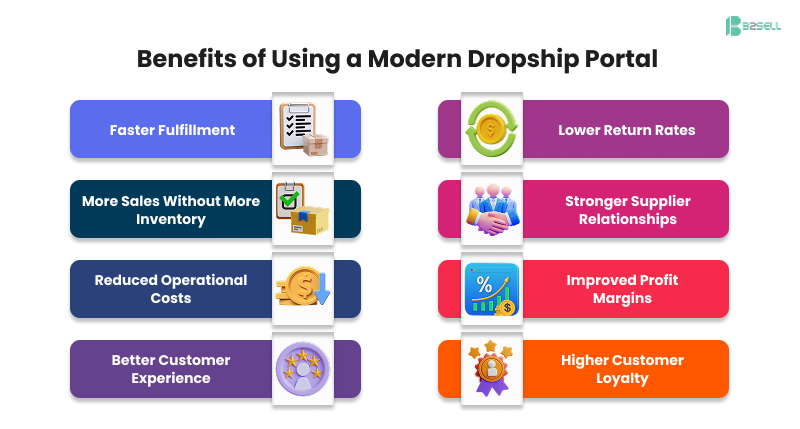
1. Faster Fulfillment (20–50% improvement)
Automated routing cuts delays drastically.
2. More Sales Without More Inventory
List thousands of supplier products without increasing warehouse space.
3. Reduced Operational Costs (up to 40%)
Automation reduces labor hours and manual work.
4. Better Customer Experience
Customers get real-time shipment visibility.
5. Lower Return Rates
Accurate supplier data reduces errors.
6. Stronger Supplier Relationships
Clear communication + shared dashboards = fewer conflicts.
7. Improved Profit Margins
Better routing + fewer errors + lower labor costs = higher ROI.
8. Higher Customer Loyalty
Faster delivery and accurate information build trust.
FAQ
What is a dropship portal for industrial distributors?
A dropship portal is a system that connects distributors with suppliers to automate order routing, shipment tracking, stock updates, and communication. It allows suppliers to ship directly to customers on behalf of the distributor.
How does a dropship portal work?
A dropship portal syncs ecommerce, ERP, and supplier systems. When a customer places an order, the portal automatically sends the order to the correct supplier, syncs tracking, and notifies the customer.
Why do B2B distributors need a dropship portal in 2026?
Because customer expectations for real-time delivery, tracking, and product availability are rising. A portal helps distributors scale catalog size, cut costs, and reduce manual work.
What features should a dropship portal include?
Real-time inventory sync, automated routing, supplier onboarding, tracking visibility, order dashboards, and ERP/ecommerce integration.
Why is real-time visibility important in dropshipping?
Industrial buyers expect accurate delivery dates and tracking. Real-time visibility reduces cancellations, improves customer trust, and speeds up service.
How do dropship portals reduce costs?
They cut down manual work, lower warehouse storage needs, automate supplier communication, and minimize errors—leading to 25–40% operational savings.
Strategies Industrial Wholesalers Should Use in 2026
Strategy 1: Standardize Vendor Data From Day One
Create one consistent format for:
- Pricing
- Images
- Attributes
- Lead times
- Inventory feeds
A portal makes standardization automatic.
Strategy 2: Use Automation for Order Routing
Let the portal choose the supplier based on:
- Stock
- Location
- Shipping cost
- Delivery promise
This ensures faster and cheaper fulfillment.
Strategy 3: Roll Out Supplier Self-Service Dashboards
Allow suppliers to:
- Update inventory
- Upload tracking
- Manage documentation
- Accept or reject orders
This reduces inbound emails drastically.
Strategy 4: Connect ERP and Ecommerce for Real-Time Sync
Whether you use Prophet 21, NetSuite, SAP B1, or Sage, integrating with a dropship portal ensures data flows instantly.
Strategy 5: Build a Customer-Friendly Order Tracking Hub
Customers expect transparency.
Provide:
- Real-time tracking
- Shipment updates
- Delivery ETAs
- Order summaries
This reduces support volume.
Strategy 6: Use Analytics to Improve Performance
Track:
- Supplier reliability
- Order delays
- Shipping trends
- SKU-level performance
Use scorecards to standardize supplier quality.
Strategy 7: Offer Multi-Supplier Catalog Expansion
Make it easy to add new suppliers without increasing warehouse complexity.
Conclusion: The Transformation Impact of Modern Dropship Portals
In 2026, distributors cannot rely on outdated dropshipping methods. Manual work, slow updates, and data errors hold back growth. A modern dropship portal centralizes product data, automates supplier workflows, and provides real-time visibility across the entire fulfillment process.
With the right system, distributors gain:
- Faster order processing
- Lower operating costs
- Stronger supplier relationships
- Happier customers
- A much bigger product catalog
Dropship portals are no longer optional—they’re the backbone of modern B2B fulfillment.
Start Transforming Your Dropship Operations Today
Want to streamline your dropshipping workflows, speed up fulfillment, and expand your catalog with ease?
Explore the B2Sell Dropship Portal and see how it can modernize your operations.
.png)
.png)
.png)


.png)