


Most distributors lose money every day — not because of price, not because of competitors, but because their product data is a mess.
Sound familiar? Pricing lives in your ERP. Images sit in a shared drive. Specs are buried in supplier PDFs. Descriptions were copy-pasted from a vendor site that hasn't been updated in three years. Now multiply that across 50,000 SKUs.
This is why PIM for distributors is no longer a "nice to have." It is the single biggest growth lever in B2B distribution today. A modern Product Information Management (PIM) system gives you one source of truth for every SKU, every channel, and every customer.
In this guide, you will learn what PIM is, why distributors need it, the real benefits to expect, and how to choose the best PIM for distributors in 2026 — including specific use cases for bearing distributors, electrical wholesalers, HVAC suppliers, and other industrial verticals.
What Is a PIM for Distributors?
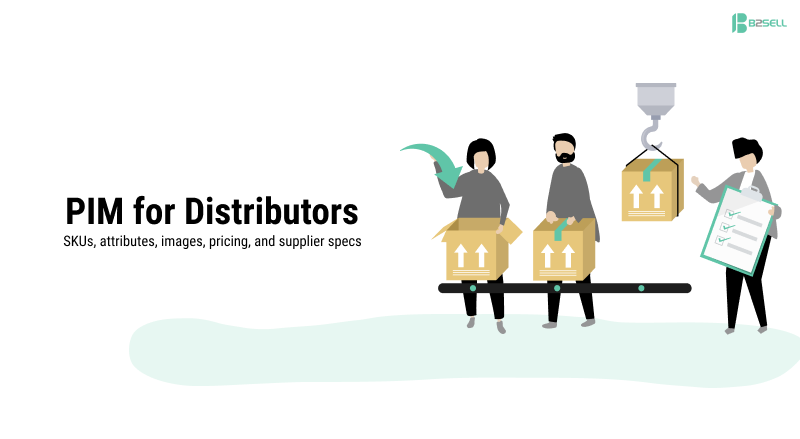
PIM for distributors is software that centralizes, enriches, and publishes product data — SKUs, attributes, images, pricing, and supplier specs — across every sales channel including B2B websites, marketplaces, mobile apps, and print catalogs. It helps distributors deliver complete, accurate, and consistent product information to buyers in less time.
A Product Information Management system is the bridge between your ERP and your customer.
Your ERP knows the price. Your supplier has the spec sheet. Your marketing team has the images. A PIM brings them all together in one clean record.
A PIM for distributors does five core jobs:
- Stores all product data in one place
- Cleans and enriches data using AI
- Pushes data to your website, ERP, app, and marketplaces
- Generates print catalogs and price books on demand
- Tracks who changed what, and when
Think of it as the engine room behind every product page, every search result, and every quote.
Why Distributors Need a PIM in 2026
B2B buyers now shop like consumers.
They expect rich images. They expect full specs. They expect real-time stock. They expect side-by-side comparison. Studies show that most B2B buyers will switch suppliers for a better digital experience. Distributors that still rely on Excel sheets and shared drives are losing those buyers — quietly and quickly.
A PIM solves this. But it also solves something even bigger: AI search visibility.
Today, buyers search on Google, ChatGPT, Perplexity, Amazon, and even inside their own ERP. Each channel needs clean, structured product data to return your products. Without a PIM, you cannot feed any of them well. With a PIM, you can feed all of them at once.
If you are not in AI Overviews and ChatGPT answers in 2026, you are invisible to a growing share of buyers.
The Biggest Challenges Distributors Face Without a PIM
Most distributors share the same painful problems. Here are the ones we hear every single week.
1. Product Data Is Scattered Everywhere
- Pricing in ERP (Epicor Prophet 21, SAP, Infor, NetSuite, Sage)
- Specs in supplier PDFs and emails
- Images on shared drives or marketing folders
- Descriptions inside the eCommerce site
- Cross-references in someone's head
This creates data drift. The ERP says one thing. The website says another. The catalog says a third. Customers lose trust. Sales reps lose deals.
2. Slow Time-to-Market
Launching a new product can take weeks or months. By the time the SKU is live on your website, your competitor is already ranking for it on Google.
3. Poor Digital Buyer Experience
B2B buyers want filters. They want compare. They want full specs. Without rich attributes, your search bar returns junk. Buyers leave and call your competitor.
4. Manual Catalog and Price Book Pain
Most distributors still build catalogs in InDesign, line by line. One typo and you reprint thousands of pages. One price change and the catalog is wrong the day it ships.
5. Channel Inconsistency
The same SKU often shows up differently on:
- Your website
- Amazon, Walmart, eBay
- Your mobile app
- The PDF catalog
- The dealer portal
This kills SEO, kills AI search visibility, and damages brand trust.
6. Bearing Distributors and Industrial Verticals Face Extra Pain
Bearing distributors deal with thousands of dimensional attributes — bore, OD, width, dynamic load, static load, RPM, seal type, cage material, ABEC class. Without structured PIM data, search and filtering are simply impossible. The same applies to fasteners, fluid power, electrical, plumbing, HVAC, and MRO distributors.
Top PIM Benefits for B2B Distributors
Now the part you came for. Here are the PIM benefits for B2B distributors, with real-world numbers from distributors who have made the switch.
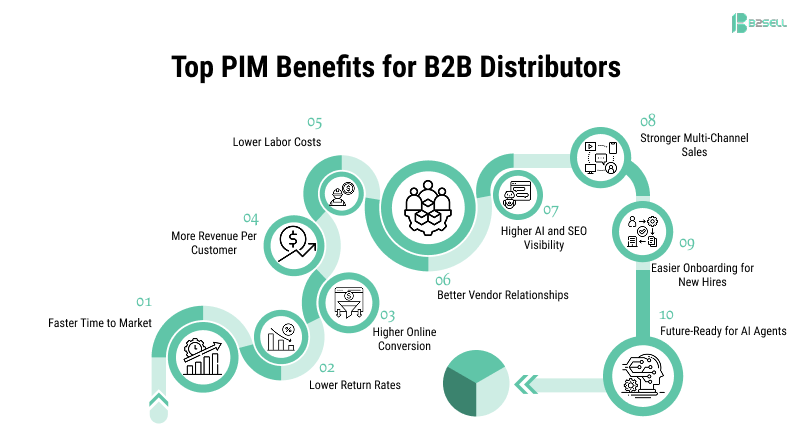
1. Faster Time to Market
New SKUs go live in days, not weeks. Distributors typically see a 60% to 80% drop in time-to-publish after PIM rollout.
2. Lower Return Rates
Better data means fewer wrong orders. Many distributors report a 20% to 40% drop in returns within the first year.
3. Higher Online Conversion
Rich product pages with images, specs, and filters convert better. Expect a 15% to 30% lift in online conversion rate.
4. More Revenue Per Customer
When buyers can find related parts, accessories, and substitutes, basket size grows. Distributors often see a 10% to 25% rise in average order value.
5. Lower Labor Costs
Tasks that took a team of five can be done by one person plus AI tools. Some distributors cut catalog management labor by half.
6. Better Vendor Relationships
When you publish manufacturer content well, manufacturers reward you with co-op funds, exclusives, and faster product access.
7. Higher AI and SEO Visibility
Clean, structured product data wins in Google AI Overviews, ChatGPT, and Perplexity. Your products get cited, not your rivals'.
8. Stronger Multi-Channel Sales
One source of truth means your website, marketplaces, and reps all sell the same product the same way. No more confusion or mixed messages.
9. Easier Onboarding for New Hires
Sales reps and customer service learn the catalog faster when data is clean and consistent.
10. Future-Ready for AI Agents
The next wave of B2B buying will involve AI agents placing orders for buyers. Only distributors with clean, machine-readable data will be picked by these agents.
How to Choose the Best PIM for Distributors
Not every PIM is built for distribution. Many are designed for fashion, retail, or DTC brands. Distributors need something different. Here is what to look for in the best PIM for distributors in 2026.
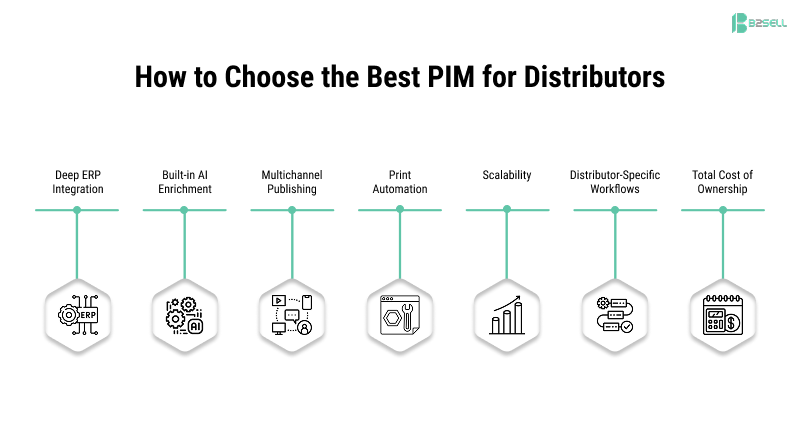
1. Deep ERP Integration
Your PIM must talk to your ERP. Look for native connectors for:
- Epicor Prophet 21
- SAP Business One
- Infor
- NetSuite
- Sage
- QuickBooks
- Microsoft Dynamics
Two-way sync matters more than one-way export. Your PIM and ERP should agree at all times.
2. Built-in AI Enrichment
Manual data entry is dead. The best PIMs use AI product enrichment to:
- Auto-write SEO descriptions
- Extract attributes from supplier PDFs
- Tag and categorize SKUs
- Translate content
- Detect missing data
This alone can save thousands of hours a year.
3. Multichannel Publishing
Your PIM should push clean data to:
- B2B and B2C eCommerce
- Marketplaces (Amazon, Walmart, eBay, Facebook)
- Mobile apps
- Print catalogs and price books
- Dealer and drop-ship portals
4. Print Automation
If you still ship print catalogs, your PIM must generate them on demand. Look for print catalog automation that drives both digital and print from the same data.
5. Scalability
Can it handle 100,000+ SKUs? Several million? Distributors grow fast through new lines, new brands, and acquisitions. Your PIM should not slow you down.
6. Distributor-Specific Workflows
Look for features built for the way distributors actually sell:
- Supplier onboarding
- Drop-ship dealer portals
- Customer-specific catalogs
- Contract pricing
- Bulk import and bulk edit
- Cross-reference and interchange tables
7. Total Cost of Ownership
The cheapest PIM is rarely the best PIM. Ask about:
- Setup and integration costs
- Training
- Per-SKU or per-user fees
- Ongoing support
- Time to first value
The 7 Steps to Solving Product Data Chaos With PIM
Here is a clear, step-by-step plan to fix the problem. Each step is something you can start this quarter.
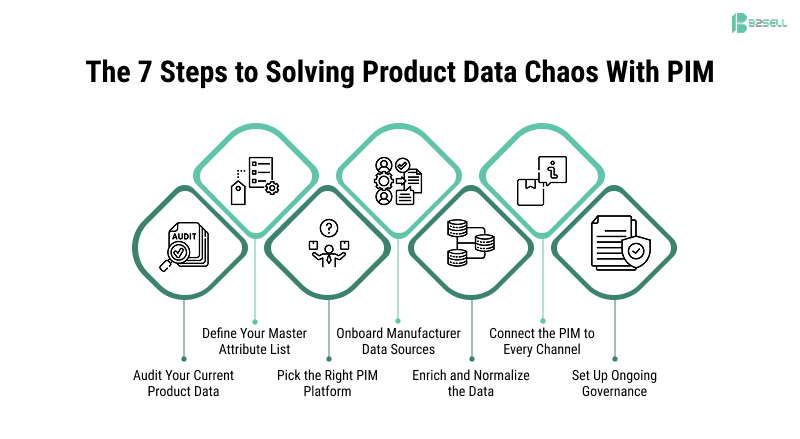
Step 1: Audit Your Current Product Data
Pull a sample of 100 SKUs. Check for missing fields, broken images, and old specs. Score the data quality. This gives you a baseline.
Step 2: Define Your Master Attribute List
Decide what fields every product must have. For example:
- SKU
- Manufacturer part number
- UPC or GTIN
- Title
- Short description
- Long description
- Primary image
- Spec sheet PDF
- Category and subcategory
- Key attributes (size, weight, material, voltage, etc.)
- Cross-references and substitutes
- Compliance documents
Step 3: Pick the Right PIM Platform
Look for a PIM made for distributors. Retail-focused PIMs often miss the depth that B2B needs. Key features to check:
- Native ERP integration (Epicor P21, Infor, NetSuite, Sage, SAP Business One, QuickBooks)
- Bulk import and mapping tools
- Vendor data ingestion (CSV, Excel, API, EDI)
- Digital asset management for images and PDFs
- Channel-specific output (website, marketplace, print)
- User permissions for vendors and team members
See how B2Sell PIM stacks up for industrial distributors →
Step 4: Onboard Manufacturer Data Sources
Set up automatic data feeds with your top 50 manufacturers. Most have API or feed options today. For the rest, set a standard template they must follow.
Step 5: Enrich and Normalize the Data
Use AI Product Enrichment inside the PIM to fill in gaps. Tools can write SEO-friendly descriptions, tag attributes, and suggest categories. A human reviews and approves.
Step 6: Connect the PIM to Every Channel
Push clean data to:
- Your B2B eCommerce site
- Your ERP via API & Connectors
- EDI partners
This is where the magic happens. Update once, publish everywhere.
Step 7: Set Up Ongoing Governance
Assign a data owner. Build a weekly review cycle. Track data quality scores over time. A PIM is not a one-time project. It is a living system. AI Workflow Automation can handle most of the routine governance work for you.
Real-World Use Cases and Examples
Example 1: Industrial supply distributor with 80,000 SKUs The team spent 6+ hours daily updating spreadsheets. After moving to PIM, they cut that to under an hour, launched 3 new marketplaces, and grew online revenue meaningfully in year one.
Example 2: Bearing and power transmission distributor By structuring 200+ technical attributes inside PIM, the company powered an advanced filter on their site. Bounce rate dropped sharply. Quote requests rose. Engineers started bookmarking the site.
Example 3: HVAC wholesaler running on Epicor P21 Using a P21-native PIM, the company synced live pricing, stock, and spec data to their B2B portal. Phone orders dropped, and online orders grew — without hiring more reps.
Example 4: Pool and outdoor distributor A drop-ship dealer portal powered by PIM let them onboard dozens of dealers in months, with each dealer getting a custom-branded shopping cart fed from one central catalog.
You can see more wins like these in B2Sell case studies.
How B2Sell PIM Helps Distributors Win
B2Sell PIM for Distributors is built specifically for industrial and B2B distributors. It is not a retail PIM repackaged for distribution.
Why distributors choose B2Sell:

- Native ERP connectors for Epicor Prophet 21, SAP B1, Infor, NetSuite, Sage, and more
- AI-driven enrichment that fills attributes, writes descriptions, and tags categories
- Multichannel publishing to web, mobile, marketplaces, and print
- Print catalog automation to ship price books on demand
- Drop-ship and dealer portals to grow channels without extra headcount
- AI intelligent search to help buyers find the right SKU instantly
- Scalable from 5,000 SKUs to several million
- Distributor-first workflows built from years of working with industrial supply, bearing, electrical, HVAC, and pool distributors
Distributors using B2Sell Central PIM typically see faster product launches, cleaner data, and a measurable lift in online revenue within the first year.
Conclusion: Turn Your Product Data Into Your Biggest Asset
Distributors that win in 2026 will not be the ones with the lowest prices. They will be the ones with the cleanest, richest, and most accessible product data.
A modern PIM for distributors is how you get there. It cuts your time-to-market, fuels every channel, feeds AI search, and turns your catalog into a real growth engine. Whether you sell bearings, electrical, HVAC, fasteners, pool, or any other industrial line, the right PIM transforms a daily data headache into a long-term competitive moat.
You do not have to do it alone. The right partner — one who understands ERP, AI enrichment, and the unique needs of industrial distribution — can take you from messy spreadsheets to a single source of truth in months, not years.
Ready to Centralize Your Product Data With B2Sell?
If you are a distributor tired of chasing spreadsheets, fixing errors, and losing sales to bad data, we should talk. B2Sell has helped hundreds of B2B industrial distributors connect their ERP, build rich B2B eCommerce sites, and manage product data at scale.
👉 Explore B2Sell PIM for Distributors — see features, benefits, and a live demo 👉 Book a Free Consultation with our team 👉 See Our Customer Showcase — real distributors winning with B2Sell
Stop losing orders to bad data. Start winning with the PIM built for distributors.
FAQ
Q1. What is a PIM for distributors? A PIM for distributors is software that centralizes product data — SKUs, attributes, images, pricing, and specs — and publishes it across websites, mobile apps, marketplaces, and print catalogs. It is the single source of truth for every product.
Q2. Why do B2B distributors need a PIM? B2B buyers expect consumer-grade product experiences. A PIM gives distributors clean, complete data for every channel, which improves conversion, reduces returns, and powers visibility in Google and AI search engines.
Q3. What is the best PIM for distributors in 2026? The best PIM for distributors offers deep ERP integration (Epicor P21, SAP B1, Infor, NetSuite), AI enrichment, multichannel publishing, print automation, and distributor-specific workflows like drop-ship portals and customer-specific pricing. B2Sell PIM is one of the leading platforms built specifically for industrial distribution.
Q4. How does a PIM help bearing distributors? A PIM for bearing distributors structures dimensional attributes (bore, OD, width, load ratings), stores OEM and aftermarket cross-references, and powers filtered search across millions of SKUs and interchanges.
Q5. Is a PIM the same as an ERP? No. An ERP runs business operations like orders, inventory, and accounting. A PIM manages and enriches product content for sales and marketing. The two work together.
Q6. How long does PIM implementation take? Most B2B distributors go live in 60 to 120 days, depending on data quality, ERP type, and number of channels.
Q7. What is the ROI of a PIM for distributors? Most distributors see ROI within 9 to 14 months through faster product launches, lower data ops costs, fewer returns, and higher online conversion.
Q8. Do small distributors need a PIM? Yes. Even with a few thousand SKUs, distributors that sell across web, marketplaces, and print quickly outgrow spreadsheets. A PIM scales as you grow.
.png)
.png)
.png)


.png)