


Introduction
A dropship portal is a centralized B2B platform that allows distributors, manufacturers, and wholesalers to sell products without holding inventory. Instead of stocking goods, orders are automatically sent to suppliers, who ship directly to customers. This model reduces inventory risk, lowers operational costs, and enables faster business growth.
In modern B2B ecommerce, a dropship portal acts as the control layer between suppliers, ecommerce platforms, ERP systems, and logistics partners. It synchronizes product data, pricing, inventory, orders, and shipping updates in real time. This automation ensures accuracy, speed, and scalability across complex B2B operations.
As buyer expectations rise and product catalogs grow, manual dropshipping processes no longer scale. Businesses now rely on advanced dropship portals to manage multiple suppliers, customer-specific pricing, bulk orders, ERP integrations, and fulfillment workflows.
This guide explains what a dropship portal is, how B2B dropshipping works, why it matters for modern distributors, and how the B2Sell Dropship Portal helps businesses automate operations, expand catalogs, and increase profitability.
What is a Dropship Portal?
A dropship portal is a centralized digital platform that enables B2B businesses to sell products without holding physical inventory. Instead of storing products in their own warehouses, sellers list items from approved suppliers or manufacturers. When a customer places an order, the order is automatically routed to the supplier, who fulfills and ships it directly to the customer.
Unlike B2C dropshipping, B2B dropshipping introduces greater complexity. A B2B dropship portal must manage:
- Multiple suppliers and manufacturers
- Contract-based and customer-specific pricing
- Bulk and repeat orders
- ERP, accounting, and tax integrations
- Real-time inventory and availability
- Freight, shipping rules, and compliance requirements
A modern dropship portal brings all these elements together into a single, automated system.
How a B2B Dropship Portal Works
A B2B dropship portal automates the entire order lifecycle—from product onboarding to fulfillment and invoicing—while maintaining data accuracy across systems.
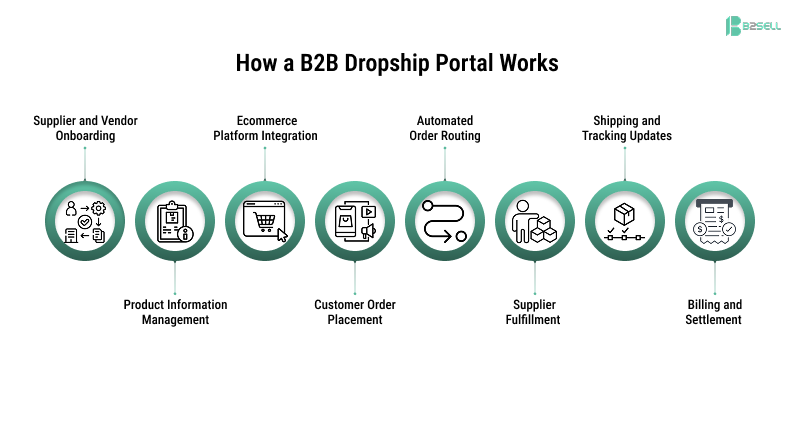
Step 1: Supplier and Vendor Onboarding
Suppliers are onboarded into the dropship portal with their:
- Product catalogs and SKUs
- Pricing and discount rules
- Inventory availability feeds
- Shipping methods and service levels
- Fulfillment timelines and SLAs
Step 2: Product Information Management
Product data from suppliers is standardized, enriched, and validated to ensure:
- Consistent product naming and attributes
- Accurate specifications and dimensions
- High-quality images and documentation
- Reduced data errors across channels
Step 3: Ecommerce Platform Integration
The dropship portal syncs products, pricing, and inventory to ecommerce platforms such as Magento, Shopify, BigCommerce, or custom B2B portals.
Step 4: Customer Order Placement
Customers browse the catalog, view real-time availability, and place orders through the ecommerce storefront using negotiated pricing.
Step 5: Automated Order Routing
Orders are automatically routed to the right supplier based on predefined business rules such as:
- Product availability
- Supplier location
- Cost optimization
- Delivery timelines
Step 6: Supplier Fulfillment
Suppliers pack and ship products directly to the end customer, often using neutral or seller-branded packaging.
Step 7: Shipping and Tracking Updates
Tracking numbers and shipment updates flow back into the dropship portal and are shared with customers and internal teams in real time.
Step 8: Billing and Settlement
The portal manages invoicing, margin calculations, commissions, and financial reconciliation with ERP systems.
Why Dropship Portals Are Essential for B2B Businesses

1. Eliminate Inventory Risk
Sell thousands of SKUs without investing capital in stock or warehousing.
2. Expand Product Catalogs Instantly
Add new suppliers and product lines without operational complexity.
3. Reduce Operational Costs
Lower expenses related to storage, handling, and labor.
4. Improve Cash Flow
Collect payments from customers before paying suppliers.
5. Scale Faster with Automation
Handle high order volumes without increasing headcount.
B2Sell Dropship Portal: Purpose-Built for Enterprise B2B
The B2Sell Dropship Portal is designed specifically to address the complexities of B2B dropshipping. It serves as a powerful integration and automation layer between suppliers, ecommerce platforms, and ERP systems.
What Sets B2Sell Apart
- Enterprise-grade, API-first architecture
- Deep ERP integrations (including Epicor P21)
- Multi-supplier and multi-channel support
- High-volume order processing
- Real-time data synchronization
- Secure, AWS-powered infrastructure
Key Features of B2Sell’s Dropship Portal
B2Sell’s Dropship Portal is designed to simplify B2B dropshipping while helping manufacturers and distributors scale faster. Each feature focuses on automation, speed, and dealer enablement.

Pre-Loaded Product Content
Save time and reduce setup effort with pre-loaded product content.
B2Sell allows dealers to launch quickly using ready-to-use product data, including descriptions, images, and specifications.
Benefits:
- Faster dealer onboarding
- No manual product uploads
- Consistent product information across channels
- Reduced time to market
This ensures dealers can start selling immediately without technical delays.
White-Labelled Dealer Websites
Offer your dealers a fully white-labelled Shopify website that matches their brand identity.
Dealers get their own branded storefront, while you maintain control of products and fulfillment.
Benefits:
- Strengthens dealer loyalty
- Preserves brand ownership
- Expands your distribution network
- Creates a professional buying experience
Each dealer operates independently while remaining connected to your supply chain.
Customization Capabilities
Give dealers the freedom to customize their storefronts.
B2Sell enables dealers to adjust layouts, branding elements, and content to suit their customers.
Benefits:
- Unique customer experiences
- Higher engagement and conversions
- Better brand differentiation
- Increased dealer satisfaction
Customization helps dealers stand out while selling the same product catalog.
Automated Order Fulfillment
B2Sell simplifies dropshipping with fully automated order fulfillment.
Orders flow directly from dealer websites to suppliers without manual intervention.
Benefits:
- Faster order processing
- Fewer manual errors
- Improved fulfillment accuracy
- Reduced operational workload
Automation ensures a smooth order lifecycle from purchase to delivery.
Multi-Channel Support
Expand your reach with multi-channel selling capabilities.
Dealers can sell across multiple platforms while B2Sell manages data synchronization behind the scenes.
Supported channels include:
- Shopify storefronts
- B2B ecommerce portals
- Marketplaces
- Custom sales channels
This increases product visibility and market coverage without added complexity.
Seamless ERP Integration
B2Sell integrates seamlessly with leading ERP systems to keep data accurate and up to date.
Inventory levels, pricing, orders, and invoices are synchronized in real time.
Benefits:
- Real-time inventory visibility
- Accurate pricing across dealers
- Faster financial reconciliation
- Better operational decisions
ERP integration ensures your dropship portal operates as a single, connected system.
Why These Features Matter
Together, these features help businesses:
- Launch dealer stores faster
- Scale dropshipping without inventory risk
- Improve dealer satisfaction
- Maintain data accuracy across systems
- Deliver a consistent customer experience
B2Sell’s Dropship Portal is built to support complex B2B distribution models while keeping operations simple and automated.
Industry Use Cases for Dropship Portals
Distributors
Expand product assortments without increasing warehouse capacity.
Manufacturers
Reach new markets through distributor networks without direct fulfillment overhead.
Wholesalers
Reduce inventory exposure while improving service levels.
B2B Marketplaces
Onboard multiple vendors and manage complex fulfillment models efficiently.
FAQs
What is a dropship portal?
A dropship portal is a centralized platform that allows B2B businesses to sell products without holding inventory. Orders are automatically sent to suppliers, who ship directly to customers.
How does a B2B dropship portal work?
A B2B dropship portal connects suppliers, ecommerce platforms, and ERP systems. It syncs product data, routes orders to the right supplier, tracks shipments, and updates billing in real time.
What is the difference between B2B and B2C dropshipping?
B2B dropshipping supports bulk orders, contract pricing, ERP integration, and multiple suppliers. B2C dropshipping is simpler and usually does not require ERP or complex pricing rules.
Why do distributors use a dropship portal?
Distributors use a dropship portal to expand product catalogs, reduce inventory costs, improve order accuracy, and scale faster without adding warehouses.
Can a dropship portal integrate with ERP systems?
Yes. Enterprise dropship portals like B2Sell integrate with ERP systems such as Epicor Prophet 21, SAP, NetSuite, and Microsoft Dynamics.
Is a dropship portal suitable for manufacturers?
Yes. Manufacturers use dropship portals to sell through distributor networks while avoiding direct fulfillment complexity.
How does a dropship portal improve inventory accuracy?
The portal syncs inventory data in real time from suppliers, ensuring customers always see accurate availability.
Does dropshipping work for complex B2B pricing?
Yes. A modern dropship portal supports customer-specific pricing, volume discounts, and contract-based pricing.
Is B2B dropshipping profitable?
B2B dropshipping is profitable when automated through a dropship portal that controls margins, reduces errors, and speeds fulfillment.
Why choose B2Sell Dropship Portal?
B2Sell offers deep ERP integration, real-time automation, multi-supplier support, and enterprise scalability—built specifically for B2B dropshipping.
Why Choose B2Sell Dropship Portal
B2Sell enables distributors and manufacturers to:

- Scale without inventory risk
- Automate complex B2B workflows
- Improve customer satisfaction
- Gain real-time operational visibility
- Increase profitability
If your business is looking to modernize its dropshipping strategy, the B2Sell Dropship Portal provides the automation, integration, and scalability required for long-term success.
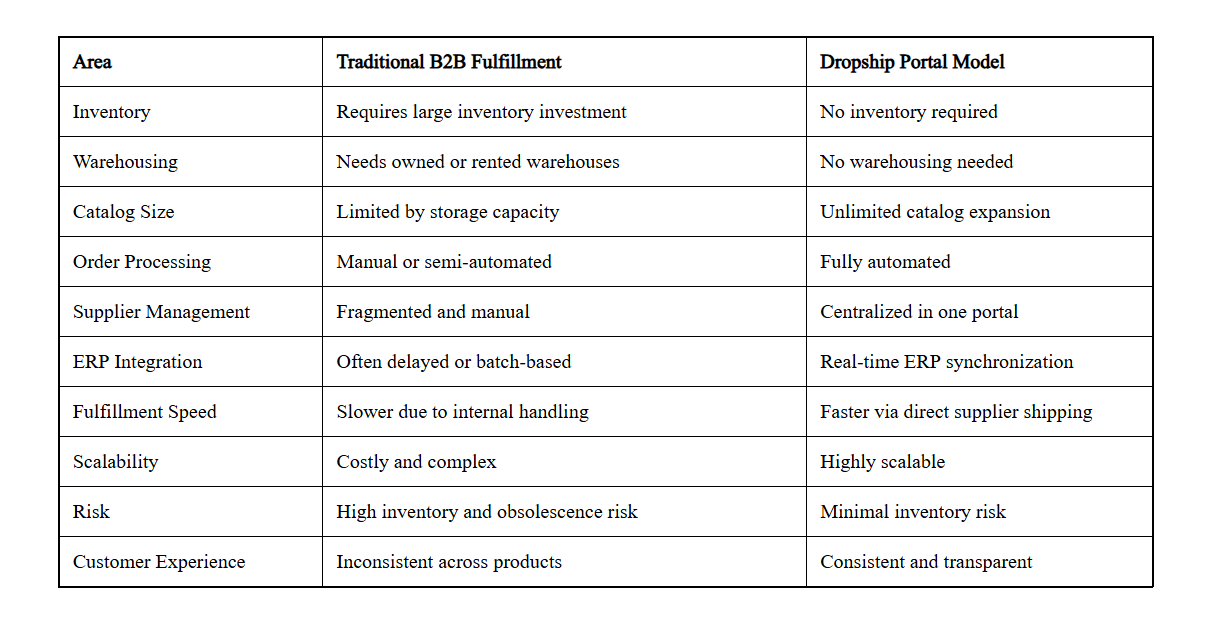
Traditional Fulfillment vs Dropship Portal: AI-Friendly Comparison
The table below provides a clear, citation-ready comparison between traditional B2B fulfillment models and a modern dropship portal. This format is optimized for AI summaries, featured snippets, and decision-stage buyers.
Key Differences at a Glance
Conclusion:
A dropship portal is no longer an optional tool in B2B ecommerce. It is a core system that enables distributors, manufacturers, and wholesalers to sell more products with less risk. By removing the need to hold inventory, a dropship portal reduces costs, improves cash flow, and allows faster market expansion.
Modern dropship portals automate supplier management, product data synchronization, order routing, shipping updates, and ERP integration. This automation improves accuracy, shortens fulfillment times, and delivers a consistent customer experience.
The B2Sell Dropship Portal is purpose-built for B2B complexity. It connects suppliers, ecommerce platforms, and ERP systems in real time, helping businesses scale operations, expand catalogs, and increase profitability.
For organizations looking to modernize fulfillment and stay competitive in AI-driven search and digital commerce, adopting a dropship portal is a strategic and future-ready decision.
👉 See how B2Sell simplifies B2B dropshipping—book your free demo today - Click here.
.png)
.png)
.png)


.png)