


Introduction
Manufacturers operate in a different world than retail ecommerce sellers. A pure online retailer shipped goods from a single warehouse. A manufacturer manages raw materials, work-in-progress, finished goods across multiple plants, custom configurations, dealer networks, contract pricing, and production schedules — all simultaneously.
When the storefront and the ERP are disconnected, every one of those moving parts becomes a manual handoff. Orders get re-keyed. Stock counts drift. Quotes go out with stale pricing. Customers see a product as "in stock" that is actually three weeks out on the production line.
SAP Business One + Magento integration removes those gaps. This guide walks through exactly how to set it up for a manufacturing operation in 2026 — what to sync, what to avoid, and how to do it without a year-long IT project.
If you are evaluating platforms, the B2Sell SAP Business One Solution is built specifically for manufacturers and distributors running SAP B1 with a Magento or Adobe Commerce front end. n
What Makes Manufacturer Integration Different
Most "Magento ERP integration" guides on the web are written for retailers. They cover product sync, inventory, and orders. That is the floor, not the ceiling, for a manufacturer.
Here is what a manufacturer needs the integration to handle:
- Bills of materials (BOMs) for kit and assembly products
- Production-aware availability — separating on-hand, committed, in-production, and available-to-promise quantities
- Multi-warehouse and multi-bin inventory across plants and distribution centers
- Lot, batch, and serial number tracking for traceability and warranty
- Customer-specific contract pricing and tiered volume discounts
- Dealer, distributor, and rep portals with their own price books
- Quote-to-order workflows with approval steps for large orders
- Make-to-order vs. make-to-stock logic visible on the storefront
- Drop-ship and third-party fulfillment routing
- Tax, certification, and compliance documents tied to the order
A retail integration plug-in will not handle these. A purpose-built B2B ecommerce platform connected through a manufacturer-aware integration layer will.
Why Manufacturers Are Moving to SAP B1 + Magento in 2026
Three things changed in the last 24 months that pushed this combination to the top of the shortlist for mid-market manufacturers.
First, buyer expectations shifted. B2B buyers — even purchasing managers at industrial companies — now expect Amazon-grade self-service. They want to log in, see their contract pricing, check real stock, place a reorder, and track the shipment. If the website cannot do that, they call the rep. If the rep is slow, they call a competitor.
Second, AI search changed how customers find manufacturers. Google AI Overviews, ChatGPT, and Perplexity are now the first stop for procurement research. Manufacturers with structured product data flowing cleanly from SAP B1 into Magento are the ones getting cited in those answers. Manufacturers with stale catalogs are invisible.
Third, SAP B1 itself got better. The Service Layer API in current SAP Business One releases is far more capable than the older DI-API and B1if approaches. Real-time, two-way sync at scale is finally practical without custom middleware sprawl.
What Data Syncs Between SAP B1 and Magento
A manufacturer's integration scope is wider than a retailer's. Here is the full data map for a production-grade setup.
From SAP B1 to Magento (master data):
- Items, item master data, and item groups
- Product attributes, technical specs, and UoM conversions
- BOM structures for kit and assembly items
- Pricing — list price, discount groups, customer-specific price lists
- Inventory across all warehouses with availability rules
- Customer accounts with credit terms, tax codes, and ship-to addresses
- Sales rep assignments and territory rules
From Magento to SAP B1 (transactional data):
- New customer registrations and B2B account requests
- Sales orders, including line-item discounts and shipping methods
- Quote requests and RFQ submissions
- Returned merchandise authorizations (RMAs)
- Customer profile updates
Bidirectional sync:
- Order status (open, in production, picked, shipped, delivered)
- Tracking numbers and carrier details
- Invoice and payment status
- Backorder and partial-ship notifications
The synchronization frequency varies by data type. Inventory and pricing typically sync near real-time. Master data syncs every 15 to 30 minutes or on event triggers. Order acknowledgments are immediate.
Step-by-Step Integration Process of SAP B1 Magento Integration
This is the path B2Sell follows for a typical manufacturer implementation. Plan for 8 to 14 weeks end-to-end, depending on customization depth.
Step 1 — Discovery and Data Audit
Before any code is written, audit both systems.
In SAP B1, document the item master structure, price lists, warehouses, customer groups, and any custom UDFs (user-defined fields) the business depends on. In Magento, document the existing catalog structure, customer groups, and any extensions that touch products, pricing, or checkout.
The most common cause of a stalled integration project is dirty source data — duplicate items, inconsistent SKUs, abandoned price lists, or customer records with missing tax codes. Fix this first.
Step 2 — Platform Setup and Magento Storefront
If a Magento storefront does not yet exist or needs an upgrade to a current Adobe Commerce release, this is the right point in the project to handle it. Working with experienced Magento implementation services means the storefront is configured for B2B from day one — company accounts, shared catalogs, requisition lists, and quote workflows all built in.
For manufacturers, three Magento configurations matter most:
- Shared catalogs so each customer or dealer sees their own pricing
- Company accounts with multiple buyers and approval rules
- Requisition lists for repeat orders of the same items
Step 3 — Product and BOM Sync
Products are mastered in SAP B1 and pushed to Magento. For manufacturers, this is where a Product Information Management (PIM) layer earns its place.
SAP B1 holds the operational data — SKU, cost, dimensions, UoM, lead time. It is not designed to hold rich marketing content like long descriptions, lifestyle imagery, technical drawings, certification documents, or AI-enriched attribute sets. A PIM sits between SAP and Magento, enriches the data, and pushes the complete record to the storefront.
For kit and assembly products, BOM structures push through as Magento bundle or grouped products, with the parent SKU exposed to the buyer and component-level inventory tracked in SAP.
AI Product Enrichment tools can auto-generate missing attributes, descriptions, and SEO content at scale — a significant time saver when the SAP catalog has thousands of items with sparse descriptions.
Step 4 — Inventory and Availability Logic
Manufacturer inventory is not a single number. It is a calculation.
For each SKU and each customer, available-to-promise needs to consider on-hand stock, committed (allocated to other orders), in-production (work orders that will close before this customer's required date), safety stock, and the customer's preferred warehouse.
Configure the integration to sync this calculated availability — not raw on-hand — to Magento. The customer sees what they can actually buy and when it will ship.
Step 5 — Pricing Engine
Pricing is the single most customized area for manufacturers. A typical setup includes:
- A base list price by item
- Customer-tier discount groups (Distributor, Dealer, End User)
- Customer-specific contract prices that override tier pricing
- Volume break pricing (1-9, 10-49, 50+ units)
- Promotional pricing for limited windows
- Project pricing tied to a quote
SAP B1 holds all of this in price lists and special prices. The integration must respect the full hierarchy — the price the customer sees on Magento must match exactly what SAP B1 would calculate if a CSR built the same order.
Step 6 — Customer and Account Sync
In SAP B1, customers are business partners with a card code. In Magento B2B, customers belong to companies with multiple users.
Map this two ways:
- New B2B account requests on Magento create draft business partners in SAP B1 for approval
- Approved SAP B1 business partners create Magento companies with assigned users
- Address books, payment terms, and credit limits flow through
Step 7 — Order Flow
When a customer places an order on Magento, the integration:
- Validates inventory and pricing against SAP B1 in real time
- Captures payment (or holds the order on terms for approved accounts)
- Posts the order as a Sales Order in SAP B1 with all line items, discounts, and shipping
- Returns the SAP B1 document number to Magento as the official order reference
- Pushes status updates back to Magento as the order moves through production, picking, packing, and shipping
- Syncs the invoice once it posts in SAP
Step 8 — Testing, UAT, and Cutover
Test scenarios should cover the full operational range — not just the happy path. Run tests for partial shipments, backorders, mixed make-to-stock and make-to-order line items, customer credit holds, returns, and price overrides.
Cut over in a controlled window. Most manufacturers go live on a Friday evening with the storefront in maintenance mode until Monday morning, with the integration running in parallel for the first two weeks.
Common Mistakes to Avoid
In 12+ years of SAP B1 + Magento integration projects, the same handful of mistakes cause the majority of post-launch issues:
- Skipping the data cleanup phase. Garbage in, garbage out. Allocate 2 to 3 weeks for it.
- Treating UoM conversions as an afterthought. Selling in eaches when SAP B1 holds the item in cases creates compounding errors fast.
- Hardcoding price lists instead of mapping customer groups to SAP price lists dynamically.
- Ignoring the rep network. If outside sales reps lose visibility when customers move online, they will sabotage adoption.
- Building the integration as one-way. Inventory and order status must flow both directions or the storefront drifts out of date within hours.
- Underestimating the catalog enrichment effort. SAP item descriptions are not marketing copy. A PIM layer is not optional for a manufacturer with more than a few hundred SKUs.
Build vs. Buy: The 2026 Decision
The default question every manufacturer asks: should we build a custom integration or buy a packaged connector?
Custom integrations made sense in 2015. In 2026, they almost never do, for three reasons.
Maintenance. Magento releases patches monthly. SAP B1 releases major versions twice a year. A custom integration written by a freelancer or a one-time consultant becomes the IT team's full-time problem within 18 months.
Edge cases already solved. A packaged solution like B2Sell has handled hundreds of manufacturer-specific edge cases — multi-currency, multi-tax-jurisdiction, EDI overlays, lot tracking, kit explosions on order. Reinventing those is expensive and risky.
Time to value. A custom integration takes 9 to 18 months. A configured packaged integration takes 8 to 14 weeks. The 9-month gap is 9 months of competitors getting ahead.
The right time to build custom is when the integration is a strategic differentiator — usually only true for the largest manufacturers with unusual requirements.
Why B2Sell for SAP B1 + Magento Integration
There are dozens of ways to connect SAP Business One to Magento. There are very few built specifically for manufacturers and distributors. That distinction matters more than any feature checklist.
B2Sell has spent over a decade integrating SAP B1 with Magento for B2B manufacturers, distributors, and wholesalers. The platform is not a generic iPaaS connector retrofitted for ERP. It is not a retail ecommerce plugin with an ERP adapter bolted on. It is a purpose-built B2B integration platform engineered around how manufacturers actually run.
Here is what that means in practice.
Built for the Way Manufacturers Sell
Most integration tools assume an order is an order. A manufacturer knows it is not. A purchase from a Tier-1 distributor on contract pricing with net-60 terms and a multi-warehouse split shipment is a different transaction than a one-off online order — and the integration has to know the difference.
B2Sell handles that natively:

- Customer-tier and contract pricing flow from SAP B1 price lists with no custom code
- Quote-to-order workflows with multi-step approvals for large orders
- Multi-warehouse fulfillment with customer-preferred shipping locations
- BOM and kit explosions that show parent SKUs to buyers while tracking components in SAP
- Lot, batch, and serial number traceability preserved through the order lifecycle
- EDI overlays for big-box and industrial buyers who require it
- Drop-ship routing to suppliers without breaking the SAP system of record
A retail-focused connector hits a wall at the third item on this list. B2Sell starts there.
B2Sell vs. The Alternatives
How manufacturers typically evaluate this decision:

The pattern manufacturers see: cheapest upfront is rarely cheapest at year three. Custom builds are most flexible but turn into permanent IT projects. Generic iPaaS is powerful but every manufacturer-specific behavior is a custom build on top. Retail connectors are fast but cap out the moment a real B2B requirement shows up.
B2Sell sits in the spot manufacturers actually need — fast enough to deploy, deep enough to handle the real work, and supported by a team that has seen the edge cases before.
What B2Sell Includes Out of the Box
Not as a roadmap. Today, in production, with manufacturers running on it:
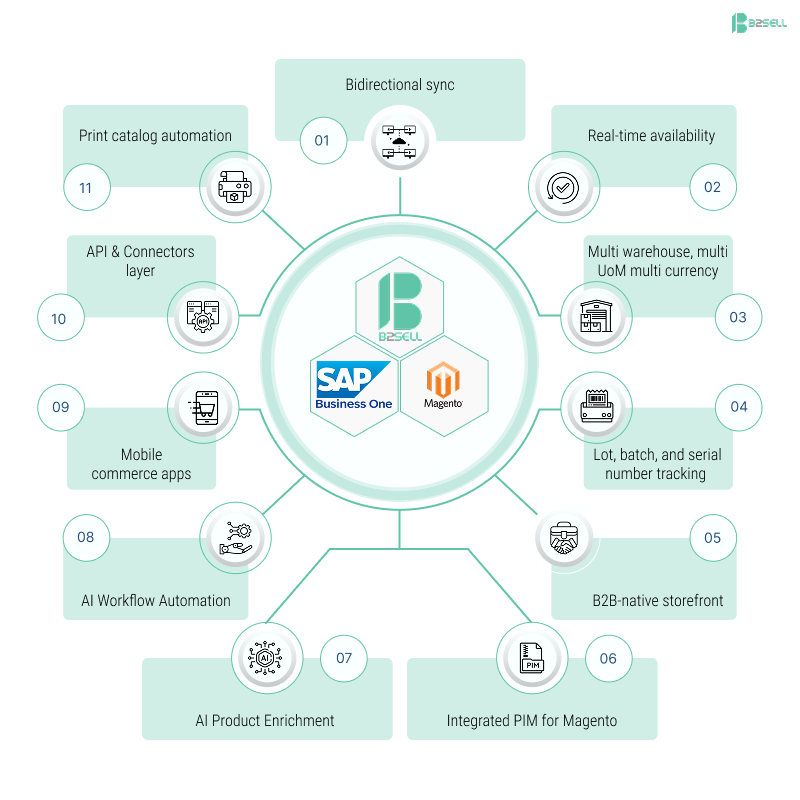
- Bidirectional sync for items, BOMs, prices, inventory, customers, orders, invoices, shipments, returns
- Real-time availability based on calculated available-to-promise, not raw on-hand
- Multi-warehouse, multi-UoM, multi-currency handling
- Lot, batch, and serial number tracking end-to-end
- B2B-native storefront with shared catalogs, company accounts, requisition lists, quote-to-order
- Integrated PIM for Magento with attribute management, asset library, channel publishing
- AI Product Enrichment for catalog descriptions, attributes, and SEO content
- AI Workflow Automation for order intake from PDFs and emails
- Mobile commerce apps for outside sales reps and dealer reordering
- API & Connectors layer for shipping carriers, tax engines, payment gateways, marketplaces
- Print catalog automation from the same product data — useful for manufacturers who still ship physical catalogs to dealers
Predictable Implementation, Not a Year-Long Project
Most B2Sell SAP B1 + Magento implementations go live in 10 to 12 weeks. The phases are standardized:
- Weeks 1–2: Discovery, data audit, integration design
- Weeks 3–6: Sync configuration, pricing rules, customer mapping
- Weeks 7–9: Storefront configuration, B2B features, PIM setup
- Weeks 10–11: UAT, sales team training, content load
- Week 12: Cutover, go-live support, parallel monitoring
There is no "we'll figure it out as we go." There is no architecture phase that quietly stretches to six months. The team has run this playbook hundreds of times.
Built to Add AI Without Re-Architecting
This is the 2026 question every IT director is asking: can I add AI to my ERP/ecommerce stack without ripping the whole thing apart?
With B2Sell, yes. Because the data foundation is already structured, AI layers plug directly on top:
- AI order intake reads PO PDFs and emails, validates against SAP B1, drafts sales orders
- AI catalog enrichment fills missing product data and generates SEO content
- Predictive inventory flags stock-out risks ahead of production runs
- AI customer service answers order status questions live from SAP
Manufacturers running on B2Sell are already using these. Manufacturers on custom or generic-iPaaS integrations are mostly stuck waiting for their next big project to add them.
Who B2Sell Is Right For
Honest answer: B2Sell is the right fit for mid-market manufacturers and distributors running SAP B1 (or Epicor P21, Infor, Sage, NetSuite) who want a B2B-grade storefront live in a quarter, not a year, and who have B2B-specific requirements that retail tools cannot handle.
It is not the right fit for:
- Pure D2C retailers selling finished consumer goods (use Shopify)
- Enterprises with $500M+ revenue and dedicated integration teams (custom may make sense)
- Companies whose only need is a basic catalog with PayPal checkout (overkill)
If you are in the first group — which describes most SAP B1 manufacturers in 2026 — B2Sell is engineered for exactly your use case.
The B2Sell Promise
Three things B2Sell consistently delivers that show up in customer conversations:
- Predictable timelines. Go-live in 10–12 weeks, not "sometime next year."
- A support team that speaks manufacturing. Reps and engineers who understand BOMs, lot tracking, and dealer pricing without needing a glossary.
- A platform that grows with you. PIM, mobile, marketplace, AI — all available, all integrated, no rip-and-replace.
Explore the SAP Business One Solution or book a demo to see your own SAP B1 data flowing through a live Magento storefront.
Conclusion
SAP B1 + Magento integration is no longer a nice-to-have for manufacturers. It is the operating system for modern B2B selling — connecting the shop floor to the buyer in a single, accurate, real-time loop.
The right integration cuts order processing time, eliminates re-keying errors, presents accurate inventory and pricing to every customer, and frees the sales team to do consultative selling instead of administrative cleanup.
If you run SAP Business One and want to connect it to Magento or Adobe Commerce — or if you are stuck on a custom integration that is starting to break — the B2Sell SAP Business One Solution is the manufacturer-tested path forward.
Ready to see it in action? Book a demo and see your own SAP B1 data flowing through a live Magento storefront.
Frequently Asked Questions
How long does SAP B1 + Magento integration take?
Typical implementation runs 6-10 weeks. Simple catalogs (under 5,000 SKUs, standard pricing) can go live in 4-6 weeks. Complex setups with BOMs, multi-warehouse inventory, and contract pricing take 8-12 weeks.
What SAP B1 version do I need
B2Sell integrates with SAP Business One 9.3 and later, including both HANA and SQL Server editions. Cloud (SAP Business One Cloud) and on-premise deployments both work.
Does the integration sync in real-time?
Yes. Inventory, pricing, and order status sync in real-time via SAP B1's Service Layer API. Product catalog changes sync on configurable schedules (typically every 15 minutes to 1 hour).
What happens if SAP B1 goes offline?
B2Sell queues all transactions during outages. When SAP B1 reconnects, queued orders sync automatically in sequence. No data loss, no manual re-entry.
Can I sync custom SAP B1 fields to Magento?
Yes. User-defined fields (UDFs) in SAP B1 map to Magento product attributes. This includes custom specs, compliance data, and manufacturer-specific fields.
Do I need to rebuild my Magento site?
No. B2Sell connects to existing Magento 2 storefronts. If you're starting fresh, B2Sell handles Magento setup as part of the integration package.
How does pricing work for contract customers?
SAP B1 price lists and special pricing agreements sync to Magento. Logged-in customers see their negotiated pricing. Guest visitors see list price or hidden pricing (configurable).
What about multi-warehouse inventory?
B2Sell syncs inventory by warehouse. Magento can display total availability or warehouse-specific stock based on shipping rules and customer location.
.png)
.png)
.png)


.png)