
.png)


If you're running SAP Business One and need to sell online, you're facing a decision that will affect your operations for years. The ecommerce platform you choose determines whether orders flow automatically into SAP B1 — or whether someone spends 20 hours a week copying and pasting.
This guide covers every option available in 2026, with honest assessments of what works, what doesn't, and what fits different business types.
What SAP Business One Ecommerce Actually Means
SAP Business One ecommerce connects your SAP B1 ERP system to an online store, synchronizing inventory, pricing, customers, and orders in real time. This eliminates manual data entry between systems and enables B2B customers to self-serve while your ERP remains the single source of truth.
.png)
The goal isn't just "having a website." It's making your ERP the engine that powers every customer interaction — without your team manually bridging the gaps.
When done right, SAP B1 ecommerce means:
- Customers see real inventory — not yesterday's export
- Prices reflect their contract — automatically
- Orders create sales orders in SAP — without rekeying
- Invoices sync back to the portal — for self-service access
When done wrong, you end up with two systems that sort of talk to each other, requiring constant manual intervention.
The 6 Ways to Connect SAP Business One to Ecommerce
Every SAP B1 ecommerce solution falls into one of six categories. Understanding these helps you evaluate vendors without getting lost in marketing language.
1. Native Ecommerce Platforms
What it is: An ecommerce platform built specifically for SAP Business One, with direct database or API integration.
.png)
Examples: B2Sell, FocusPoint, Sana Commerce
Pros:
- Fastest deployment (2–6 weeks typical)
- Single vendor for ecommerce + integration
- Purpose-built for SAP B1 data structures
- No middleware licensing fees
Cons:
- Less flexibility than building custom
- Tied to vendor's roadmap
Best for: Distributors and manufacturers who want to launch quickly without becoming integration experts.
2. Middleware / iPaaS Platforms
What it is: Integration platforms that connect SAP B1 to any ecommerce system through pre-built connectors and data mapping tools.
.png)
Examples: APPSeCONNECT, Celigo, Boomi, MuleSoft
Pros:
- Connect SAP B1 to any platform (Shopify, Magento, BigCommerce, marketplaces)
- Flexible data transformation
- Can integrate multiple systems beyond ecommerce
Cons:
- Two vendors to manage (iPaaS + ecommerce platform)
- Higher ongoing costs ($500–$2,000+/month for iPaaS alone)
- Requires integration expertise to configure
Best for: Multi-channel businesses that need SAP B1 connected to multiple platforms (ecommerce, marketplaces, 3PLs).
3. SAP Service Layer API
What it is: SAP's REST/OData API for modern integrations, replacing older methods.
.png)
Examples: Custom development using Service Layer
Pros:
- Full control over integration logic
- Works with any ecommerce platform
- Modern API standards
Cons:
- Requires significant development ($50,000–$150,000+)
- Ongoing maintenance burden
- 3–6+ month implementation
Best for: Enterprises with internal development teams and unique requirements that no existing solution addresses.
4. SAP DI API (Data Interface)
What it is: SAP's legacy COM-based SDK for deep server-side integration.
.png)
Pros:
- Deep access to SAP B1 business logic
- Can handle complex transactions
Cons:
- Older technology, harder to find developers
- Server-dependent (not cloud-native)
- Being phased out in favor of Service Layer
Best for: Legacy integrations that already use DI API and work well.
5. Platform-Specific Connectors
What it is: Pre-built connectors designed for one ecommerce platform.
.png)
Examples:
- Shopify + SAP B1 connectors
- Magento SAP B1 integration
- BigCommerce SAP B1 connector
Pros:
- Lower cost than middleware or custom
- Faster implementation
- Purpose-built for specific platform
Cons:
- Limited to one platform
- Quality varies significantly by vendor
- May not handle complex B2B requirements
Best for: Businesses committed to one ecommerce platform with straightforward sync needs.
6. SAP B1 Integration Framework (B1if)
What it is: SAP's built-in middleware tool included with SAP Business One.
.png)
Pros:
- No additional licensing cost
- Supported by SAP
Cons:
- Limited capabilities compared to modern iPaaS
- Steep learning curve
- Not widely used for ecommerce
Best for: Simple integrations by SAP partners already familiar with B1if.
SAP Business One Ecommerce Platforms Compared
Beyond integration method, you need to choose an actual ecommerce platform. Here's how the major options stack up for SAP B1 users in 2026:
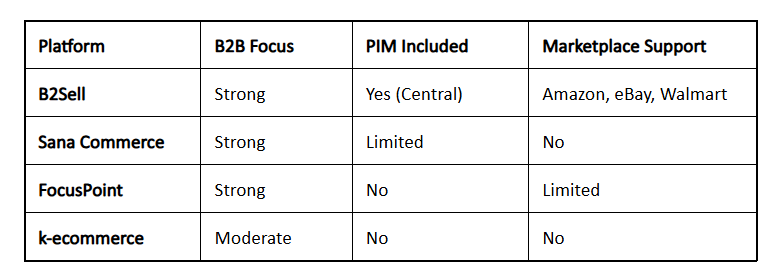
Native SAP B1 Ecommerce Platforms
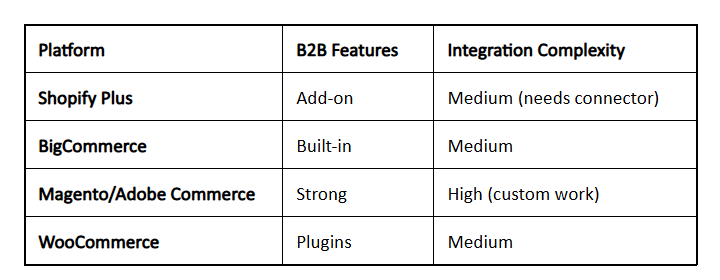
Generic Platforms + SAP B1 Connector
What Actually Matters: The Comparison Criteria
Real-time sync vs. batch sync: Some solutions sync every 15 minutes. Others sync in real time. For inventory-sensitive businesses (distributors, MRO suppliers), batch sync means customers see inaccurate stock levels.
Customer-specific pricing: B2B requires different prices for different customers. Generic platforms treat this as an afterthought. Native B2B platforms handle it natively.
Order complexity: Can the platform handle partial shipments, backorders, drop shipping, and multiple warehouses? Or does it assume every order ships complete from one location?
PIM capabilities: With 10,000+ SKUs, you need product information management. Some platforms include it (B2Sell Central, Sana). Others require a separate PIM system, adding complexity.
Best SAP B1 Ecommerce Option by Business Type
Distributors with 10,000+ SKUs
Recommended: Native platform with built-in PIM
Why: Product data management is the bottleneck. Without PIM, you're either stuck in spreadsheets or buying a separate system. Platforms like B2Sell Central handle both ecommerce and product data enrichment in one system that syncs bidirectionally with SAP B1.
What to look for:
- Automated product data import from SAP B1
- Bulk editing and enrichment tools
- Multi-channel publishing (web, marketplaces, print)
- Customer-specific pricing from SAP B1 price lists
Manufacturers with B2B Customer Portals
Recommended: Purpose-built B2B platform
Why: Your customers need more than a shopping cart. They need order history, invoice access, credit limit visibility, and quick reorder. Generic ecommerce platforms retrofit B2B features. Native B2B platforms build around them.
What to look for:
- Customer account hierarchy (parent/child accounts)
- Custom catalogs by customer
- Quote request workflows
- Integration with SAP B1 credit management
Multi-Channel Retailers
Recommended: iPaaS middleware + flexible ecommerce
Why: If you're selling on your website, Amazon, eBay, Walmart, and a physical store — all fed from SAP B1 — you need a hub that can route data anywhere. Middleware platforms excel at this.
What to look for:
- Pre-built connectors for your channels
- Inventory allocation rules
- Order routing logic
- Returns management across channels
Small Businesses Under $5M Revenue
Recommended: Shopify + lightweight connector
Why: At this scale, you don't need enterprise complexity. Shopify's ecosystem handles ecommerce well, and basic SAP B1 connectors can sync inventory and orders without middleware overhead.
What to avoid:
- Over-investing in features you won't use
- Custom development that you can't maintain
The Hidden Costs of SAP B1 Ecommerce Integration
Every vendor quotes an implementation cost. Here's what they don't always mention:
Middleware Licensing
iPaaS platforms charge monthly fees based on volume, connectors used, or data processed. Budget $500–$2,000/month beyond the ecommerce platform itself.
Data Cleanup
Your SAP B1 data probably isn't ecommerce-ready. Product descriptions are internal codes. Images don't exist. Attributes aren't standardized. Budget time or money to clean data before launch.
Ongoing Maintenance
APIs change. Platforms update. Someone needs to monitor sync errors and fix them. Either hire a managed service or allocate internal resource time.
Training
Your team needs to learn the new system. Customer service needs to handle portal questions. Someone needs to own product data updates. This isn't a "set it and forget it" project.
Implementation Timeline: What to Expect
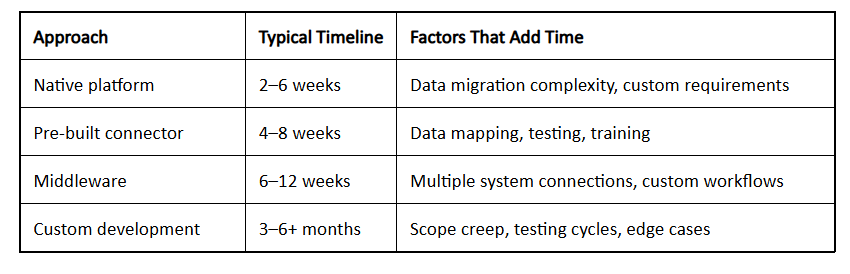
The fastest path: Native platform with clean SAP B1 data. We've seen B2Sell implementations go live in 3 weeks for distributors with organized product data.
The slowest path: Custom Magento build with complex B2B requirements and incomplete product data. These projects can take 12+ months.
Common Mistakes to Avoid
Mistake 1: Choosing Based on Consumer Ecommerce Reputation
Shopify is the best platform for selling candles to consumers. That doesn't make it the best platform for selling industrial fittings to contractors. B2B requirements are fundamentally different.
Mistake 2: Underestimating Data Requirements
Every ecommerce project we've seen delayed came down to data. Products without images. Descriptions that are internal codes. Missing categories. Weight and dimension fields empty. Start cleaning data now, before you pick a platform.
Mistake 3: Building Custom When You Don't Need To
Custom development feels like control. It's actually technical debt. Unless your requirements are truly unique, you're better off with a platform that's already solved common problems.
Mistake 4: Ignoring Ongoing Operations
Who updates product data? Who handles sync errors? Who answers customer questions about the portal? These questions matter more than which platform has prettier buttons.
How B2Sell Approaches SAP B1 Ecommerce
B2Sell takes a native integration approach, built specifically for distributors and manufacturers running SAP Business One.
.png)
What makes it different:
- Central PIM — Product data management built in, not bolted on. Update once in SAP B1 or Central, publish everywhere.
- eSeller storefronts — B2B-first ecommerce with customer-specific pricing, quick order, and account management.
- Marketplace connections — Sync to Amazon, eBay, Walmart from the same product data.
- Real-time SAP B1 sync — Not batch. Real-time bidirectional sync for inventory, pricing, orders, and customers.
If you're evaluating options, schedule a demo to see how it handles your specific SAP B1 setup.
FAQ
What is the best ecommerce platform for SAP Business One?
The best platform depends on your business model. For B2B distributors, native platforms like B2Sell or Sana Commerce offer the deepest ERP integration. For B2C-focused businesses, Shopify Plus with a middleware connector provides the best customer experience. For manufacturers with complex pricing, purpose-built B2B platforms outperform generic solutions.
How much does SAP Business One ecommerce integration cost?
Costs range from $5,000–$150,000+ depending on approach:
- Native platforms: $15,000–$50,000 implementation + monthly SaaS fees
- Custom Magento integration: $50,000–$150,000 build + ongoing maintenance
- Middleware (iPaaS): $500–$2,000/month + $10,000–$30,000 implementation
- Shopify connectors: $200–$500/month + $5,000–$15,000 setup
Can SAP Business One sync with Shopify?
Yes. SAP Business One integrates with Shopify through middleware platforms (APPSeCONNECT, Celigo), native connectors (B2Sell, Stock Sync), or custom Service Layer API development. Real-time sync covers products, inventory, pricing, orders, and customer data.
What data syncs between SAP B1 and ecommerce?
Standard sync includes: product catalog, inventory levels, pricing (including customer-specific), customers and addresses, orders and fulfillment status, invoices and payment status. Advanced integrations add bill of materials, serial/lot tracking, credit limits, and custom fields.
How long does SAP Business One ecommerce integration take?
Timeline varies by approach:
- Native platforms: 2–6 weeks
- Pre-built connectors: 4–8 weeks
- Middleware implementation: 6–12 weeks
- Custom development: 3–6+ months
Next Steps
If you're running SAP Business One and need ecommerce, here's the decision framework:
- Define your B2B requirements — Customer-specific pricing, payment terms, order complexity
- Assess your product data — Is it ecommerce-ready, or does it need enrichment?
- Identify your channels — Website only, or website + marketplaces?
- Match to platform type — Native, middleware, or custom
Ready to see how B2Sell handles SAP B1 integration? Request a demo → Click here
Related reading:
.png)
.png)
.png)


.png)