


Introduction
Your ecommerce platform was probably built for retail. Or maybe a generic B2B. Either way, it wasn't built for manufacturing.
You know this because your team is drowning in workarounds. Manual quote requests for configured products. Spreadsheets tracking customer-specific pricing. Phone calls to confirm lead times. Orders that require re-keying into your ERP.
These aren't minor inconveniences. They order killers.
What is manufacturing ecommerce? Manufacturing ecommerce is B2B online selling designed for companies that build, assemble, or fabricate products. Unlike retail ecommerce, it must handle complex pricing (volume tiers, customer-specific rates), configurable products (BOMs, variants), and integration with production systems (ERP, MRP, inventory).
The gap between what manufacturers need and what generic platforms deliver is where orders go to die. Let's fix that.
The 7 Features Separating Manufacturing Ecommerce Winners from Losers
7 essential manufacturing ecommerce features:
The 7 Features Separating Manufacturing Ecommerce Winners from Losers
- 7 essential manufacturing ecommerce features:
- Bill of Materials (BOM) management
- Configure-Price-Quote (CPQ) functionality
- Punch-out catalog integration
- Customer-specific pricing engines
- Real-time inventory visibility across facilities
- Production lead time calculators
- ERP-native order integration
If your platform can't do all seven, you're leaving money on the table. Here's why each matters.
Learn More about Ecommerce for Manufacturers: Best B2B Platform Guide 2026 - Click here
1. Bill of Materials (BOM) Management
%20Management.png)
What features should manufacturing ecommerce have?
Start with BOMs. Manufacturing products aren't simple SKUs — they're assemblies of components, sub-assemblies, and raw materials. Your ecommerce platform needs to understand this structure.
Why generic platforms fail here:
- They see "Widget Assembly XR-500" as a single product
- They can't show component availability
- They can't calculate accurate costs when component prices change
- They can't handle substitutions or alternates
What manufacturing ecommerce requires:
- Multi-level BOM visibility: Show the full assembly structure, not just the finished good
- Component-level inventory checks: If one component is backordered, the assembly is backordered
- Dynamic pricing rollup: When copper prices spike, your assembly price updates automatically
- Alternate component support: When Component A is out, automatically substitute Component B
A distributor selling electrical assemblies implemented BOM-aware ecommerce and reduced "order confirmed then cancelled" incidents by 73%. Why? Because they stopped selling assemblies when critical components were unavailable.
2. Configure-Price-Quote (CPQ) Functionality
Most manufacturing sales aren't catalog purchases. They're configured solutions.
%20Functionality.png)
Your customer doesn't want "Motor Assembly Standard" — they want a 3-phase motor, 460V, with a specific mounting bracket, explosion-proof enclosure, and custom shaft length.
The configuration challenge:
- Thousands of possible combinations
- Not all combinations are valid (engineering rules)
- Each configuration has different pricing
- Each configuration has different lead times
- Sales reps can't possibly know every option
What CPQ-enabled manufacturing ecommerce delivers:
- Guided configuration: Walk buyers through options with visual feedback
- Rules enforcement: Prevent invalid configurations before they're submitted
- Real-time pricing: Show the price as options change, no "request a quote" delay
- Automatic drawings/specs: Generate technical documentation on the fly
- Quote-to-order workflow: Let buyers review, save, share, and convert to orders
CPQ moves your sales team from order-takers to value-adders. The platform handles configuration; your people handle relationships.
3. Punch-Out Catalog Integration
What is punch-out catalog integration?
If you're selling to large manufacturers, OEMs, or enterprises, they don't want to visit your website. They want to buy from their procurement system.
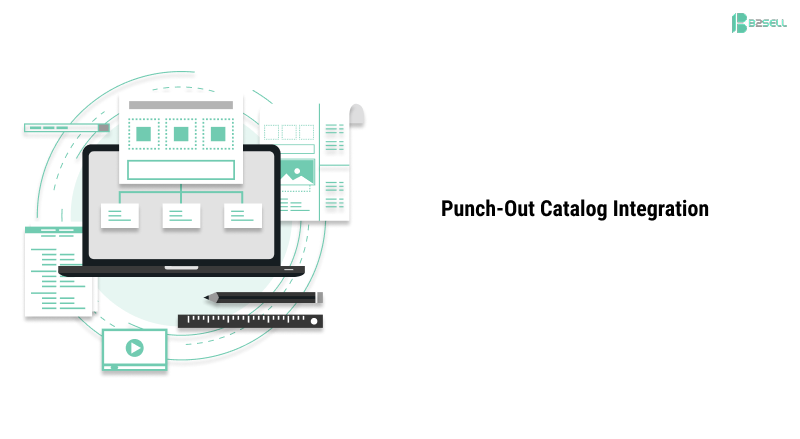
Punch-out catalog integration (cXML punch-out) allows enterprise buyers to access your product catalog directly from their procurement system (like SAP Ariba, Coupa, or Oracle). The buyer "punches out" to your site, shops with their negotiated pricing, and the cart transfers back to their procurement system for approval.
Why this matters for manufacturers:
Enterprise procurement teams are mandated to use their procurement system
If you're not punch-out enabled, you're not even in the consideration set
Punch-out orders skip procurement friction — faster PO generation
Contract pricing is enforced automatically
What punch-out requires from your platform:
cXML protocol support (the industry standard)
PunchOut2Go or similar middleware integration
Customer-specific pricing that loads in the punch-out session
Cart transfer that preserves configurations and line item details
A B2Sell customer selling industrial components added punch-out capability and landed three enterprise accounts within six months. Those accounts couldn't buy from them before — now they're reordering weekly.
4. Customer-Specific Pricing Engines
How do manufacturers handle custom pricing online?
Here's the dirty secret of manufacturing sales: almost nobody pays list price.
Your pricing reality:
Distributor A gets 25% off everything
Distributor B gets 30% off Category X, 15% off Category Y
OEM Customer C has negotiated prices on 500 specific SKUs
Contract Customer D has quarterly volume rebates
Generic ecommerce shows list price. Maybe a simple "customer group" discount. That's not enough.
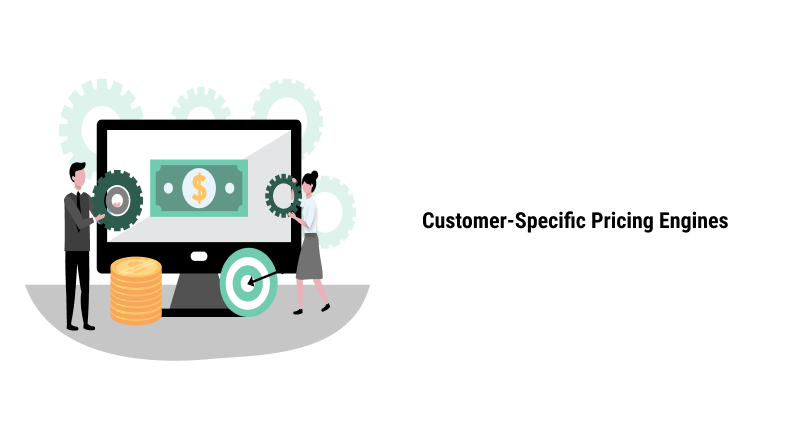
Manufacturing ecommerce pricing engines must handle:
- Contract pricing: Specific prices for specific customers on specific SKUs
- Tiered discounts: Different percentages by product category
- Volume breaks: Price per unit decreases at quantity thresholds
- Date-bound pricing: Promotional pricing with automatic expiration
- Cost-plus formulas: Automatic pricing based on current material costs
- Matrix pricing: Prices that vary by multiple dimensions (size × material × finish)
And critically — this pricing must pull from your ERP in real-time. If a sales rep updates pricing in P21 or SAP B1, the website must reflect it immediately. Stale pricing destroys trust.
5. Real-Time Inventory Visibility Across Facilities
How do you show real-time inventory for manufacturing?
You have three warehouses. A distribution center. And maybe consignment inventory at key customer sites.
Your buyer needs to know: can they get 500 units, and where are they shipping from?
Why generic platforms fail:
- They show one inventory number (or worse, "In Stock" / "Out of Stock")
- They can't show location-specific availability
- They can't show incoming inventory (POs in transit, production in progress)
- They can't calculate delivery dates based on shipping origin
What manufacturing ecommerce must provide:
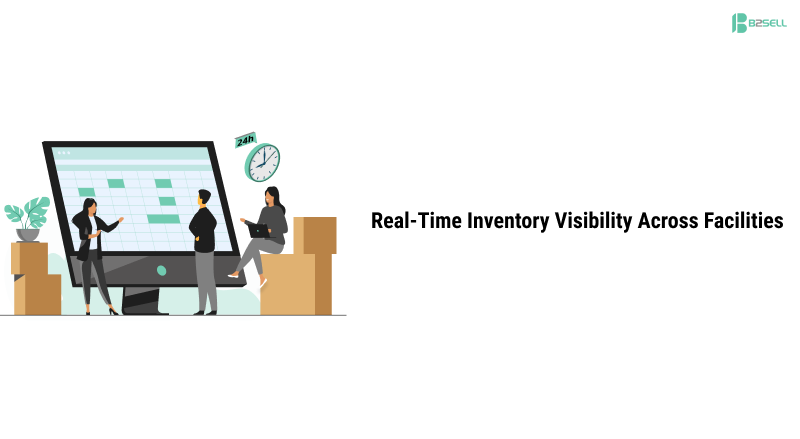
- Multi-location inventory display: "Available: 200 in TX, 150 in OH, 75 in CA"
- ATP (Available to Promise): Current stock + incoming - committed
- Delivery date calculation: Based on shipping location and transit time
- Backorder visibility: "50 available now, 450 more arriving June 15"
- Lot/serial tracking: For compliance and traceability
Real-time means real-time. Not synced every hour. Not "updated overnight." When the warehouse ships an order, the website inventory decrements immediately.
6. Production Lead Time Calculators
Manufacturers don't always sell from stock. They sell from production.
When a buyer orders a custom-configured motor, they need to know: when will it ship?
The lead time calculation nightmare:
- It depends on current production backlog
- It depends on component availability
- It depends on the specific configuration (some options add time)
- It depends on production capacity constraints
What generic platforms offer: A static field that says "Lead time: 4-6 weeks."
What manufacturing ecommerce should calculate:
- Dynamic lead times: Pull from ERP production scheduling
- Configuration-adjusted times: Add 5 days for custom powder coating
- Component-constrained times: If the special bearing takes 8 weeks, so does the assembly
- Rush option pricing: "Expedite to 2 weeks for +15%"
Buyers making purchase decisions need accurate lead times. If you tell them 4 weeks and it takes 8, you've damaged the relationship. If you tell them 8 weeks conservatively and a competitor says 4, you lose the order.
Accurate, real-time lead time calculation is a competitive advantage.
7. ERP-Native Order Integration
What ERP systems integrate with manufacturing ecommerce?
This is where everything comes together — or falls apart.
Orders placed on your ecommerce platform must flow into your ERP. Automatically. Completely. Accurately.
What "integration" means for manufacturing:
- Order header: customer, ship-to, billing terms, PO number
- Line items: SKUs, configurations, quantities, pricing
- Notes and attachments: drawings, specs, special instructions
- Tax calculation: pulled from your tax engine, not the ecommerce platform's guess
- Credit check: verify customer credit limit before order confirmation
- Inventory allocation: reserve stock at order placement, not order processing
Common integration failures:
- Orders require manual re-keying (errors, delays)
- Pricing doesn't match ERP (margin leakage)
- Configurations don't translate (production confusion)
- Customer records don't sync (duplicate data)
What native ERP integration delivers:
Leading manufacturing ecommerce platforms integrate with Epicor P21, SAP Business One, NetSuite, Microsoft Dynamics, and Acumatica. The integration should be bi-directional and real-time, syncing inventory, pricing, orders, and customer data.
B2Sell's Epicor P21 integration and SAP Business One solution deliver this native connectivity. Orders flow directly into your ERP for production scheduling. No middleware. No manual steps. No errors.
How Is Manufacturing Ecommerce Different From B2B Ecommerce?
Manufacturing ecommerce vs. generic B2B platforms: Generic platforms handle simple SKU-based selling. Manufacturing ecommerce must support configurable products with bills of materials, production scheduling integration, and complex quoting workflows that generic platforms cannot deliver without extensive customization.
Here's the comparison:
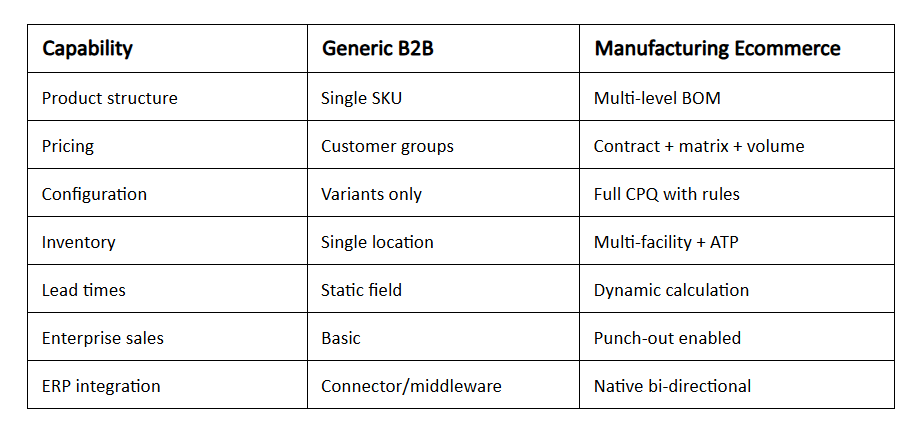
The gap isn't fixable with plugins. These capabilities must be architected into the platform from the foundation.
Can Shopify Handle Manufacturing Ecommerce?
Let's be direct: Shopify is an excellent platform for D2C and simple B2B. It is not designed for manufacturing complexity.
Where Shopify falls short:
- No native BOM management
- No built-in CPQ (apps exist but are limited)
- No punch-out catalog support
- Customer-specific pricing requires workarounds
- ERP integration requires middleware (not native)
- Multi-location inventory is basic
When Shopify works for manufacturers:
- You're selling finished goods only (no configuration)
- Your pricing is simple (list price with basic discounts)
- Your customers don't require punch-out
- You're okay with middleware for ERP integration
- Your catalog is under 5,000 SKUs
For many manufacturers, Shopify requires so much customization and middleware that a purpose-built platform is more cost-effective.
For a complete overview of platform options, see our guide to ecommerce for manufacturers.
The Real Cost of Missing Features
Every missing feature has a cost:
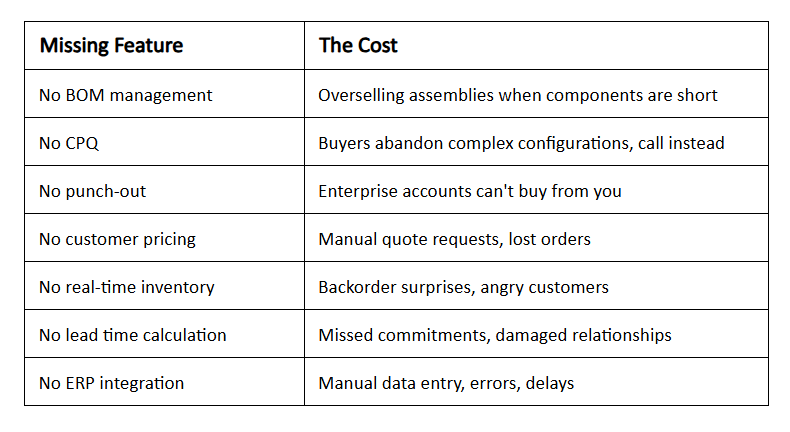
What Manufacturing Ecommerce Actually Looks Like
Here's what changes when you implement a platform built for manufacturing:
Before:
- Customer calls for a quote
- Sales rep builds the configuration in a spreadsheet
- Rep checks inventory manually
- Rep emails quote
- Customer responds a week later
- Rep re-enters order into ERP
After:
- Customer logs in, sees their contract pricing
- Configures the product online with guided CPQ
- Sees real-time inventory and delivery date
- Adds to cart, checkout completes
- Order flows to ERP automatically
- Production scheduling begins immediately
The sales rep? They're spending time on strategic accounts instead of order entry.
Getting Started: The Manufacturing Ecommerce Checklist
Before selecting a platform, verify these capabilities:
- Can it display multi-level BOMs?
- Does it support product configuration with rules?
- Is punch-out catalog integration available?
- Can it handle contract and matrix pricing from your ERP?
- Does it show inventory by location with ATP?
- Can it calculate dynamic lead times?
- Is ERP integration native or middleware-dependent?
If your current platform can't check all seven boxes, you're leaving money on the table.
B2Sell Central provides the product information management foundation that handles BOMs, configurations, and complex pricing. Combined with our ERP connectors for Epicor P21 and SAP Business One, manufacturers get the full stack without middleware complexity.
Next Steps
You have two choices:
Keep the workarounds. Spreadsheets, phone calls, manual re-keying. It works. Sort of.
Build for manufacturing. Implement ecommerce that handles your complexity natively.
Learn how leading manufacturers are transforming their sales channels in The Complete Guide to Ecommerce for Manufacturers.
Or skip the reading and request a demo. We'll show you what manufacturing ecommerce looks like when it actually works.
Frequently Asked Questions
What features should manufacturing ecommerce have?
Manufacturing ecommerce must include BOM management, configure-price-quote (CPQ) functionality, punch-out catalog integration, customer-specific pricing engines, real-time multi-facility inventory visibility, production lead time calculators, and ERP-native order integration. Generic B2B platforms lack these capabilities without extensive customization.
How is manufacturing ecommerce different from B2B ecommerce?
Manufacturing ecommerce handles configurable products with bills of materials, production scheduling integration, and complex quoting workflows. Standard B2B ecommerce assumes fixed SKUs with simple pricing tiers. Manufacturers need platforms that can calculate lead times based on production capacity, manage component-level inventory, and integrate with MRP systems.
Can Shopify handle manufacturing ecommerce?
Shopify can handle simple manufacturing sales but lacks native BOM management, CPQ functionality, and punch-out catalog support. Manufacturers using Shopify typically need middleware connectors to their ERP and extensive customization for complex product configuration. Purpose-built manufacturing ecommerce platforms offer these features natively.
What is punch-out catalog integration?
Punch-out catalog integration (cXML punch-out) allows enterprise buyers to access your product catalog directly from their procurement system (like SAP Ariba, Coupa, or Oracle). The buyer "punches out" to your site, shops with their negotiated pricing, and the cart transfers back to their procurement system for approval.
What ERP systems integrate with manufacturing ecommerce?
Leading manufacturing ecommerce platforms integrate with Epicor P21, SAP Business One, NetSuite, Microsoft Dynamics, and Acumatica. The integration should be bi-directional and real-time, syncing inventory, pricing, orders, and customer data.
.png)
.png)
.png)


.png)