


Shopify vs Magento vs B2Sell eSeller : What's Best for Wholesale Ecommerce in 2026
Wholesale ecommerce isn’t just about putting a “Buy in Bulk” button on a website. It’s about complex pricing, multi-user accounts, personalized catalogs, seamless ERP integrations, role-based access, automated workflows, and tools that let distributors, manufacturers, and wholesalers operate online with the same power and precision that their traditional sales teams deliver offline.
Today, three leading contenders are frequently discussed:
- Shopify — a hugely popular hosted ecommerce platform known for ease-of-use.
- Magento (Adobe Commerce) — a powerful, highly customizable open-source ecommerce solution.
- B2Sell eSeller — a unified B2B, B2C, hybrid ecommerce platform built specifically to support wholesale businesses and distributors. (b2sell.com)
In this deep dive look at each platform for wholesale ecommerce, we explore strengths, weaknesses, costs, features, and ultimately which platform is best for your business needs.
1. The Rise of Wholesale Ecommerce
Wholesale ecommerce is transforming how businesses sell:
- Wholesale buyers expect self-service ordering portals where they can place bulk orders, see pricing, track stocks, and submit purchase orders.
- Distributors need customer-specific pricing, credit limits, multiple user roles, and efficient integration with backend systems (ERP/CRM).
- Large catalogs and frequent orders demand real-time inventory sync and automation.
Not all ecommerce platforms are created equal, and while Shopify and Magento have strong ecommerce roots, wholesalers often find their native capabilities limited without extensive app/extensions or custom development — especially when compared to a purpose-built solution like B2Sell eSeller.
2. Platform Overviews
Shopify — Ease of Use with Growing Wholesale Tools
Shopify is best known for its simple onboarding, hosted infrastructure, and vast ecosystem of themes and apps. It’s ideal for direct-to-consumer (D2C) brands and small-to-medium online retailers. (TechRadar)
Pros:
- Hosted SaaS model with security and hosting included.
- Quick setup and intuitive dashboards for store owners.
- Wide range of apps and marketing integrations via the Shopify ecosystem.
Cons (Wholesale):
- Advanced B2B features are limited in core plans and often require Shopify Plus or paid third-party apps to handle:
- Custom pricing tiers
- Volume discounts
- Multi-user accounts
- Purchase orders
- Managing hybrid B2B + B2C often becomes complex and fragmented or requires multiple stores/apps. (Reddit)
Bottom Line for Wholesale: Shopify can work for small wholesalers or businesses testing online channels, but its out-of-the-box wholesale capabilities are limited without expensive add-ons.
Magento (Adobe Commerce) — Power and Flexibility with Cost
Magento (especially Adobe Commerce) is open-source and highly customizable. It offers powerful native ecommerce capabilities and a robust ecosystem of extensions. (Liquid Web)
Pros:
- Full customization with complete code access — ideal for complex buyer journeys.
- Strong native multi-store and advanced catalog capabilities.
- Enterprise B2B suite includes:
- Custom price lists
- Company accounts
- Multiple user roles and approvals
- Purchase orders
Cons:
- Requires development expertise and hosting.
- Higher initial costs and ongoing maintenance.
- Not inherently unified for B2B + B2C without planning and customization.
Bottom Line for Wholesale: Magento is a great choice for enterprises with internal development teams who want full control — but it demands investment and technical resources.
B2Sell eSeller — Built for Wholesale and Hybrid Commerce
B2Sell eSeller is a next-generation ecommerce platform designed specifically for businesses that need wholesale, retail (B2C), hybrid storefronts, and dropship operations from a single platform.
Rather than retrofitting B2B functionality onto a consumer platform, B2Sell eSeller comes with core capabilities built for complex commerce workflows that wholesalers, distributors, manufacturers, and multi-channel sellers need.
3. Head-to-Head Comparison: Shopify vs Magento vs B2Sell eSeller
Below is a comparison across key wholesale ecommerce criteria:
3.1. Wholesale & B2B Features
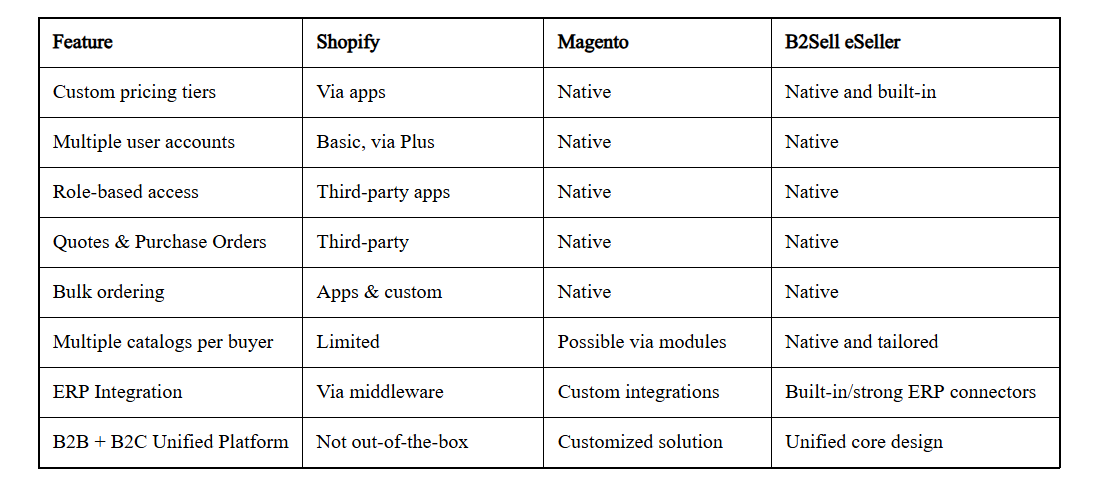
Analysis: Shopify needs apps or custom work for B2B, Magento handles many B2B needs but can be complex to implement, while B2Sell eSeller provides these wholesale capabilities as part of its core platform — without heavy custom development.
3.2. Catalog & Pricing Flexibility
Shopify
- Catalog and pricing logic are fairly basic unless customized with apps.
- Wholesale features often require creative workarounds.
Magento
- Flexible catalog and pricing.
- Supports multi-store setups with different catalogs per region/client group.
B2Sell eSeller
.png)
- Customer-specific catalogs and pricing tiers built in.
- Volume pricing, contract pricing, and personalized offers are first-class features.
Who wins? B2Sell eSeller takes the lead for complex pricing scenarios — especially when pricing must adapt per customer or buyer group.
3.3. Ease of Setup and Maintenance
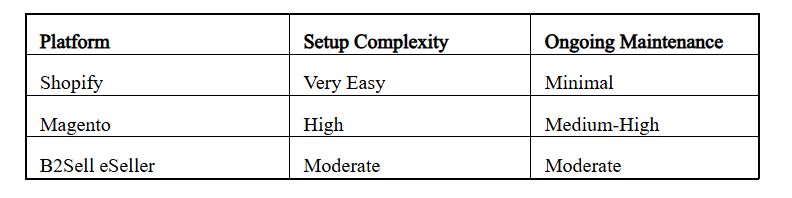
Shopify wins for simplicity, but those simple setups don’t scale neatly into wholesale operations. Magento is powerful but demands technical expertise. B2Sell eSeller hits a sweet spot, offering robust features without needing enterprise-level developer teams.
3.4. Multi-Channel Selling and Scalability
Shopify
- Excellent multi-channel integrations (social, marketplaces).
- Shopify Plus adds deeper wholesale features but at high cost.
Magento
- Scales well for global, complex marketplaces and multiple storefronts.
B2Sell eSeller
- Supports multi-channel retailing and omnichannel selling — ensuring inventory, orders, and customer data remain synced across channels.
- Designed to scale with your business and handle hybrid selling models seamlessly.
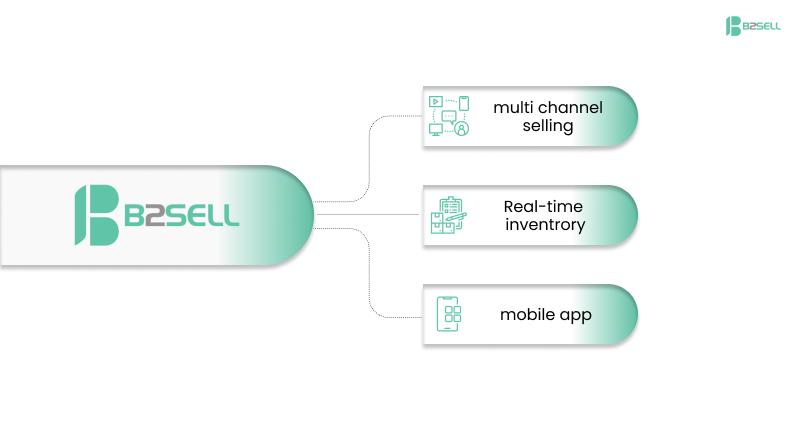
Winner: B2Sell eSeller and Magento both serve complex selling needs at scale, but B2Sell’s unified approach simplifies operations without sacrificing power.
3.5. Real-Time Inventory and ERP Integration – B2Sell's ERP Integration
Wholesalers rely on accurate data:
- Magento can integrate with ERP but usually requires custom development.
- Shopify’s ERP sync depends heavily on third-party apps.
- B2Sell eSeller integrates with ERPs like SAP, NetSuite, Epicor and ensures real-time inventory, pricing, and orders are synchronized seamlessly. (b2sell.com)
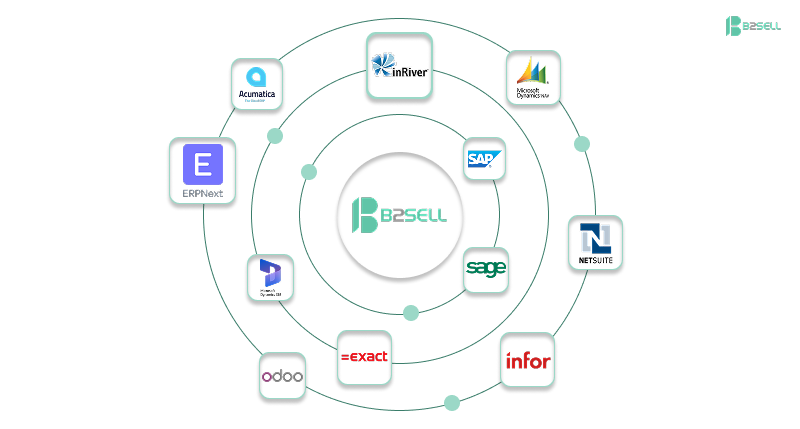
This real-time sync translates into fewer stockouts, more accurate pricing online, and better customer trust.
3.6. Pricing and Total Cost of Ownership
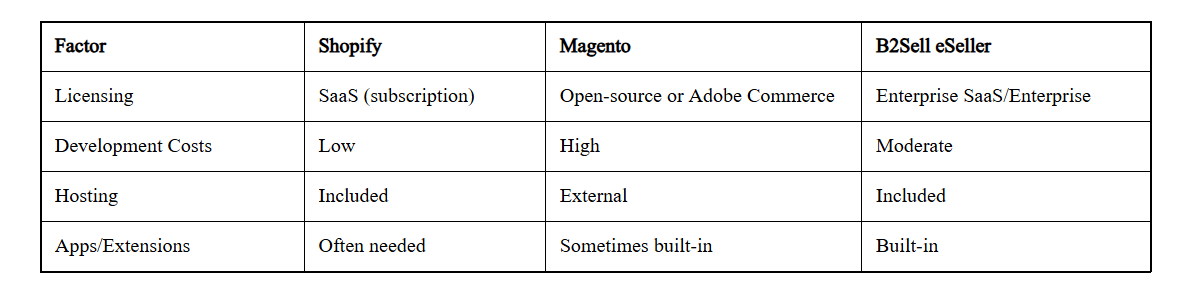
Shopify offers predictable monthly pricing but add-ons and transaction fees can add up. Magento requires hosting and developer costs. B2Sell eSeller offers a strong built-in feature set that reduces reliance on third-party extensions — lowering long-term operational costs.
4. When to Choose Shopify, Magento or B2Sell eSeller
Choose Shopify if:
- You’re a small wholesaler or D2C retailer starting online quickly.
- You value ease of use and fast deployment.
- Wholesale operations are small/occasional and can be supported with add-ons.
Choose Magento if:
- You have internal technical resources and need full control.
- You run enterprise-scale operations with custom requirements.
- You want deep customization and flexibility but are prepared for complexity.
Choose B2Sell eSeller if:
This is where B2Sell shines for wholesale ecommerce:
- You operate or plan to operate B2B, B2C, hybrid, and dropship models from a unified platform. (b2sell.com)
- You need enterprise-grade B2B features (custom catalogs, volume pricing, bulk ordering, user roles) built natively, not pieced together through plugins. (b2sell.com)
- You want real-time ERP integration and accurate inventory across channels.
- You need tools for large distributors, manufacturers, and wholesalers where automation, scale, and buyer experience matter.
In short: B2Sell eSeller is built for the next generation of wholesale commerce — delivering power, flexibility, and simplicity in one platform. (b2sell.com)
5. Deep Dive: Why B2Sell eSeller Is Ideal for Wholesale
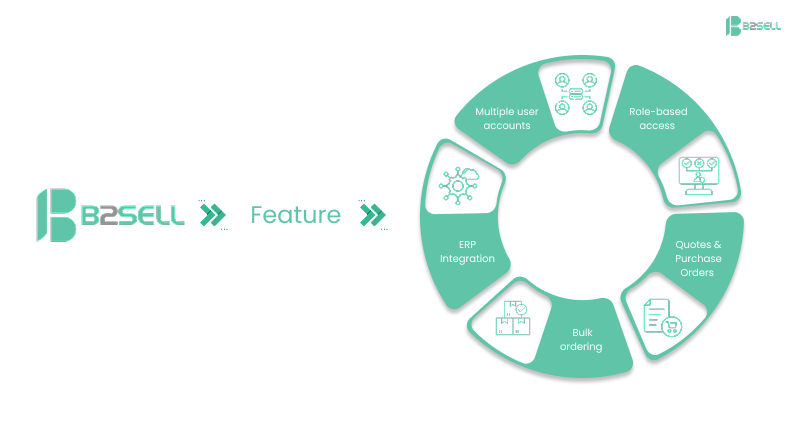
5.1. Unified B2B + B2C + Hybrid Commerce
Unlike many ecommerce solutions where B2B and B2C are separate or heavily customized, B2Sell eSeller supports all selling models from day one — traditional retail, wholesale, hybrid storefronts, and even dropship portals.
This not only simplifies management but also provides a consistent experience for buyers whether they are individual consumers or corporate buyers.
5.2. Customer-Specific Catalogs & Pricing
Wholesale buyers don’t want to see the same product list as retail buyers. They need:
- Role-based visibility
- Contract pricing
- Tiered discounts
- Volume pricing
B2Sell eSeller lets you set custom catalogs and pricing tiers at a granular level — creating unique buying experiences for each customer segment.
5.3. ERP Integration and Real-Time Sync
A major pain point for wholesalers has always been manual synchronization between ecommerce and backend systems.
With B2Sell’s strong ERP integrations (e.g., SAP, NetSuite, Epicor), online storefronts reflect:
- Accurate inventory
- Current pricing
- Order status
- Customer information
This eliminates costly errors and supports scalable operations.
5.4. Sales Rep Account Impersonation
This is a unique B2Sell feature where sales reps can:
- Log in as the customer
- Navigate their catalog
- Manage orders on behalf of that buyer
This enhances customer service, accelerates ordering for large clients, and mirrors the traditional seller-assisted buying experience online. (b2sell.com)
5.5. Built-in Marketing, Analytics & SEO Tools
B2Sell eSeller isn’t just transactional — it’s designed for growth:
- Built-in SEO tools help rank product pages.
- Analytics dashboards offer data to improve sales and marketing decisions.
- Integrated marketing tools help execute campaigns without third-party apps. (b2sell.com)
6. Real-World Scenario Comparisons
Scenario 1: Small Wholesaler Just Starting Online
- Shopify could get you selling quickly.
- But you’ll likely need apps for custom pricing and purchase orders.
- B2Sell eSeller handles these needs natively, ready for scaling later.
Winner: B2Sell eSeller (forward-thinking and scalable)
Scenario 2: Large Manufacturer with Complex ERP
- Magento offers deep customization if you have dev resources.
- B2Sell eSeller gives you strong ERP integration without reinventing the wheel — saving time and cost.
Winner: B2Sell eSeller (powerful integration + less engineering overhead)
Scenario 3: Multi-Channel Retail + Wholesale
- Shopify or Magento might need custom setups or multiple instances.
- B2Sell’s unified platform makes this straightforward and efficient from one admin dashboard.
Winner: B2Sell eSeller
7. Final Verdict: Which Platform Is Best for Wholesale?
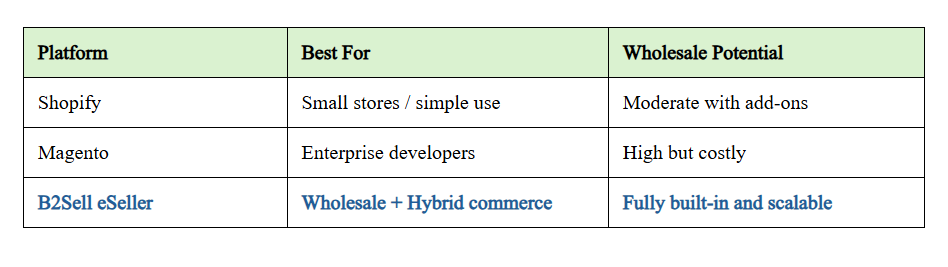
Conclusion: For serious wholesale ecommerce — where pricing complexity, real-time ERP integration, customer segmentation, and multi-channel selling matter — B2Sell eSeller emerges as the best fit. It blends power with accessibility, removing common barriers that force businesses to choose between simplicity and capability.
Ready to Transform Your Wholesale Ecommerce?
If you’re a distributor, manufacturer, or wholesaler looking to take your online sales to the next level — B2Sell eSeller is built for your success. From handling complex B2B workflows to supporting hybrid commerce and automated backend integration, it’s the platform that lets you compete — and win — in modern wholesale markets. (b2sell.com)
👉 Explore B2Sell eSeller and book a free demo today - Click here .
.png)
.png)
.png)


.png)