


AI Product Enrichment for B2B Distributors: The Complete 2026 Guide
Your catalog has 50,000 SKUs. Half of them have incomplete descriptions. Supplier data arrives in 15 different formats. Sound familiar?
AI product enrichment solves this problem by automatically completing, standardizing, and improving product information at scale — without manual data entry. For B2B distributors managing complex catalogs, this technology transforms chaotic supplier feeds into clean, channel-ready product content.
This guide covers everything you need to know: how AI product enrichment works, what results to expect, and how to implement it without replacing your existing systems.
What Is AI Product Enrichment?
AI product enrichment is the use of artificial intelligence to automatically complete, improve, and standardize product information across your catalog. Instead of manually entering specifications, writing descriptions, and categorizing products, AI analyzes existing data — supplier files, images, PDFs, and partial records — to generate accurate, structured product content.

For B2B distributors, this means:
- Incomplete supplier data becomes fully attributed products
- Inconsistent formatting becomes standardized catalog entries
- Manual data entry becomes automated workflows
- Months of catalog cleanup becomes weeks or days
The technology combines several AI capabilities: natural language processing to extract specifications from text, computer vision to identify product attributes from images, and machine learning to classify products into correct categories based on patterns in your existing data.
Why B2B Distributors Need AI Product Enrichment Now
The pressure on B2B product data has never been higher. Here's what's changed:

AI Shopping Assistants Read Your Catalog
In 2026, product data needs to be readable by machines. AI shopping assistants, automated buying agents, and marketplace recommendation engines make decisions based on structured product data quality. Catalogs with missing attributes, inconsistent values, and unoptimized content become invisible to the AI layer that increasingly sits between products and customers.
If your product data isn't enriched, AI systems can't recommend your products — regardless of price or availability.
Your Competitors Are Already Doing It
71% of B2B businesses now use AI or machine learning in their ecommerce operations. The gap isn't whether to use AI, but how deeply to deploy it. Product data enrichment is often the first AI project that delivers measurable ROI because the before/after is so clear: incomplete catalog in, complete catalog out.
Manual Methods Don't Scale
Consider the math: A distributor with 40,000 SKUs needs to update specifications, descriptions, and categories for each product. At 15 minutes per product, that's 10,000 hours of manual work — nearly five full-time employees working for a year. AI completes the same work in days.
How AI Product Enrichment Works: Step by Step
The process follows a structured workflow designed for large distributor catalogs:

Step 1: Data Ingestion
AI systems ingest your existing product data from multiple sources:
- ERP exports (Epicor P21, SAP Business One, NetSuite)
- Supplier feeds (EDI, spreadsheets, PDFs)
- Existing PIM or catalog systems
- Product images and digital assets
The system maps fields from disparate sources into a unified product model, identifying which attributes exist and which need enrichment.
Step 2: Gap Analysis
AI analyzes your catalog to identify:
- Missing attributes — products without dimensions, weights, or specifications
- Incomplete descriptions — products with only a part number and name
- Inconsistent values — "12 inch" vs "12 in" vs "12"" vs "1 ft"
- Misclassified products — items in wrong categories affecting search and filtering
This analysis typically reveals that 30-40% of products need significant enrichment.
Step 3: Automated Enrichment
For each product needing enrichment, AI:
- Extracts specifications from manufacturer PDFs, datasheets, and images
- Generates descriptions based on product attributes and category patterns
- Standardizes values to consistent formats and units
- Assigns categories based on attribute analysis
- Identifies relationships between compatible products (accessories, replacements)
Step 4: Human Review
AI flags low-confidence enrichments for human review. A product manager verifies questionable data rather than entering all data manually. This reduces human effort from 100% to approximately 20-30% while maintaining accuracy.
Step 5: Continuous Improvement
As humans approve or correct AI suggestions, the system learns. Accuracy improves over time, and new products benefit from patterns learned across your entire catalog.
Learn more about PIM for distributors - Click here
What Results Can You Expect?
Based on distributor implementations, here are realistic benchmarks:
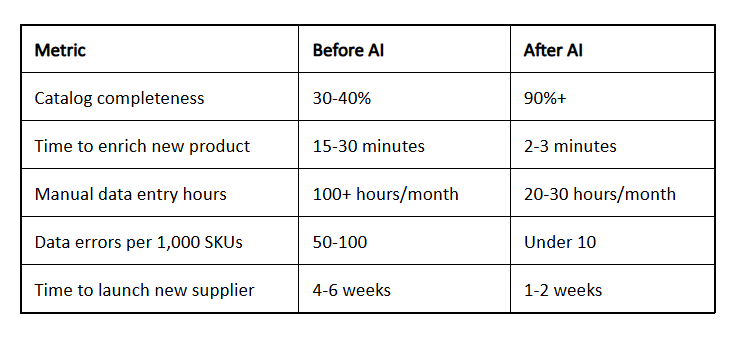
The operational impact translates directly to business outcomes:
- Faster product availability — new products reach your website and sales team sooner
- Better search and filtering — customers find products because attributes are complete
- Fewer returns — accurate specifications reduce order errors
- Higher conversion rates — detailed product pages build buyer confidence
AI Product Enrichment vs. Traditional PIM: What's the Difference?
Traditional PIM (Product Information Management) systems provide a central repository for product data. You still need to enter, clean, and maintain that data manually. PIM is the database; humans are the data entry team.
AI-powered product enrichment automates the work that feeds into PIM:

The best approach combines both: AI enrichment feeds clean data into a PIM that manages workflows, approvals, and distribution to channels.
B2Sell Central integrates AI enrichment directly into PIM workflows, eliminating the gap between where data is cleaned and where data is managed. Learn more about PIM for distributors.
Common AI Product Enrichment Use Cases for Distributors
Electrical Distributors
Electrical distributors manage catalogs with precise technical specifications: voltage ratings, amperage, wire gauges, UL certifications. AI extracts these attributes from manufacturer datasheets, standardizes units, and ensures every product has the specifications electricians need to make purchasing decisions.
Plumbing and HVAC Distributors
Pipe sizes, pressure ratings, material compositions, and fitting compatibility require exact data. AI identifies these specifications from supplier content and maps relationships between compatible products — this fitting works with that pipe, this valve matches that connector.
Industrial and MRO Distributors
Maintenance, repair, and operations catalogs span thousands of categories. AI categorization ensures products appear in correct categories for search, while enrichment completes specifications for everything from safety equipment to fasteners to lubricants.
Fastener Distributors
Fasteners require dozens of attributes: thread pitch, head type, material, finish, length, diameter. AI extracts these from manufacturer data and images, standardizing values so "1/4-20 x 1" and "0.25" x 20 TPI x 1 inch" become the same searchable product.
How to Evaluate AI Product Enrichment Solutions
Not all AI enrichment tools deliver equal results. Here's what to look for:

1. ERP Integration
Does the solution connect directly to your ERP (Epicor P21, SAP B1, NetSuite, Sage)? Solutions that require manual exports and imports create extra work and data sync issues.
2. Distributor-Specific Training
General-purpose AI struggles with technical product data. Look for solutions trained on distributor catalogs — electrical, plumbing, industrial — not consumer retail.
3. Confidence Scoring
The best AI systems tell you when they're uncertain. Look for confidence scores that route low-confidence enrichments to human review rather than blindly applying bad data.
4. Incremental Processing
You shouldn't need to re-process your entire catalog for every change. Look for incremental enrichment that handles new products and updates without starting over.
5. Human-in-the-Loop Workflows
AI isn't perfect. You need workflows where humans can approve, edit, or reject AI suggestions — and where those corrections train the system to improve.
Implementation: Getting Started with AI Product Enrichment
A typical implementation follows this timeline:
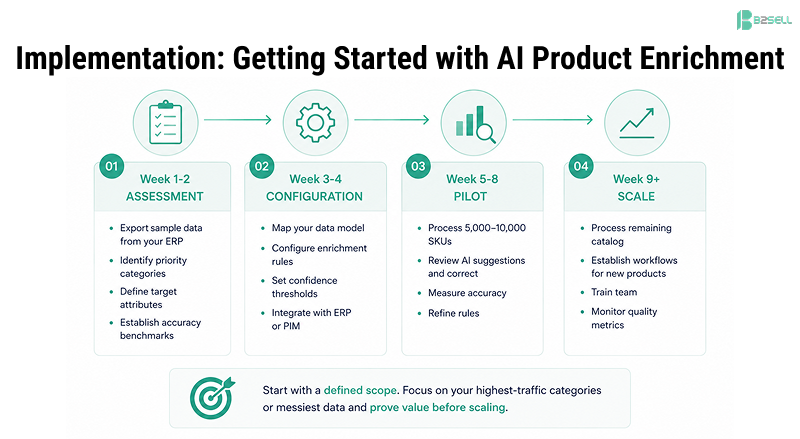
Week 1-2: Assessment
- Export sample data from your ERP
- Identify highest-priority categories for enrichment
- Define target attributes for each product type
- Establish accuracy benchmarks
Week 3-4: Configuration
- Map your data model to the AI system
- Configure category-specific enrichment rules
- Set confidence thresholds for human review
- Integrate with your ERP or PIM
Week 5-8: Pilot
- Process a subset of your catalog (5,000-10,000 SKUs)
- Review AI suggestions and provide corrections
- Measure accuracy against benchmarks
- Refine rules based on results
Week 9+: Scale
- Process remaining catalog
- Establish ongoing workflows for new products
- Train team on review processes
- Monitor quality metrics
The key is starting with a defined scope. Don't try to enrich everything at once. Pick your highest-traffic categories or messiest supplier data and prove value before scaling.
Frequently Asked Questions
How accurate is AI product enrichment?
Modern AI enrichment systems achieve 85-95% accuracy on first pass, depending on the quality of source data and specificity of your catalog. With human review and correction, final accuracy typically exceeds 98%.
Will AI enrichment work with my existing ERP?
Yes. AI product enrichment integrates with major ERPs including Epicor P21, SAP Business One, NetSuite, Sage, and Infor. Data flows from your ERP to the enrichment system and back, keeping your source of truth updated.
How long does it take to see results?
Most distributors see measurable improvement within 4-6 weeks. A pilot of 5,000-10,000 products typically completes in 2-3 weeks, with results visible immediately as enriched products reach your website and catalog.
What about products with no existing data?
AI performs best when some data exists — at minimum, a product name or part number. For completely blank products, AI can extract information from images and manufacturer PDFs, but accuracy depends on source quality.
How much does AI product enrichment cost?
Pricing varies by catalog size and complexity. Most solutions price per-SKU or as a monthly subscription based on catalog volume. ROI typically appears within 3-6 months through reduced manual labor and faster product availability.
Can AI write product descriptions?
Yes. AI generates descriptions based on product attributes, category patterns, and your brand voice. These descriptions are typically 80-90% ready to publish, with human editing for final polish on high-visibility products.
The Bottom Line: AI Product Enrichment Is Now Table Stakes
B2B distributors can no longer afford incomplete product data. Buyers expect detailed specifications. AI systems require structured attributes. Competitors with enriched catalogs win the sale.
AI product enrichment isn't experimental technology — it's the standard approach for distributors managing catalogs at scale. The question isn't whether to implement AI enrichment, but how quickly you can start.
Ready to see AI product enrichment in action? Request a demo to see how B2Sell transforms distributor catalogs with AI-powered enrichment that integrates directly with Epicor P21 and SAP Business One.
Related Resources
.png)
.png)
.png)


.png)